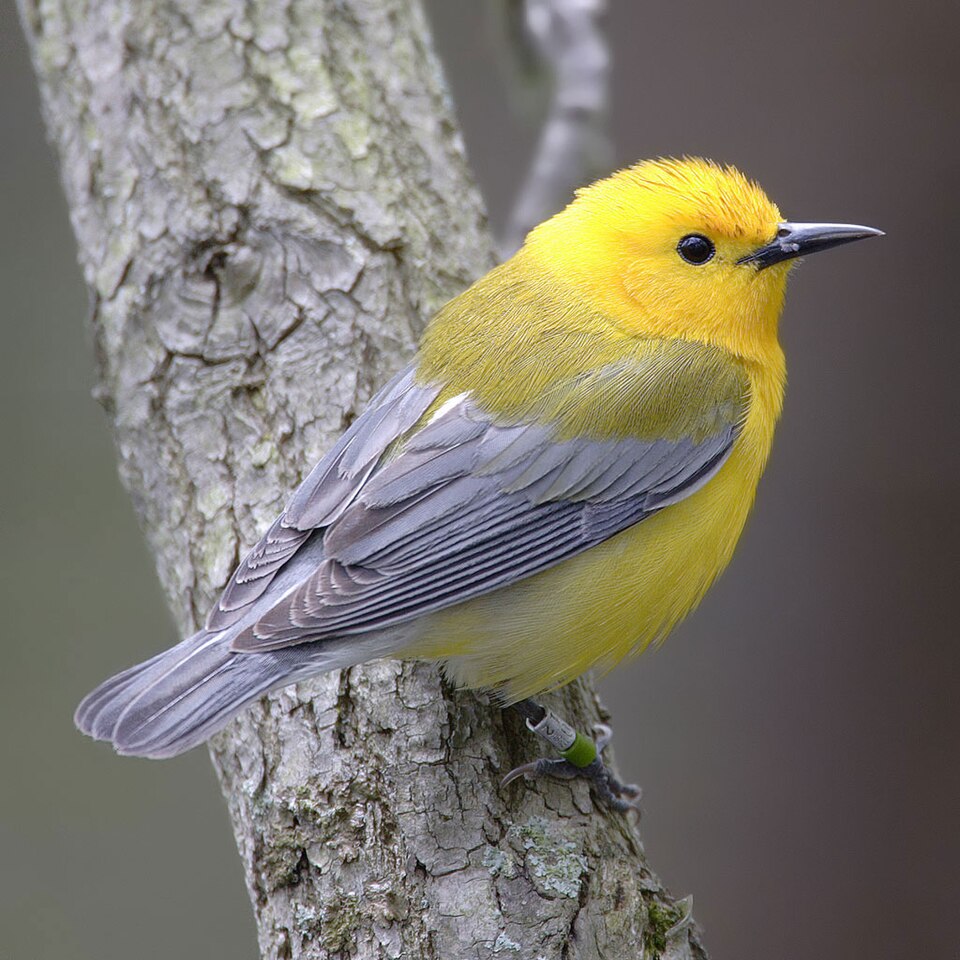
Few birds in eastern North America stop you in your tracks like a Prothonotary Warbler. Its head and breast burn a deep, saturated gold-orange that seems almost to glow against the dark, shaded water of a wooded swamp. Birders often describe the moment of seeing one as a flash of sunlight moving low through the trees. The name comes from the brilliant yellow robes once worn by papal clerks called prothonotaries, and once you have seen the bird, the comparison feels exactly right.
This is a warbler of bottomland forests, flooded woods, and slow blackwater rivers across the southeastern and central United States. Unlike most wood-warblers, which build open cup nests in shrubs or trees, the Prothonotary is one of only two North American warblers that nest inside cavities, which ties it tightly to standing dead trees and old woodpecker holes near water. Loss of these swampy bottomland forests is the species' main long-term threat, and it has become a flagship bird for conservation of riverine wetlands throughout its range.
The Prothonotary Warbler is a small, compact, large-headed warbler with a relatively long, heavy black bill and short tail. Its silhouette is plumper and less restless than many warblers, and it tends to forage low, often just above or beside the water, which helps separate it from canopy-feeding species.
| Head & breast | Brilliant deep golden-yellow to orange-yellow, evenly colored and unmarked |
| Wings | Plain blue-gray with no wing bars, contrasting sharply with the golden body |
| Back | Yellow-green, blending into the gray wings and rump |
| Bill | Long, stout, and entirely black, heavier than most warblers' |
| Tail | Gray above with large white patches obvious from below when spread |
| Eye | Large and dark, set in the plain golden face, giving a beady, expressive look |
Male vs. female
Males and females look similar and both show the golden head, blue-gray wings, and white tail spots, so a lone bird is not always easy to sex. The difference is one of intensity: adult males are a richer, more saturated orange-gold, especially on the head, while females and first-year birds are a paler, softer lemon-yellow with a slightly grayer wash on the crown and nape. Side by side, a breeding pair shows the contrast clearly, but a single dull bird is often best called simply a female or immature.
Juveniles
Juveniles fresh from the nest are duller and grayer overall, with a yellowish-olive cast rather than glowing gold, and they can look washed-out and nondescript. By their first fall, young birds resemble adult females, paler than breeding males but already showing the diagnostic combination of an unmarked yellow head, plain blue-gray unbarred wings, and white tail spots. The heavy black bill is a useful clue at any age.
The song is one of the most distinctive sounds of a southern swamp in spring: a loud, ringing, emphatic series of sweet, even notes on one pitch, usually written as tweet-tweet-tweet-tweet-tweet or zweet-zweet-zweet. The notes are clear, penetrating, and almost metallic, carrying well across open water, and they rise slightly in volume rather than changing pitch. Once learned, it is hard to mistake for anything else in flooded woodland.
Calls include a sharp, dry tink or chip, somewhat metallic and reminiscent of a Hooded Warbler's call note, and a buzzy flight song given in display. Males sing persistently from low perches near the nest cavity through the breeding season.
Prothonotary Warblers breed across the southeastern and east-central United States, with the densest populations in the bottomland hardwood swamps of the Mississippi River valley, the coastal plain of the Southeast, and the river systems of the Gulf and lower Atlantic states. The breeding range extends north up major river corridors into the Ohio Valley, parts of the Great Lakes region, and locally to the mid-Atlantic, always closely following wooded wetlands.
This is a long-distance migrant. After breeding, birds head to wintering grounds in the mangrove forests and lowland woodlands of southern Central America and northern South America, including Panama, Colombia, and Venezuela. Migration takes many of them across or around the Gulf of Mexico, and spring arrivals reach the southern states by late March and April. They are early-departing fall migrants, with most gone south by September.
Prothonotary Warblers are primarily insectivores, gleaning beetles, ants, flies, mayflies, caterpillars, and spiders from tree trunks, low branches, fallen logs, and the surface of leaves close to the water. They forage methodically and low, often hitching along mossy limbs and probing into bark crevices, and they will pick insects right off the water's surface or from floating debris.
During migration and on the wintering grounds they broaden the menu, taking small fruits, seeds, and nectar in addition to insects, which helps them fuel long flights. Their habit of foraging at eye level near slow water makes them unusually easy to watch compared with treetop warblers.
The Prothonotary Warbler is a cavity nester, one of only two warblers in North America to nest in holes rather than open cups. The female builds inside an abandoned woodpecker hole, a natural cavity in a rotting stump, or a nest box, almost always over or very close to standing water. She fills the cavity with mosses, lichens, leaves, and rootlets, lining the cup with finer material; the male helps by carrying moss to the site and may stuff several nearby cavities as a courtship display.
The female lays a clutch of typically four to six creamy eggs marked with brown and lavender spots and incubates them for about 12 to 14 days. The young fledge roughly 10 to 11 days after hatching. Nesting low over water gives some protection from ground predators, though snakes, raccoons, and House Wrens still take eggs and young, and nest cavities are sometimes lost to flooding.
This is not a typical seed-feeder bird, but it is one of the few warblers you can genuinely attract if you have the right setting. If you live near a wooded river, swamp, pond, or flooded woodland within its breeding range, a properly placed nest box can draw a nesting pair, and providing water and habitat matters more than any feeder.
- Put up a nest box over or right beside standing water, a box on a post in a pond edge or a tree at a swamp margin, with a 1.25-inch entrance hole, mimics the natural cavities they prefer.
- Choose wooded wetland habitat: Prothonotaries need bottomland forest, flooded timber, or slow blackwater near your property, they will not use boxes in dry upland yards.
- Add a predator baffle below the box; snakes and raccoons readily climb to cavity nests over water.
- Preserve standing dead trees and snags near water rather than removing them, these provide the natural woodpecker holes the species depends on.
- During migration, a clean water feature or shallow stream can briefly draw foraging birds even outside ideal breeding habitat.
- Skip the seed feeders for this species, they eat insects and spiders, so chemical-free, insect-rich wetland edges do far more good.
- Blue-winged Warbler: Also bright yellow but has a thin black eye-line, two white wing bars, and yellow-green (not blue-gray) wings; favors brushy fields, not swamps.
- Yellow Warbler: Yellower overall with yellowish wing edges and yellow tail spots; males show reddish breast streaks, and it lacks the contrasting blue-gray unbarred wings.
- Hooded Warbler: Shares swampy habitat and a similar chip note, but males have a black hood framing a yellow face; greener back and white tail spots flashed differently.
- Yellow-throated Vireo: Yellow throat and spectacles can suggest a Prothonotary, but it is chunkier, has white wing bars, a hooked bill, and forages slowly in the canopy.
Why is it called a Prothonotary Warbler?
The name comes from prothonotaries, senior clerks in the Roman Catholic Church who historically wore bright golden-yellow robes. The bird's glowing orange-gold head reminded early naturalists of those vivid vestments. Birders sometimes simply call it the 'golden swamp warbler.'
Where is the best place to see a Prothonotary Warbler?
Look in wooded swamps, flooded bottomland forests, and along slow blackwater rivers in the southeastern and central U.S. during spring and summer. Boardwalk trails through cypress-tupelo swamps are classic spots. Listen for the loud, ringing 'tweet-tweet-tweet' song and scan low, near the water's surface.
Will a Prothonotary Warbler use a nest box?
Yes, it is one of the few warblers that readily uses nest boxes, but only if the box is placed over or very close to standing water in suitable wooded wetland habitat. A 1.25-inch entrance hole and a predator baffle improve your chances. Boxes in dry yards will not attract them.
How do I tell a Prothonotary Warbler from a Yellow Warbler?
The Prothonotary has plain blue-gray wings with no wing bars and a deeper orange-gold head, plus a long heavy black bill. The Yellow Warbler is yellow all over including its wing edges, shows yellow tail spots rather than white, and males have fine reddish breast streaks.
Are Prothonotary Warblers endangered?
They are listed as Least Concern globally and remain locally common in good habitat, but populations have declined as bottomland swamp forests are drained and cleared. They are a conservation priority for wetland protection, and habitat loss on both breeding and wintering grounds is the main concern.