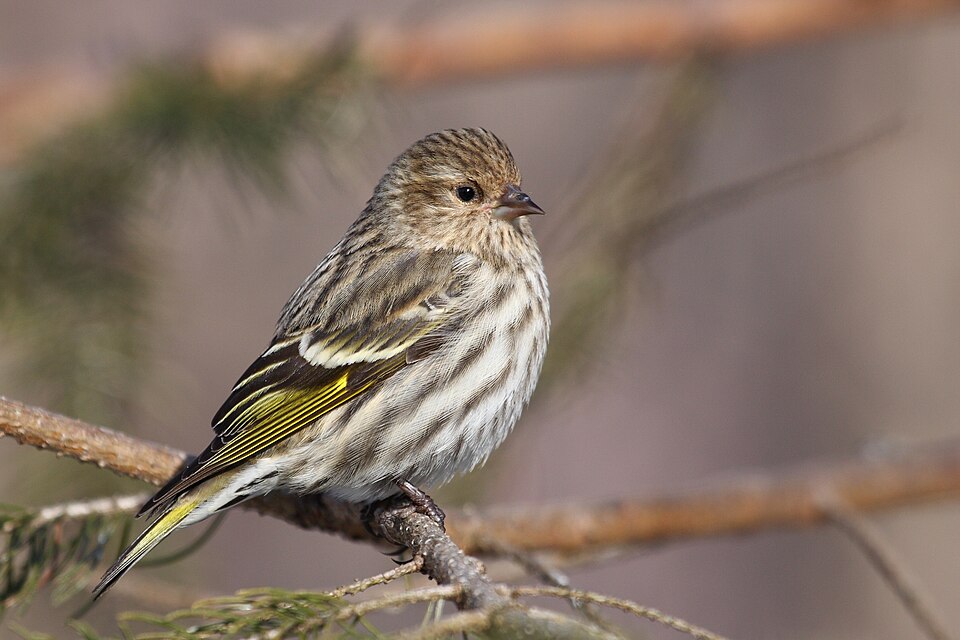
The Pine Siskin is one of North America's most unpredictable little birds, a small brown-streaked finch that can blanket your feeders by the dozen one winter and be completely absent the next. Closely related to goldfinches, it shares their bouncy flight and twittering voice but trades their bright color for an all-over streaky brown plumage broken by subtle yellow flashes in the wings and tail. For many backyard birders, the first sign of a siskin invasion is a tight, restless flock descending on the nyjer feeder, jostling and squabbling with surprising boldness for such a tiny bird.
Siskins are classic irruptive finches: their movements are driven by the boom-and-bust cycles of conifer seed crops across the boreal forest and western mountains. In years when spruce, pine, and hemlock cones fail in the north, siskins pour southward in huge numbers, turning up far outside their usual haunts. This nomadic lifestyle makes them a delight to watch and a genuine wild card on any winter bird list. Though still widespread, the species has shown a long-term population decline, making the flocks that do arrive all the more worth appreciating.
Pine Siskins are tiny, slim finches with a sharply pointed, conical bill that is noticeably thinner and more needle-like than the stubby bill of a goldfinch or House Finch. They have a short, deeply notched tail and a streaky brown body that can look drab at a glance, until they move and reveal yellow edging in the wings and tail.
| Overall look | Small, slender brown finch streaked from head to belly, with a sharp pointed bill |
| Yellow flashes | Yellow patches at the base of the flight feathers and along the tail edges, most visible in flight or when flicking the wings |
| Bill | Thin, sharply pointed and conical, more slender than a goldfinch or House Finch bill |
| Tail | Short and deeply notched, with yellow on the outer edges |
| Wingbars | Two pale to buffy wingbars, the lower one often washed yellow |
| Underparts | Whitish to buff, heavily streaked with brown all the way down the flanks |
Male vs. female
Male and female Pine Siskins look very similar and are difficult to separate in the field. On average, males show brighter and more extensive yellow in the wings and tail, and may appear slightly less heavily streaked, while females tend to be a touch duller with finer or more even streaking. A small percentage of birds, sometimes called the "green morph," show unusually bright yellow and reduced streaking; these are most often males. For practical backyard identification, it is usually safest to simply call them Pine Siskins without assigning sex.
Juveniles
Juvenile Pine Siskins look much like adults but are washed with a warmer buffy or yellowish tone overall, especially on the underparts, before their first winter. Their streaking is a bit softer and less crisp, and the yellow in the wings is typically muted. By their first fall and winter they are essentially indistinguishable from adults in the field, blending seamlessly into the flocks at feeders.
The Pine Siskin's most distinctive vocalization is a buzzy, rising zzzreeeet that sounds like a watch spring being wound tight, slurring upward at the end. This wheezy call is unique enough that once you learn it, you can pick siskins out of a mixed flock by ear alone. They also give a sharp, twittering tit-i-tit in flight, similar to a goldfinch but huskier.
The song is a long, jumbled series of twitters, trills, and buzzes run together with little pattern, ending in those signature rising buzzes. Siskins are highly social and vocal, so a feeding flock keeps up a near-constant background chatter of chirps and wheezes.
Pine Siskins breed across the boreal forest of Canada and Alaska and down through the conifer forests of the western mountains, from the Rockies and Cascades into Mexico's highlands. In the breeding season they favor open coniferous and mixed woodlands.
Their winter range is famously unpredictable. In some years they stay largely within the northern and western forests; in others they irrupt far south and east across most of the United States, appearing in backyards where they may be absent for several winters running. These irruptions track the abundance of conifer and birch seed crops up north. When food fails in the boreal zone, siskins can show up almost anywhere, sometimes lingering well into spring before heading back north to breed.
Pine Siskins are primarily seed eaters, and their slender bills are well suited to prying small seeds from conifer cones, alders, and birches. They are acrobatic foragers, hanging upside down at the tips of branches and clinging to seed heads of thistles, dandelions, and other weeds. Their flexible diet and willingness to travel are what let them exploit good seed crops wherever they appear.
At feeders they strongly prefer small seeds, especially nyjer (thistle) and hulled sunflower, and will mob both tube feeders and trays. Siskins also eat tree buds, some insects in the breeding season, and are known to visit mineral sources like road salt and even ash, apparently to supplement their diet. They drink and bathe readily and will visit bird baths regularly.
Pine Siskins typically nest in conifers, building a shallow but well-insulated cup of twigs, grasses, rootlets, and bark, lined with soft material such as fur, feathers, moss, and lichen, usually well out on a horizontal branch. The female does most or all of the nest building and incubation, while the male brings her food on the nest. Nesting can begin surprisingly early, sometimes while snow is still on the ground, and the heavily lined nest helps protect eggs against the cold.
The female lays a clutch of greenish-blue eggs lightly spotted with brown and black, and incubates them for roughly two weeks. Both parents feed the young, often regurgitating seeds. Siskins are loosely colonial and somewhat nomadic even in the breeding season, settling to nest where conifer seed is abundant rather than returning to the same site year after year.
Pine Siskins are very much a feeder bird, but only when they are in the area. Because they are irruptive, you cannot count on them every winter; the trick is to be ready so that when a flock does pass through, your yard is the one they stop at.
- Offer nyjer (thistle) seed in a tube or mesh sock feeder, the single most reliable siskin magnet
- Provide hulled sunflower or sunflower chips, which siskins take eagerly alongside goldfinches
- Use feeders with multiple ports or several feeders, since siskins arrive in flocks and feed shoulder to shoulder
- Keep a clean bird bath available; siskins drink and bathe often, and moving water helps draw them in
- Plant or leave standing native seed sources like birch, alder, and unmowed thistle and coneflower heads
- Practice good feeder hygiene, cleaning and disinfecting feeders regularly, because dense siskin flocks are prone to spreading salmonella
- American Goldfinch: Winter goldfinches are plain buffy-brown without heavy streaking, have a stubbier bill, and show no yellow in the wings the way siskins do; siskins are streaky all over.
- House Finch: House Finches are larger with a thicker curved bill; males show red, and females are blurry brown-streaked but lack any yellow wing flashes.
- Common Redpoll: Redpolls are also small streaky irruptive finches but have a red forehead patch and black chin, with no yellow in the wings or tail.
- Lesser Goldfinch: Lesser Goldfinches have unstreaked underparts and a dark back or cap; siskins are uniformly streaked and lack the clean color blocks of a goldfinch.
Why do Pine Siskins show up some winters but not others?
Siskins are irruptive finches whose movements follow conifer and birch seed crops in the northern forests. When those seed crops fail, siskins move far south in large numbers; in good seed years they stay north, so they can be abundant one winter and absent the next.
What is the best food to attract Pine Siskins?
Nyjer (thistle) seed is the top choice, offered in a tube feeder or mesh sock. They also readily take hulled sunflower seed and sunflower chips, often feeding side by side with goldfinches.
How do I tell a Pine Siskin from a female House Finch?
Both are brown and streaky, but a siskin is smaller with a thin, sharply pointed bill and shows yellow flashes in the wings and tail. A female House Finch is chunkier, has a thicker, more curved bill, and shows no yellow at all.
Are Pine Siskins aggressive at feeders?
For their size, yes. Siskins are bold and feisty, often squabbling with each other and standing their ground against larger birds like goldfinches, flaring their wings and tails to show off the yellow as a threat display.
Why do dead Pine Siskins sometimes appear near feeders?
Dense siskin flocks are vulnerable to salmonella outbreaks, which spread at crowded, soiled feeders. If you find sick or dead birds, take feeders down for a couple of weeks and clean and disinfect them thoroughly before refilling.