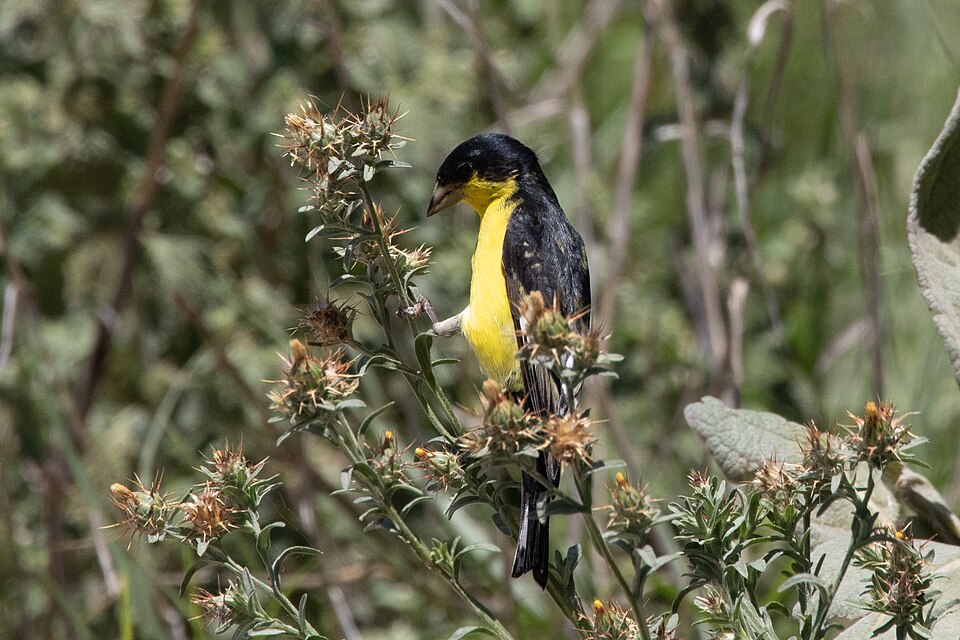
The Lesser Goldfinch is the West's pint-sized answer to the more famous American Goldfinch, and in much of the Southwest and Pacific states it is the goldfinch you are most likely to see. Barely larger than a hummingbird in feel, it travels in chattering, loose flocks that descend on weedy fields, sunflower patches, and backyard feeders with a constant trickle of soft, plaintive calls. Despite its name and modest size, a bright male in spring is anything but plain: lemon-yellow underparts, a glossy black or greenish cap, and crisp white flashes in the wings make it one of the most cheerful small birds you can find.
This is a bird of open and edge habitats rather than deep forest. It thrives in foothills, oak woodlands, riverside thickets, suburban gardens, weedy roadsides, and irrigated farmland, and it has been steadily expanding its range northward over recent decades. Wherever there are thistles, sunflowers, and a little water, Lesser Goldfinches tend to turn up, often staying year-round and forming the bustling backbone of the winter feeder crowd across the Southwest.
Look for a very small, compact finch with a short, conical seed-cracking bill, a notched tail, and a quick, bouncy flight. At rest it can look almost dumpy and big-headed for its size. The combination of yellow underparts, dark upperparts, and a flash of white at the base of the primaries (visible as a small white patch in the folded wing and as white bars in flight) is the quickest way to clinch the identification.
| Size & shape | Tiny and stocky for a finch, with a stubby conical bill, large rounded head, and a short, notched tail. |
| Male underparts | Bright lemon-yellow from throat to vent, unbroken and clean. |
| Male cap & back | Glossy black cap; back ranges from solid black (interior/eastern birds) to greenish (Pacific birds). |
| Wing pattern | Dark wings with a distinctive small white patch at the base of the primaries, plus white wing bars; conspicuous in flight. |
| Female & immature | Olive-green above, dull yellow below, no black cap, but still show white wing markings. |
| Bill & legs | Pale pinkish to grayish conical bill; dark legs. |
Male vs. female
Males and females look clearly different. Adult males have bright lemon-yellow underparts and a black cap that contrasts sharply with the rest of the head and back; depending on region the back is either solid glossy black or olive-green. Females and first-year birds lack the black cap entirely, showing instead a soft olive-green back, grayish-olive head, and paler, more muted yellow underparts. In all plumages the white patch at the base of the primaries is a reliable mark, so even a drab female can be told from many similar finches by the wing.
Juveniles
Juveniles resemble adult females but are even softer and plainer, with diffuse, washed-out yellow or buffy underparts and faint, blurry streaking on a grayish-olive body. They show the same pale wing bars and the small whitish wing patch, though it is less crisp than on adults. Young males begin to acquire dark feathering on the crown through their first fall and winter, so birds in transition can show a patchy, incomplete cap before reaching full adult plumage.
The Lesser Goldfinch is a gifted and persistent singer with a long, rambling, jumbled warble that often includes imitations of other birds woven in among its own sweet notes. Males sing from exposed perches and treetops, especially in spring, delivering a wandering, twittering performance that can go on for many seconds without an obvious pattern.
The calls are the surest giveaway and you will usually hear them before you see the bird. Listen for a soft, plaintive, descending tee-yee or rising tee-yer, almost questioning in tone, given constantly by foraging flocks. In flight they also give a light, tinkling chig-chig chatter. That mournful, two-note slurred whistle is a classic sound of western weedy fields and gardens.
The Lesser Goldfinch is a bird of the western and southwestern United States, Mexico, and southward through Central America into parts of South America. In the U.S. it is common across California, the Southwest, Texas, and the southern Rockies, and its breeding range has been pushing steadily north and east, now reaching into Oregon, Washington, Idaho, and the western Great Plains.
Across the warmer southern and coastal parts of its range it is largely a year-round resident. Birds breeding at higher elevations and in the northern edge of the range are more migratory or move downslope and southward in winter, when flocks gather around reliable food and feeders. Movements are flexible and tied to seed availability rather than rigid calendar timing.
Lesser Goldfinches are dedicated seed-eaters with a special fondness for the seeds of plants in the sunflower and thistle families, along with grasses, weeds, and the catkins and buds of trees. They are acrobatic foragers, hanging upside down to pry seeds directly from drooping seed heads and dangling from thin stems with ease. Flocks work methodically through stands of wild sunflower, thistle, dandelion, and chicory.
They also take some small insects and other tree material, especially when feeding young, and they need regular access to water for drinking and bathing. Because so much of their diet is small seeds, they are strongly drawn to nyjer (thistle) and small sunflower offerings at feeders.
Pairs typically nest later in the season than many songbirds, often timing breeding to coincide with peak seed and flower availability. The female builds a compact, neat cup nest of plant fibers, fine grasses, and plant down, usually placed in a shrub or tree at low to moderate height, frequently well concealed in foliage near the outer branches.
She lays a small clutch of pale bluish-white eggs and does most or all of the incubation, while the male helps feed her on the nest and later helps feed the nestlings a regurgitated paste of seeds. Pairs may raise more than one brood in a season where conditions are good, and outside of breeding the birds are highly social, returning to flocking behavior.
Yes, the Lesser Goldfinch is an excellent and reliable backyard and feeder bird across its range, and a few simple steps will keep flocks coming back day after day.
- Offer nyjer (thistle) seed in a fine-port or mesh "thistle" feeder, which is the single best draw for this species.
- Provide small or hulled sunflower seed (sunflower chips) in tube or mesh feeders; they handle small seeds far better than large striped sunflower.
- Add a clean, shallow water source or a gentle dripper or fountain. Goldfinches bathe often and moving water is a strong attractant.
- Plant native sunflowers, coneflowers, cosmos, thistles, and other seed-bearing flowers and let the seed heads stand rather than deadheading them.
- Keep feeders clean and the seed dry and fresh. Nyjer spoils and clumps quickly, and goldfinches will abandon moldy or stale seed.
- Be patient and consistent; once a flock finds a dependable feeder they often become daily regulars and arrive in chattering groups.
- American Goldfinch: Larger and chunkier; breeding males are all-yellow with a black forecap (not a full black cap) and an unmarked yellow back. Lesser Goldfinch is smaller with a dark cap extending farther back and a black or green back.
- Lawrence's Goldfinch: Mostly gray with a yellow breast patch and yellow wing flashes, and the male has a black face. Lacks the extensive lemon-yellow underparts of a male Lesser Goldfinch.
- Pine Siskin: Heavily streaked brown overall with thin pointed bill and yellow wing edgings; lacks the clean yellow underparts and white primary patch of the Lesser Goldfinch.
What is the difference between a Lesser Goldfinch and an American Goldfinch?
The Lesser Goldfinch is noticeably smaller and shows a small white patch at the base of the primaries. Breeding male Lessers have a full black (or black-and-green) cap and a dark back, while breeding male American Goldfinches are brighter all-yellow with just a black forehead and an unmarked yellow body. Their calls differ too: the Lesser gives a plaintive, descending tee-yee.
Are Lesser Goldfinches year-round residents or do they migrate?
It depends on where you are. In the warmer southern and coastal parts of the range they are largely present all year. Birds at higher elevations and along the northern edge of the range tend to move downslope or southward in winter, following seed availability rather than a strict schedule.
What do Lesser Goldfinches eat at feeders?
They love nyjer (thistle) seed and small or hulled sunflower seed. Offer these in fine-mesh thistle feeders or small-port tube feeders, keep the seed fresh and dry, and add a shallow water source to make your yard even more attractive.
Why are some male Lesser Goldfinches black-backed and others green-backed?
This is regional variation. Males in the interior and eastern parts of the U.S. range tend to have solid glossy black backs, while those along the Pacific Coast typically have greenish backs. Both are the same species, and the two forms intergrade where their ranges meet.
How do I tell a female Lesser Goldfinch from other small finches?
Females are olive-green above and dull yellow below with no black cap, which can look plain, but they still show pale wing bars and a small whitish patch at the base of the primaries. That wing mark, plus the soft descending tee-yee call, separates them from streaky birds like Pine Siskins.