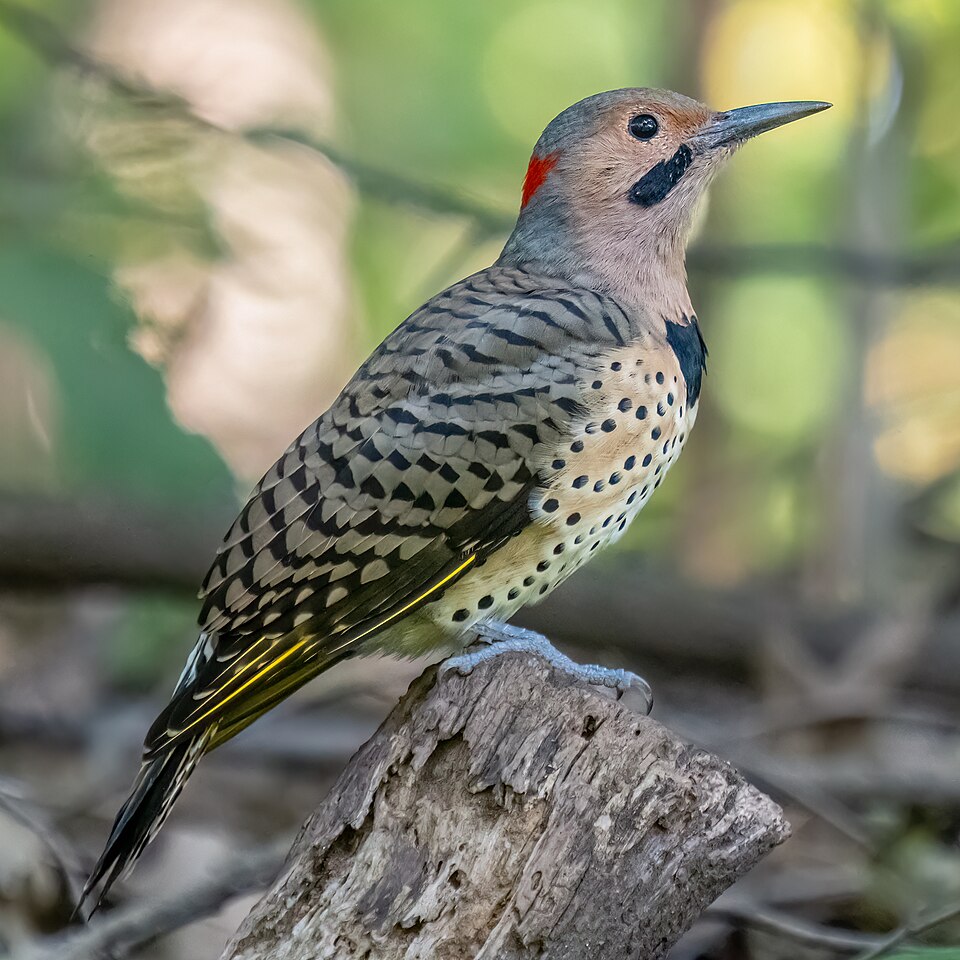
The Northern Flicker is one of North America's most surprising woodpeckers, because so much of the time it isn't on a tree at all. Flush one from a suburban lawn or a roadside and you'll see a big brown bird bound away in deep, undulating swoops, flashing a brilliant white rump patch that's almost impossible to mistake. Where most woodpeckers chisel into bark, the flicker spends much of its day hopping awkwardly across open ground, probing the soil for ants. It is a woodpecker that has quietly reinvented itself as a ground forager, and that single habit explains nearly everything odd and wonderful about it.
Up close it's a genuinely handsome bird: warm brown above with crisp black barring, a dense field of round black spots across a buffy breast, and a bold black crescent like a bib at the throat. Two regional forms dominate the continent. The Yellow-shafted flicker of the East and far North glows lemon-yellow under the wings and tail, while the Red-shafted flicker of the West flashes salmon-red in the same places. Once lumped as separate species, they interbreed freely across a wide zone in the Great Plains, producing birds with every mix of field marks in between.
Flickers are large, long-bodied woodpeckers, noticeably bigger than a robin, with a slightly curved bill and a long flared tail. In flight they look brown and pointed-winged with a deeply bounding, roller-coaster path, and that flashing white rump is the single best mark at any distance. Perched, they often sit upright on a fence post or lean back against a tree trunk.
| Rump | Bright white patch, conspicuous in flight and the surest field mark |
| Underwing/tail color | Lemon-yellow (Yellow-shafted, East) or salmon-red (Red-shafted, West) |
| Breast | Buffy with dense round black spots, plus a bold black crescent bib |
| Back | Warm grayish-brown with neat black barring |
| Head | Yellow-shafted has gray crown and tan face with a red nape crescent; Red-shafted has brown crown and gray face, no red nape |
| Size | Large for a woodpecker, clearly bigger than a robin |
Male vs. female
Males and females look alike except for one tidy detail: the malar stripe, the mustache mark beside the bill. In the Yellow-shafted form, males show a black mustache and females have none. In the Red-shafted form, males show a red mustache and females have none. So a flicker with a clean, unmarked face is a female, and one wearing a colored "mustache" is a male. This is one of the easiest sex distinctions in any backyard bird once you know to look for it.
Juveniles
Juveniles look much like adults within a few weeks of fledging and can be hard to age in the field. They tend to be slightly duller and softer in pattern, with somewhat messier spotting and barring and a paler, less crisply defined throat crescent. Young males already begin showing a hint of the malar mark. By their first fall they are essentially indistinguishable from adults.
The flicker's signature spring song is a long, loud, even-pitched series, "wick-wick-wick-wick-wick" or "ki-ki-ki-ki," rolling on for several seconds. It carries a long way and is one of the classic sounds of an April morning. People often confuse it with the Pileated Woodpecker's call, but the flicker's is steadier, more monotone, and less wild and ringing.
The everyday contact call is a sharp, ringing single note often written as "kleeer" or "peah," given year-round and easy to learn. Pairs and rivals also trade a soft, conversational "wicka-wicka-wicka" during courtship displays, bobbing their heads and fanning their tails at each other. Like all woodpeckers they drum too, hammering on resonant wood, and sometimes on metal gutters or chimney caps, to broadcast territory in spring.
The Northern Flicker is one of the most widespread woodpeckers in North America, breeding from Alaska and across nearly all of Canada south through the United States into Mexico, in open woodlands, forest edges, parks, orchards, and suburbs almost everywhere there are trees and open ground. The Yellow-shafted form occupies the East and the boreal North; the Red-shafted form holds the West, and the two blend along a broad seam through the Great Plains.
Birds in the southern half of the range are largely year-round residents. Those nesting in Canada, Alaska, and the northern states are strongly migratory, pulling south in fall, often in loose daytime flocks. Flicker migration along the East Coast and Great Lakes can be a real spectacle, with hundreds streaming past a hawk-watch in a single autumn morning.
Flickers are ant specialists, and they eat more ants than any other North American bird. Rather than excavating wood, a flicker probes soft soil, lawns, and anthills with its long, slightly curved bill, then laps up ants and their larvae with a remarkable barbed tongue that extends far beyond the bill tip and is coated in sticky saliva. They'll also take beetles, termites, caterpillars, and other ground insects.
In late summer, fall, and winter, when insects are scarce, flickers turn to fruits and seeds: berries of dogwood, sumac, poison ivy, hackberry, Virginia creeper, and wild cherry, plus acorns and weed seeds. This flexible diet helps northern birds survive cold months and is part of why the species ranges so widely.
Like other woodpeckers, flickers nest in cavities, and both sexes share the labor of chiseling one out, usually in a dead or rotting tree, a large limb, or sometimes a utility pole, fence post, or even an earthen bank. The entrance is round and the chamber is excavated downward, lined with nothing but the wood chips left from digging. Pairs often reuse old cavities, and the holes they abandon become essential homes for other species that can't dig their own, including bluebirds, kestrels, screech-owls, and small ducks.
A typical clutch is large for a woodpecker, and both parents take turns incubating, with the male doing the night shift. The eggs are pure glossy white, as in nearly all cavity nesters. Once hatched, the young are fed regurgitated insects and stay in the cavity for several weeks before fledging, often clinging noisily near the entrance and begging as the adults arrive.
Flickers are only occasional feeder visitors, since their favorite food is ants in your lawn rather than seed in a tube. But they're very much a backyard bird, and you can tip the odds in your favor with the right offerings and habitat.
- Offer suet in a sturdy cage feeder, ideally one with a tail-prop below it, which is the single best way to draw flickers to a yard.
- Keep part of your lawn pesticide-free so the ants and beetles flickers depend on can thrive; a chemically treated lawn offers them nothing.
- Plant native berry producers like dogwood, sumac, serviceberry, and Virginia creeper for fall and winter food.
- Leave a dead tree or large dead limb standing where it's safe to do so; snags provide both nesting cavities and foraging.
- Put up a large woodpecker-style nest box packed with wood chips, mounted high on a pole or trunk, to invite a breeding pair.
- Provide a ground-level or low birdbath, since flickers spend so much time foraging on the ground and will come to water there.
- Pileated Woodpecker: Much larger and crow-sized, black with bold white neck stripes and a flaming red crest; lacks the flicker's brown spotted body and white rump.
- Gilded Flicker: A close desert relative of the Southwest with yellow underwings but Red-shafted-style head pattern; tied to saguaro cactus and drier habitat.
- Yellow-bellied Sapsucker: Smaller, with a bold vertical white wing stripe and red forehead; clings to bark and drills neat sap wells rather than feeding on the ground.
- American Robin: Often confused at a distance on lawns, but robins are rusty-breasted thrushes that run-and-stop, while flickers hop, show spots and a white rump, and bound in flight.
Why is there a woodpecker on my lawn?
It's almost certainly a Northern Flicker. Unlike most woodpeckers, flickers feed mainly on ants and other insects in the soil, so seeing one hopping around a lawn or garden is completely normal behavior, not a sign anything is wrong.
How do I tell a male flicker from a female?
Look at the 'mustache' beside the bill. Males have a colored malar stripe, black in the eastern Yellow-shafted form and red in the western Red-shafted form, while females have a plain, unmarked face. That single mark is the easiest way to sex them.
What's the difference between Yellow-shafted and Red-shafted flickers?
They're two regional forms of the same species. Yellow-shafted birds in the East glow yellow under the wings and tail and have a red nape crescent; Red-shafted birds in the West flash salmon-red and lack the red nape. Where their ranges meet on the Great Plains, they interbreed and show mixed traits.
How do I keep a flicker from drumming on my house?
Flickers drum on metal and siding mostly in spring to advertise territory, and the loud, resonant spot is the attraction. Discourage it by hanging shiny reflective tape or a fake owl near the spot, covering the resonant surface, or offering a suet feeder and nest box nearby as an alternative outlet.
Do Northern Flickers come to bird feeders?
Sometimes. They aren't reliable seed-feeder birds, but they readily visit suet feeders, especially ones with a tail prop, and will take fruit. A pesticide-free lawn full of ants and native berry shrubs will attract them more than any feeder.
Are Northern Flickers endangered?
No, they're still common and listed as Least Concern. However, long-term surveys show a notable population decline over recent decades, likely tied to loss of dead trees for nesting and competition for cavities, so they're a species worth keeping an eye on.