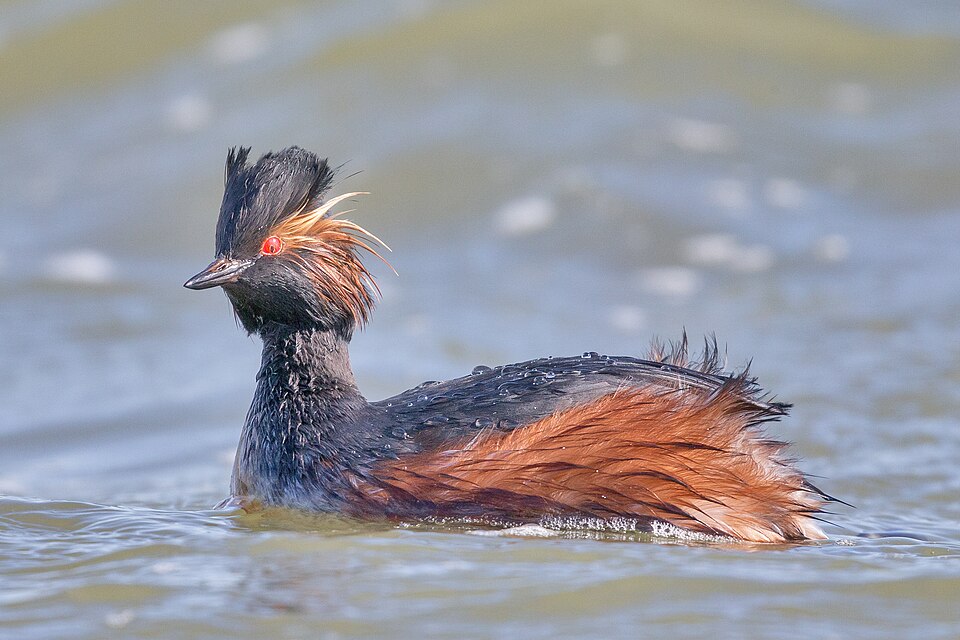
The Eared Grebe is a small, slim diving bird of open lakes and alkaline ponds, and despite its modest size it holds a remarkable title: it is the most abundant grebe on Earth. In North America it is a bird of the West, breeding on prairie sloughs and marshy wetlands from the northern Great Plains across the Intermountain region. But its true claim to fame is what happens after breeding, when hundreds of thousands gather on a handful of salty inland seas like Mono Lake and the Great Salt Lake to gorge on brine shrimp and alkali flies.
For backyard birders, the Eared Grebe is a creature of patient scope-watching rather than feeder-watching. It rides low in the water like a little submarine, dives endlessly, and changes its look dramatically with the seasons. In spring it sports a coal-black neck, glowing red eyes, and a spray of golden plumes fanning back from each ear. In winter it fades to a sooty gray-and-white bird that puzzles even experienced observers. Learning to pick it out from the similar Horned Grebe is one of the satisfying small challenges of waterbird watching.
The Eared Grebe is a compact, fine-billed grebe with a high, peaked crown and a slender neck that it often holds in a gentle S-curve. It sits buoyantly and rather high at the rear, giving it a distinctive "fluffy-bottomed" look, and its thin, slightly upturned bill is a key separator from look-alikes.
| Breeding head | Glossy black head and neck with a striking fan of wispy golden-yellow plumes spraying back behind each glowing red eye. |
| Crown shape | Tall, peaked crown that gives the head a triangular, top-heavy profile, the highest point sits above or in front of the eye. |
| Bill | Thin, dark, and slightly upturned (concave along the lower edge), finer than the straight bill of a Horned Grebe. |
| Winter plumage | Dusky gray above and on the cheeks, with a smudgy, ill-defined border between the dark cap and dingy white throat, never crisp black-and-white. |
| Neck & flanks | In breeding dress the flanks are rich chestnut; the body is dark overall with a peaked rear end held high out of the water. |
| Eye | Bright red year-round, a useful mark at close range. |
Male vs. female
Males and females look essentially alike in both breeding and winter plumage, and they cannot be reliably told apart in the field. Males average very slightly larger with marginally fuller golden ear plumes during courtship, but the difference is too subtle to use on a single bird. Pairs are best identified by their synchronized courtship behavior rather than by plumage.
Juveniles
Downy chicks are striped in black and white with bare reddish patches of skin on the crown, and they ride on a parent's back for their first days. Juveniles and first-winter birds resemble dull winter adults, gray-brown above with dingy whitish underparts and grayish wash across the cheeks and foreneck, but they look softer and more washed-out, often with a paler face and a less peaked crown. The red eye is present but duller than in adults.
Eared Grebes are most vocal on the breeding grounds, where pairs and neighbors trade a thin, rising, mournful whistle often written as poo-eee-chk or a soft, querulous oo-leek. The notes have a frail, almost squeaky-toy quality that carries across a marsh at dawn.
During courtship they give faster chittering and trilling notes, and alarmed birds may utter short, sharp kik or chick calls before diving. On wintering and staging waters they are largely silent, so the haunting whistles are very much a sound of spring wetlands.
In North America, Eared Grebes breed across the West, from the prairie provinces of Canada and the Dakotas south and west through the Great Basin and into California, favoring shallow, productive lakes and marshes. They are scarce or absent as breeders in the East. The species is also widespread across Eurasia and Africa, where it is known as the Black-necked Grebe.
Their migration is famously dramatic. After breeding, the bulk of the western population funnels to a few hypersaline lakes, especially Mono Lake in California and the Great Salt Lake in Utah, where they molt, double their body weight on brine shrimp and alkali flies, and become temporarily flightless. From these staging areas they make long, nocturnal flights to wintering grounds along the Pacific coast, the Salton Sea, and the Gulf of California. They winter on protected bays, coastal lagoons, and large inland lakes.
Eared Grebes are pursuit divers that feed almost entirely on small aquatic invertebrates. On their breeding marshes they take aquatic insects and their larvae, small crustaceans, and the occasional tiny fish or tadpole. What sets them apart is their reliance on superabundant invertebrate swarms during migration: at Mono Lake and the Great Salt Lake they feast on brine shrimp and alkali flies in numbers that let them pack on enough fat to fuel marathon flights.
They forage by diving from the surface with a smooth forward roll, propelling themselves with their lobed feet and snapping up prey underwater. Dives are typically short and shallow, and birds often work an area in loose, scattered flocks. Like all grebes, they swallow their own feathers, which form a felt-like plug in the stomach thought to protect against sharp prey fragments and aid in casting indigestible material.
Eared Grebes are colonial nesters, sometimes gathering in dense colonies of dozens to hundreds of pairs on a single productive lake. The nest is a soggy, floating platform of decaying vegetation anchored to emergent plants, built and tended by both members of the pair. It sits low and wet, and the eggs are often partly submerged.
The female typically lays three to four pale bluish-white eggs that quickly become nest-stained to a muddy brown. Both parents incubate for roughly three weeks, and when they leave the nest they pull wet vegetation over the eggs to hide and insulate them. The striped chicks hatch ready to swim and ride on a parent's back, sheltering in the adult's feathers and being fed bill-to-bill. Pairs usually raise one brood a year, though they may re-nest if an early attempt fails.
The Eared Grebe is not a backyard or feeder bird, it lives on open water, eats live aquatic invertebrates, and never visits yards or seed feeders. You can't lure one in, but you can reliably find them with a little planning and a spotting scope.
- Scan open lakes, reservoirs, sewage ponds, and alkaline wetlands in the West, these productive, shallow waters are prime habitat.
- Bring a spotting scope: grebes ride low and dive constantly, so you'll often need magnification to study head shape and bill.
- Time a fall visit to a staging lake like Mono Lake or the Great Salt Lake, where tens of thousands gather to fatten on brine shrimp, one of the great waterbird spectacles.
- In winter, check protected coastal bays, harbors, and the Salton Sea for nonbreeding birds in drab gray-and-white plumage.
- Look for the peaked crown, thin upturned bill, and fluffy high rear end to separate it from the similar Horned Grebe.
- Watch quietly from shore and let birds surface near you, rather than walking the bank and flushing diving flocks.
- Horned Grebe: Most easily confused look-alike. Horned Grebe has a flatter crown, a straight (not upturned) bill, and in winter shows a crisp, clean border between its black cap and white cheek. Breeding Horned has golden 'horns' over the eye and a rusty neck, versus the Eared's all-black neck and fanned cheek plumes.
- Pied-billed Grebe: Chunkier and browner with a thick, blunt, chicken-like bill (ringed with black in breeding season). Lacks any golden plumes and rides lower and rounder; favors more vegetated ponds.
- Western Grebe: Much larger and longer-necked, with a long yellow dagger bill and a striking black-and-white pattern. No comparison up close, but distant grebe flocks may include both.
What's the difference between an Eared Grebe and a Horned Grebe?
Look at the head and bill. The Eared Grebe has a tall peaked crown and a thin, slightly upturned bill, and in winter its dark cap blurs into a dingy gray cheek. The Horned Grebe has a flatter crown, a straight bill, and a clean-cut black-and-white face in winter. In breeding plumage, the Eared shows a black neck with golden cheek fans, while the Horned has a rusty neck and golden 'horns' above the eye.
Why do so many Eared Grebes gather at the Great Salt Lake and Mono Lake?
These hypersaline lakes produce enormous swarms of brine shrimp and alkali flies with almost no competition from fish. Eared Grebes stage there by the hundreds of thousands to molt and roughly double their body weight on this superabundant food before flying on to their wintering grounds. During the molt they're temporarily flightless, so the food-rich, predator-poor lakes are ideal.
Are Eared Grebes rare?
Not at all, they are listed as Least Concern and are actually the most abundant grebe species in the world. They're simply localized: in North America they're a western bird that concentrates on specific lakes, so whether you see them depends heavily on being in the right region and habitat.
Can an Eared Grebe walk on land?
Barely. Like all grebes, its legs are set far back on its body for diving, which makes it almost helpless on land. Eared Grebes essentially never come ashore; they nest on floating platforms and even sleep on the water. They also need a long running takeoff across the water's surface to get airborne.
What do Eared Grebes eat?
Small aquatic invertebrates, aquatic insects and larvae, small crustaceans, and brine shrimp and alkali flies at their staging lakes, plus the occasional tiny fish or tadpole. They catch all of it underwater by diving from the surface and chasing prey with their lobed feet.