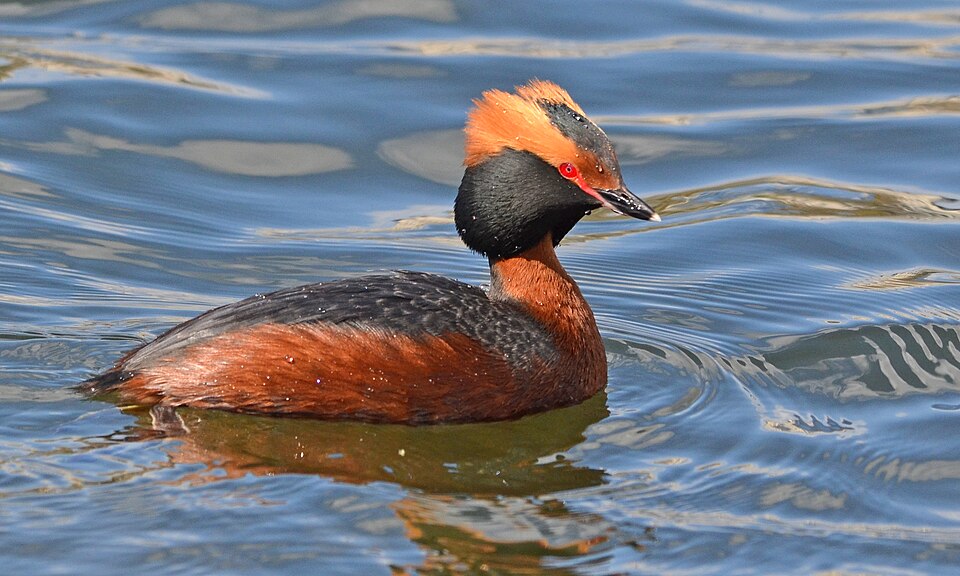
The Horned Grebe is a compact, expert diving bird that leads two strikingly different lives across the year. In summer it wears one of the most dazzling outfits in North American and Eurasian waterbirds: a black head set off by glowing golden tufts that sweep back from the eyes like horns, a rufous-chestnut neck, and a piercing ruby-red eye. Come winter, that same bird transforms into a crisp study in black and white, blending into the gray of cold-season bays and reservoirs where most birders actually meet it.
Found across the Northern Hemisphere, this is a bird of two worlds: shallow, marshy freshwater ponds for breeding, and open salt or fresh water for the colder months. It rarely sets foot on land, propelling itself underwater with strong lobed feet to chase small fish and aquatic invertebrates. Sadly, the species has declined notably in parts of its range, and it is now listed as Vulnerable on the global Red List, making every sighting a small gift worth pausing for.
Look for a small, low-slung waterbird with a flat-crowned head, a short, straight, sharply pointed bill, and almost no visible tail. Horned Grebes ride low in the water and dive frequently, often vanishing for many seconds before popping up well away from where they went under. Size and bill shape are your most reliable tools, since plumage changes dramatically with the season.
| Breeding head | Black head with broad golden-buff tufts (the "horns") flaring back from behind the red eye |
| Breeding body | Rich rufous-chestnut neck and flanks contrasting with a dark back |
| Winter plumage | Clean black-and-white: dark cap to eye level, white cheeks and foreneck, sharp contrast |
| Eye | Bright red iris in all plumages, often visible at close range |
| Bill | Short, straight, evenly tapered to a fine point, usually with a pale tip |
| Head shape | Flat-crowned with a peak toward the rear, giving a level-headed profile |
Male vs. female
Males and females look essentially alike in both breeding and winter plumage, and they cannot be reliably separated in the field. Males average very slightly larger and may show marginally brighter, fuller golden tufts in peak breeding condition, but this is not dependable for a single bird. During courtship, behavior is the better clue: paired birds perform elaborate mirror-image displays together rather than showing any obvious plumage difference between the sexes.
Juveniles
Downy chicks are striped in black and white with bare reddish skin on the face, and they famously ride on a parent's back, tucked into the feathers even while the adult dives. Juveniles in late summer and fall resemble dull winter adults: black-and-white overall but with grayer, less crisply defined face patterning, often showing dusky smudging on the cheeks and a less clean border between cap and white throat. The red eye is present but can look duller than in adults.
On the breeding grounds the Horned Grebe is surprisingly vocal, given how silent it is the rest of the year. The signature sound is a long, nasal, croaking trill that rises and then breaks into a sputtering series, often rendered as a rolling aaaarrrr-rrr-rrr or a shrieking, donkey-like braying that carries across a marsh at dawn and dusk. Pairs duet, with overlapping squeals and croaks during courtship.
Away from the nesting marsh, especially on wintering waters, these grebes are essentially silent. If you are watching a winter bird on a bay or reservoir, expect no vocalizations at all. The dramatic calls belong almost entirely to the breeding season.
The Horned Grebe breeds across the northern reaches of both North America and Eurasia. In North America its nesting range centers on the prairie potholes and boreal wetlands of western and central Canada and Alaska, dipping into the northern United States. The Eurasian population (sometimes called the Slavonian Grebe) breeds from Iceland and Scotland across Scandinavia and northern Russia.
It is a migratory bird. In winter, North American breeders move to the Pacific and Atlantic coasts, the Gulf of Mexico, and ice-free inland lakes and reservoirs, while Eurasian birds shift to sheltered coastal waters and large lakes farther south. Most birders encounter Horned Grebes during migration and winter, when they appear on open water far from the marshes where they breed.
Horned Grebes are pursuit divers that feed almost entirely underwater. Their diet shifts with habitat and season: small fish dominate in winter and on saltwater, while in the breeding marshes they take a heavy share of aquatic insects, their larvae, crustaceans, leeches, and other invertebrates. They will also eat tadpoles and the occasional small mollusk.
They hunt by making repeated shallow dives, swimming down with powerful strokes of their lobed toes and seizing prey with the sharp bill. Like all grebes, they regularly swallow their own feathers, which form a plug in the stomach thought to protect the gut from sharp fish bones and to slow digestion. Parents even feed feathers to their chicks.
Horned Grebes nest on shallow, vegetated freshwater ponds and marshes, usually as solitary pairs or in loose groupings rather than dense colonies. The nest is a floating or anchored platform of wet, decaying vegetation, built up among emergent plants or attached to reeds so it rises and falls with the water level. Both members of the pair construct it.
The female typically lays a clutch of several whitish eggs that quickly become stained brown by the damp nest material. Both parents share incubation, and they often cover the eggs with vegetation when leaving the nest. The chicks are precocial and leave the nest soon after hatching, riding on the parents' backs and being fed by both adults until they can dive and feed on their own.
The Horned Grebe is not a backyard or feeder bird, and there is no realistic way to draw one to a typical yard. It eats live aquatic prey it catches by diving and almost never comes to land, so seed, suet, and feeders are irrelevant. To see one, you go to the water rather than waiting for it to come to you.
- Scan open water in winter: Check sheltered bays, harbors, jetties, and large ice-free reservoirs from late fall through early spring, when most birders see them.
- Watch for the dive pattern: A small, low-floating bird that repeatedly disappears underwater and resurfaces yards away is often a grebe, bring binoculars and be patient.
- Time spring migration: Inland lakes and ponds can host birds briefly in breeding plumage during spring passage, your best chance at the golden-horned look.
- Protect wetlands locally: Supporting clean, vegetated freshwater marshes and prairie potholes helps a declining species far more than any feeder.
- Look closely at the head and bill: A flat crown, straight pointed bill, and red eye separate it from the similar Eared Grebe in mixed winter flocks.
- Eared Grebe: Very similar in winter; Eared Grebe has a thinner, slightly upturned bill, a peaked crown, a dingier neck, and the dark cap extends below the eye, versus the Horned Grebe's cleaner cap-to-eye border and flat head.
- Pied-billed Grebe: Stockier and brown overall with a thick, blunt, chicken-like bill (banded in breeding season). It lacks the Horned Grebe's red eye and crisp black-and-white winter pattern.
- Red-necked Grebe: Noticeably larger with a long, heavy, yellow-based bill and grayer cheeks in winter; in breeding plumage it has a chestnut neck but a whitish cheek rather than golden horns.
- Horned Lark: Unrelated land bird sometimes confused by name only, a brown songbird of open fields with tiny feather "horns," never found swimming or diving like the grebe.
Why is it called a Horned Grebe?
The name comes from the breeding plumage, when broad golden-buff tufts of feathers flare back from behind each eye like a pair of horns. These tufts can be raised or flattened. In winter the bird loses this look entirely and becomes plain black and white.
How do you tell a Horned Grebe from an Eared Grebe in winter?
Focus on the head and bill. The Horned Grebe has a flat crown, a straight pointed bill, and a clean dark cap that stops at the red eye, leaving bright white cheeks. The Eared Grebe has a peaked crown, a thin slightly upturned bill, a dingier gray neck, and a dark cap that extends below the eye.
Are Horned Grebes endangered?
The species is listed as Vulnerable on the global IUCN Red List and has declined in parts of its range, including significant losses in North America. It is still locally common in good habitat, but wetland loss and other pressures have reduced its numbers.
What do Horned Grebes eat?
They dive for live prey. On saltwater and in winter they eat mostly small fish, while on breeding marshes they take large amounts of aquatic insects, crustaceans, leeches, and other invertebrates. They also regularly swallow their own feathers, which is normal grebe behavior.
Where can I see a Horned Grebe?
Most people see them in fall, winter, and early spring on open water: coastal bays, harbors, jetties, and large inland reservoirs or lakes. In summer they retreat to shallow, marshy freshwater ponds across Canada, Alaska, and northern Eurasia to breed.