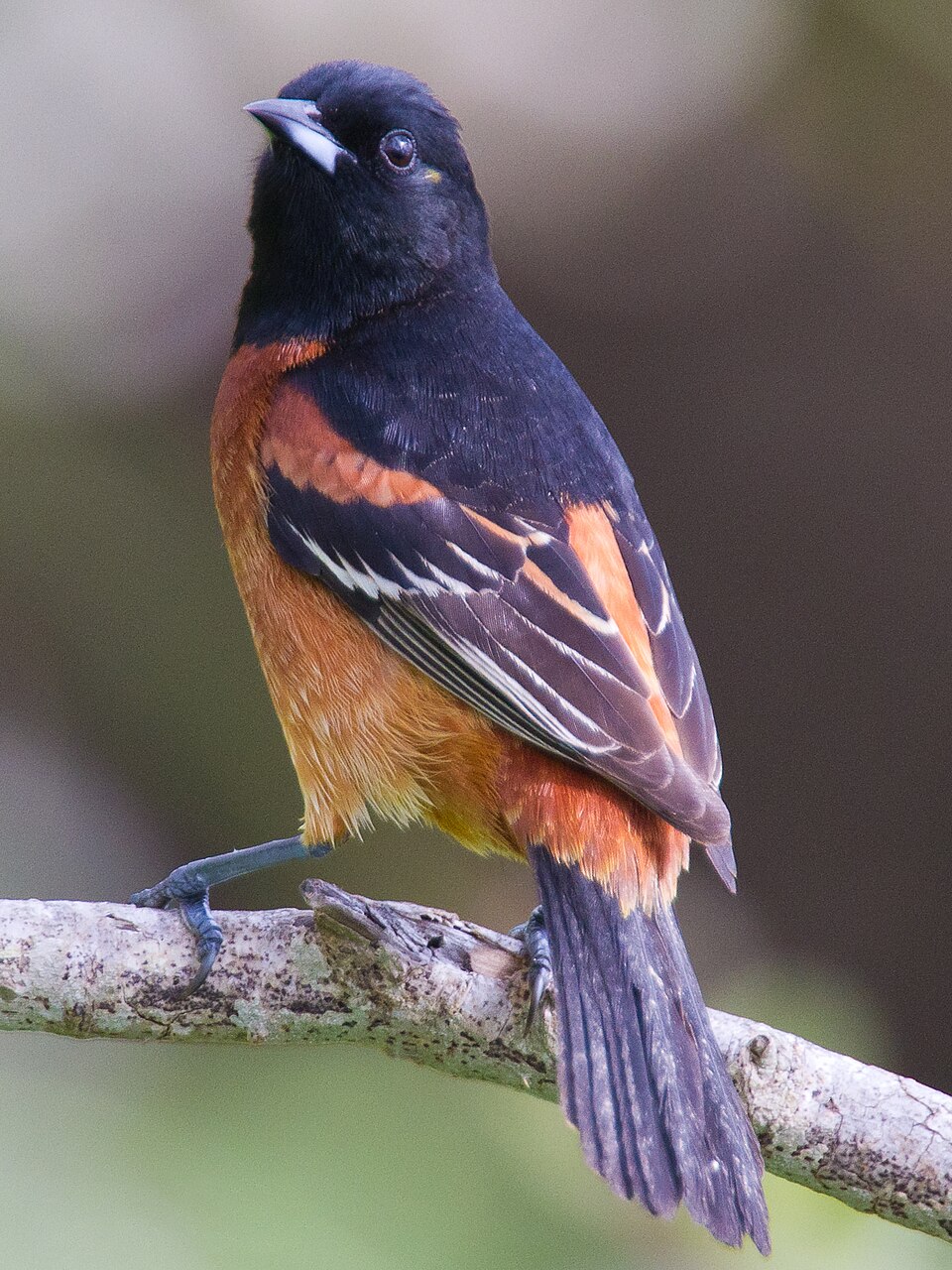
The Orchard Oriole is the smallest oriole in North America, and one of the easiest to overlook. Where the Baltimore Oriole blazes in flame-orange, the adult male Orchard Oriole wears a quieter, richer palette: a deep brick-red or chestnut body set against a glossy black hood and back. He is barely bigger than a warbler, slim and quick, and he spends much of his time tucked into the leafy crowns of shade trees and orchards where his dark plumage melts into the shadows.
True to its name, this oriole favors open country dotted with trees rather than deep forest: orchards, riverside groves, parks, suburban shade trees, and the scattered timber of farmland. It is a long-distance migrant with a famously short stay, arriving late in spring and slipping south again by midsummer, which means many backyard birders only get a few weeks to enjoy it. Its woven, hanging nest and sweet, hurried song make it a rewarding bird to track down once you learn what to look and listen for.
Think small and slender. The Orchard Oriole has the typical oriole shape - a sharply pointed, slightly downcurved bill and a trim body - but it is noticeably more compact than other orioles, with a relatively short tail. Size and the deep chestnut tone of the adult male are your best first clues.
| Size | The smallest North American oriole, only a touch larger than a sparrow and far daintier than a Baltimore Oriole. |
| Adult male | Deep chestnut (brick-red) underparts and rump with a solid black head, throat, back, wings, and tail. Reddish-brown is unique among our orioles. |
| Female | Greenish-yellow overall, brightest below, with two whitish wingbars and a grayer back. No bold markings. |
| Bill | Slender, sharply pointed, and slightly decurved - a classic oriole probing bill, but thin. |
| Wings | Black in the male with a chestnut shoulder patch; dusky with two pale wingbars in females and young birds. |
| Immature male | Yellow-green like a female but with a distinctive solid black bib (throat patch) - a key in-between plumage. |
Male vs. female
The sexes look quite different. Adult males are unmistakable once seen well: glossy black on the head, back, wings, and tail, with rich chestnut-red on the breast, belly, and rump - the only North American oriole with this reddish coloring rather than orange or yellow. Females and immatures are a soft greenish-yellow, brightest on the underparts, with a grayer-olive back and two thin white wingbars. Females lack any black and can suggest an overgrown warbler or a female tanager, so size, shape, and the slim oriole bill matter when separating them.
Juveniles
Juveniles resemble adult females - greenish-yellow with pale wingbars. The most useful plumage to know is the first-spring (one-year-old) male, which looks essentially like a female but adds a neat, solid black bib on the throat and face. These bib-wearing young males sing and even attempt to breed while still in this immature dress, so a "female with a black throat" is almost always a yearling male Orchard Oriole.
The male's song is a fast, rich, tumbling jumble of whistled and burry notes, delivered in a hurried burst that often ends with a sharp downward or churring flourish. It is sweeter and quicker than the slow, clear-whistled phrases of a Baltimore Oriole, and to many ears it recalls a hyped-up American Robin or a Purple Finch crossed with a warbler - musical but slightly scrambled, as if the bird is in a rush.
The common call is a sharp, dry chuck or chut, often repeated, and an agitated chatter when alarmed. Listen for the song high in leafy trees in late spring; because the birds leave so early, the singing season is brief.
The Orchard Oriole breeds across the eastern and central United States, from the Great Plains east to the Atlantic and south into Texas and the Gulf states, with the highest densities in the South and lower Midwest. It thrives in open, scattered-tree habitats and is often common along rivers, in farm country, and in towns within that range.
It is a long-distance migrant that winters from Mexico through Central America into northern South America. Famous for its short breeding season, it arrives relatively late in spring (often late April into May) and departs early - many adults head south by July, making it one of the first songbirds to vanish each summer. A western subspecies, the "Fuertes's" Oriole, breeds in coastal Mexico.
Orchard Orioles eat mostly insects during the breeding season - caterpillars, beetles, grasshoppers, ants, and spiders gleaned from leaves and branches. They are nimble foragers, working through the outer foliage of trees and often hanging upside down to reach prey, much like a large warbler.
They also have a strong sweet tooth. The birds drink nectar from flowers and feed heavily on fruit and berries, especially on the wintering grounds and during migration, where they visit flowering trees and have been recorded feeding at tropical blossoms. This nectar habit makes them occasional, if irregular, visitors to backyard offerings of fruit and sugar water.
The nest is a beautifully woven, hanging cup - shallower and more basket-like than the deep sock of a Baltimore Oriole. The female does the building, stitching together fine grasses and plant fibers into a pouch suspended from a fork of slender outer branches, often in a shade tree, orchard tree, or willow near water.
She lays a clutch of pale, bluish or grayish eggs blotched with dark markings and does the incubating, which lasts roughly two weeks; both parents then feed the nestlings. Orchard Orioles are notably tolerant of neighbors and sometimes nest in loose, semi-colonial clusters, and they often place their nests near aggressive species like kingbirds whose nest defense offers extra protection.
The Orchard Oriole is a real backyard possibility within its range, though it is less of a reliable feeder bird than the Baltimore Oriole and tends to favor flowers and natural food. If you live near orchards, riverside trees, or open suburban groves, a few targeted offerings can tempt one in during its brief spring visit.
- Offer orange halves and grape jelly on an oriole feeder, especially during spring migration in April and May when the birds first arrive hungry.
- Put out nectar (sugar water) in an oriole or hummingbird-style feeder - this species drinks nectar readily and is drawn to sweet liquids.
- Plant nectar-rich and fruiting trees and shrubs such as flowering trees, mulberries, and berry bushes to provide the natural food it prefers.
- Keep leafy shade trees and willows near open ground or water, which provide both nesting sites and the insect-rich foliage it forages in.
- Put feeders out early in the season - this oriole arrives late but also leaves by midsummer, so the window to attract one is short.
- Provide a water source like a shallow birdbath or dripper, which can draw orioles in to drink and bathe.
- Baltimore Oriole: Larger and brighter, with flame-orange (not chestnut) underparts in the male; female is more orange-toned. Slower, clearer whistled song.
- Bullock's Oriole: Western counterpart; male is orange with a black crown, eyeline, and large white wing patch - never reddish-chestnut like an Orchard Oriole.
- Scarlet Tanager: Female and immature can suggest a female Orchard Oriole but are stockier with a thicker, blunter bill and lack the slim oriole shape and wingbars.
- Summer Tanager: Adult male is all-red and could be confused with a chestnut Orchard Oriole at a glance, but tanagers are chunkier with heavy pale bills and no black hood.
What is the difference between an Orchard Oriole and a Baltimore Oriole?
The Orchard Oriole is noticeably smaller, and the adult male is deep chestnut-red rather than bright flame-orange. Baltimore Orioles are larger, more vividly orange, build a longer hanging-sock nest, and stay later into summer. Their songs differ too: the Baltimore sings slow, clear whistles while the Orchard sings a faster, jumbled warble.
Why is it called an Orchard Oriole?
It earned the name because it frequently nests and forages in orchards and other open, scattered-tree habitats like riverside groves, parks, and farmland. It favors the leafy crowns of these trees rather than deep forest.
What does a female Orchard Oriole look like?
She is a soft greenish-yellow overall, brightest on the underparts, with a grayer-olive back and two thin white wingbars. She has no black markings, so the slim, pointed oriole bill and small size are the best clues. A yearling male looks similar but adds a solid black throat patch.
Will Orchard Orioles come to a feeder?
They can, though less reliably than Baltimore Orioles. Try orange halves, grape jelly, and especially nectar (sugar water), and put feeders out early in spring since this oriole arrives late and leaves by midsummer. Planting flowering and fruiting trees helps even more.
When do Orchard Orioles migrate?
They are short-stay, long-distance migrants. They arrive on the breeding grounds relatively late, often in late April and May, and many adults head south again by July - among the earliest songbirds to depart - to winter in Mexico, Central America, and northern South America.