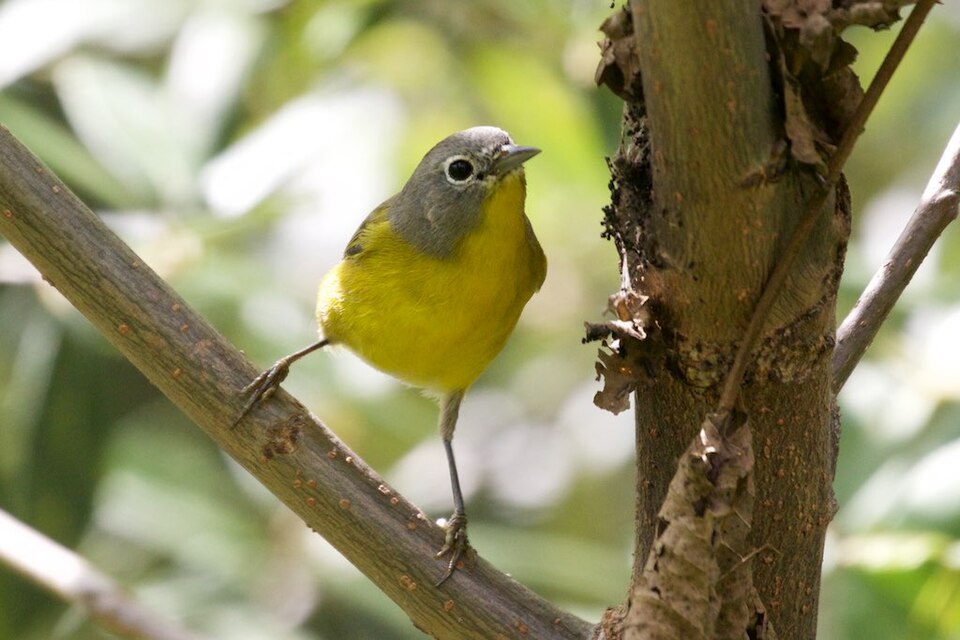
The Nashville Warbler is one of those small, restless wood-warblers that rewards a careful look. Despite the name, it has nothing to do with Tennessee as a home base, Alexander Wilson simply collected the first specimen near Nashville during spring migration in 1811, and the label stuck. The bird actually nests far to the north and west, in the cool young forests, bogs, and brushy clearings of Canada, the northern United States, and the mountains of the Pacific states. For much of North America, it is a bird seen twice a year: a flash of gray and yellow moving through the treetops on its way somewhere else.
What makes it a satisfying find is its tidy, well-marked plumage. A clean gray hood sets off a bold white eye-ring, the throat and belly glow bright yellow, and a rusty crown patch hides on top of the head, usually invisible unless the bird is excited or you catch it from just the right angle. Active and acrobatic, it forages low to mid-level in shrubs and small trees, flicking its tail and peering under leaves for insects. Once it became one of the more familiar small migrants across eastern and western flyways alike, and its numbers remain healthy across most of its range.
This is a tiny, compact warbler with a short tail, a thin pointed bill, and a rounded head that often looks slightly large for its body. The combination of a plain gray head, a crisp white eye-ring, a yellow throat, and a yellow belly with no streaking is distinctive, there's no wing bars and no chest band to complicate the picture.
| Head | Clean blue-gray hood with a bold, complete white eye-ring (no eye line or eyebrow stripe) |
| Crown patch | Rufous-chestnut patch on the crown, usually concealed and only visible when the bird raises its feathers |
| Underparts | Bright yellow throat, breast, and belly that runs unbroken from chin to undertail, unstreaked |
| Upperparts | Olive-green back and wings with no wing bars; the gray head contrasts sharply with the greenish back |
| Belly center | Often a whitish patch low on the belly between the legs, a subtle but useful mark |
| Size & shape | Very small and round-headed with a short tail and a fine, straight bill; frequently flicks its tail |
Male vs. female
The sexes look much alike, and a quick glance won't reliably separate them. Males in breeding plumage tend to be the brightest, with the cleanest gray hood, the most saturated yellow underparts, and the most extensive chestnut crown patch. Females and fall birds are duller overall, the hood is grayer-brown and less crisp, the yellow is a touch softer, and the crown patch is small or essentially absent. In the field, most birders simply note "Nashville Warbler" without committing to a sex unless they get a long, close look at a singing male.
Juveniles
Juveniles seen just after fledging are washed-out and grayish, with buffy wing edgings and only a hint of yellow on the underparts. By the fall migration, immatures resemble dull adult females: greenish above, yellow below, with a grayish head and the trademark white eye-ring already in place. The eye-ring is the most reliable feature on these confusing young birds, so when a small fall warbler shows a clean white ring on an otherwise plain face, Nashville should be high on your list.
The song is a brisk, two-parted phrase that's easy to learn once you've heard it a few times. It opens with a series of clear, ringing notes and then drops into a faster, lower trill, often written as seebit seebit seebit, ti-ti-ti-ti or see-it see-it see-it, titititi. The first half is sweet and deliberate; the second half is a rapid roll that runs down in pitch. The whole song lasts only a couple of seconds and is delivered repeatedly from a perch in the open or partway up a small tree.
The common call note is a sharp, metallic tink or spink, a little fuller and more musical than the chip of many other warblers. On migration, listen for this dry chip as birds move through hedgerows and woodland edges.
Nashville Warblers breed in two separate populations. The larger eastern population nests across central and eastern Canada and the northern United States, from the Great Lakes and New England up through Ontario and Quebec into the Maritimes. A western population breeds in the mountains and foothills from British Columbia south through the Cascades and Sierra Nevada into California and the Pacific Northwest. The two groups differ subtly in behavior and tail-bobbing intensity, with western birds tending to be brighter and more animated.
In winter the species heads south to Mexico and Central America, with some lingering in southern Texas, Florida, and along the Gulf and southern California coasts. For birders in the lower 48 east of the Rockies, the bird is mainly a spring and fall passage migrant, moving through in April-May and again in late August through October. Western birders may catch it on its breeding grounds in spring and summer.
The Nashville Warbler is an insectivore through and through, especially during the breeding season. It gleans caterpillars, beetles, flies, leafhoppers, aphids, and small spiders from leaves, twigs, and outer branches, often working the tips of shrubs and low trees where soft new growth concentrates prey. It is a busy, deliberate forager, hopping along branches, peering under leaves, and occasionally hovering briefly or flicking its tail to flush hidden insects.
Like many warblers, it shifts its diet seasonally and will take some berries, small fruit, and nectar during migration and on the wintering grounds when insects are scarcer. This flexibility helps it refuel during long-distance flights.
Nashville Warblers are ground nesters. The female builds a small open cup tucked into a depression at the base of a shrub, in a clump of grass, sedge, or moss, or beneath a small conifer, well hidden and often near the edge of a bog, clearing, or regenerating cutover. The nest is woven from grasses, bark strips, and pine needles and lined with finer material such as fur, fine grass stems, and hair.
She lays a clutch of typically 4-5 eggs, white speckled with brown, and does the incubating herself for about 11-12 days. Both parents feed the nestlings, which leave the nest after roughly 11 days. Pairs usually raise a single brood per season, occasionally a second in the southern part of the range. As a low and concealed nester, the species is vulnerable to Brown-headed Cowbird parasitism in fragmented habitats.
The Nashville Warbler is not a feeder bird, it eats insects, not seed, and it won't visit a tube or platform feeder for sunflower or suet in the way a chickadee or finch will. That said, you can absolutely draw migrants into your yard in spring and fall by making the space insect-rich and inviting.
- Offer moving water, a dripper, mister, or shallow bubbling bath is the single best magnet for migrating warblers, including Nashvilles
- Plant native trees and shrubs (oaks, willows, birches, and dogwoods) that host abundant caterpillars and other insects
- Skip pesticides, a healthy population of caterpillars and small bugs is exactly what these warblers are hunting for
- Keep some brushy edges and low shrubby cover rather than manicuring every corner, since they forage low and in tangles
- Time your watching to migration windows (April-May and late August-October in much of the East) when these birds pass through
- Leave leaf litter and native plantings intact to support the insect life that fuels passing migrants
- Connecticut Warbler: Larger and chunkier with a full gray hood that extends onto the breast as a hood/bib; walks rather than hops, and has a bold complete eye-ring like Nashville but lacks the bright unbroken yellow throat.
- Mourning Warbler: Has a gray hood with a darker breast smudge and typically no eye-ring (or only broken arcs); a skulker of dense low cover, larger than the petite Nashville.
- MacGillivray's Warbler: Western bird with a gray hood and bold broken white eye-arcs (not a complete ring); darker and more secretive, lacking Nashville's clean continuous eye-ring.
- Common Yellowthroat: Male has a black mask, not a gray hood; females are plain brownish with yellow throat but lack the crisp gray head and white eye-ring of a Nashville.
Why is it called a Nashville Warbler if it doesn't live in Nashville?
The name comes from the place it was first described, not where it lives. Ornithologist Alexander Wilson collected the first specimen near Nashville, Tennessee, in 1811 while the bird was passing through on migration. It actually breeds far to the north and west, so for most of Tennessee it's only a migrant.
How do I tell a Nashville Warbler from a Common Yellowthroat?
Look at the head. A Nashville Warbler has a smooth gray hood and a bold complete white eye-ring, with yellow that runs all the way down the belly. A male Common Yellowthroat wears a black bandit mask, and the female is plain brownish-faced with a yellow throat but no gray hood and no white eye-ring.
What does the Nashville Warbler's song sound like?
It's a quick two-part song: a series of clear ringing notes followed by a faster, lower trill, often written as 'seebit seebit seebit, ti-ti-ti-ti.' The call note is a sharp metallic 'tink.' The song is short, repeated, and drops in pitch at the end.
Will Nashville Warblers come to my bird feeder?
No, they eat insects, not seeds, so they won't visit seed or suet feeders. You're far more likely to attract them with a dripping or moving water source, native insect-rich plantings, and a pesticide-free yard during spring and fall migration.
When is the best time to see a Nashville Warbler?
In most of the eastern United States, watch during spring migration (roughly April to May) and fall migration (late August through October). In the West and across Canada you can find them on their breeding grounds in late spring and summer in brushy clearings, young forests, and bog edges.