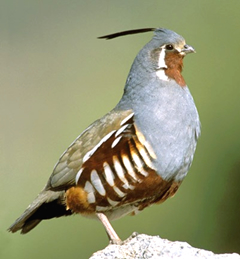
The Mountain Quail is the largest quail in North America and, for many birders, the hardest of the western quail to actually lay eyes on. It is a bird of brushy mountain slopes, chaparral, manzanita thickets, and burned-over hillsides regrowing into dense cover, where it spends most of its life hidden in the tangle. You will often hear one calling from a hidden perch long before you ever see the bird itself. Its single, long, straight head plume, held nearly upright, gives it a jaunty, almost regal silhouette that no other North American quail shares.
Beyond its good looks, the Mountain Quail is remarkable for being one of the few North American birds that migrates on foot. Rather than flying between summer and winter ranges, family groups and coveys simply walk up and down the mountains with the seasons, climbing to high elevations to breed and descending into the foothills when snow arrives. Because it favors steep, shrubby, often remote terrain and bolts for cover at the first hint of danger, it remains one of the most underappreciated and least-photographed game birds in the West.
This is a plump, round-bodied, short-tailed quail with a distinctive long, straight head plume and a strikingly patterned flank. At rest it looks compact and full-chested; in good light the chestnut throat, blue-gray breast, and bold white-and-chestnut barring along the sides are unmistakable. The single tall plume is the quickest way to separate it from California and Gambel's Quail, which have short, forward-curving teardrop topknots.
| Head plume | A single long, slender, straight plume held nearly vertical (two feathers held together); far longer and straighter than other quail topknots |
| Throat & face | Rich chestnut throat patch outlined in white, with a gray-blue crown and face |
| Breast | Smooth slate blue-gray, contrasting with the chestnut throat above |
| Flanks | Bold chestnut sides marked with crisp vertical white bars, the most colorful flank pattern of any North American quail |
| Belly | Chestnut center bordered by the barred flanks |
| Size & shape | Largest North American quail; plump, short-tailed, round-headed |
Male vs. female
Male and female Mountain Quail look very much alike, which is unusual among western quail where the sexes are typically obvious. Both show the long head plume, chestnut throat, gray breast, and barred chestnut flanks. With a close, careful look the male often appears slightly cleaner and bluer-gray on the nape and crown, while the female can show a slightly browner, more washed-out cast to the head and a marginally shorter plume. In the field, though, the differences are subtle and most birders simply note the pair rather than trying to sex them.
Juveniles
Juvenile Mountain Quail are duller and more cryptic than adults, lacking the clean chestnut throat and bold flank bars. They are grayish-brown overall with fine mottling and speckling, and their head plume is much shorter and stubbier, sometimes barely noticeable. Young birds travel in family coveys with the adults through late summer and gradually molt into adult-like plumage by their first fall, at which point the long plume and barred sides become apparent.
The signature sound of the Mountain Quail is a loud, far-carrying, single note given by males in the breeding season, often rendered as a clear, ringing "kyork" or "quee-ark," repeated at regular intervals from a hidden perch on a rock, stump, or low branch. It has a plaintive, almost mournful quality and carries surprisingly far across canyon country, which is often the only clue that the bird is present at all.
Coveys also use softer contact and assembly notes to stay together in dense brush, including clucks, soft whistles, and a quavering rally call when birds become separated. Alarmed birds give sharp, sputtering notes as they run or flush. Because the bird is so hard to see, learning the ringing single-note call is by far the most reliable way to detect it.
The Mountain Quail is a western specialty, found from southern Washington and western Idaho south through Oregon and California, and into the mountains of northern Baja California. It reaches east into parts of Nevada and is most numerous in California's coast ranges, Sierra Nevada foothills, and chaparral country. It favors brushy slopes, chaparral, montane shrubland, the edges of coniferous forest, and recently burned areas where dense regrowth provides cover.
It is famous as a short-distance altitudinal migrant that travels on foot. In spring, birds climb to higher elevations to nest, sometimes covering many miles up a mountain over several weeks; in fall, coveys walk back down to lower, snow-free foothills to spend the winter. This walking migration, rather than a true long-distance flight, makes it one of the most unusual movement patterns of any North American bird.
Mountain Quail are primarily plant-eaters, foraging on the ground for seeds, fruits, bulbs, flowers, leaves, and the new green shoots of forbs and grasses. They are especially fond of the seeds and fruits of mountain shrubs, acorns, legume seeds, and the bulbs and corms of plants they dig up by scratching at the soil and leaf litter. In summer they also take insects and other small invertebrates, which are particularly important for fast-growing chicks.
Foraging is usually done in coveys, with birds scratching and pecking through the litter under dense brush, rarely straying far from cover. They need access to water in dry country and will visit springs, seeps, and creek edges, especially during the hot, dry months of the western summer.
Mountain Quail nest on the ground, choosing a well-hidden site tucked under a shrub, log, grass clump, or rock where dense overhead cover conceals the nest. The nest itself is a shallow scrape lined with grasses, pine needles, leaves, and feathers. The female typically lays a sizable clutch of buff to pinkish, lightly marked eggs.
Incubation is handled mostly by the female and lasts roughly three to four weeks, though males stay closely involved and help tend the brood once the chicks hatch. The young are precocial, leaving the nest within hours of hatching and feeding themselves under the watchful escort of both parents. There is some evidence that pairs occasionally tend two nests at once, with each parent incubating a separate clutch, which is a striking adaptation in this species.
The Mountain Quail is not a typical backyard or feeder bird for most people. It is shy, ground-dwelling, and tied to dense brushy habitat in mountainous western country, so it rarely visits suburban yards. That said, if you live near appropriate chaparral or montane shrubland, there are ways to make your property more inviting.
- Preserve and plant dense native shrub cover such as manzanita, ceanothus, and other chaparral plants; these quail will not cross open ground far from escape cover.
- Offer a reliable ground-level water source like a low birdbath, dripper, or seep, which is especially valuable in dry western summers.
- Scatter seed and cracked grain on the ground near brush edges rather than using hanging feeders, since quail forage by scratching in litter.
- Leave leaf litter and brush piles intact to provide foraging substrate and hiding spots.
- Keep cats indoors and minimize disturbance near cover, as Mountain Quail flush and abandon areas with heavy human or predator pressure.
- Be realistic: these birds appear mainly on properties adjacent to wild mountain or chaparral habitat, not in typical city or suburban yards.
- California Quail: Has a short, forward-curving black teardrop topknot, scaly belly, and a brown cap; lacks the long straight plume and bold chestnut barred flanks.
- Gambel's Quail: Also has a short forward-curving topknot; males show a black belly patch and lack the white flank bars and chestnut throat of Mountain Quail; favors desert rather than mountain brush.
- Northern Bobwhite: An eastern quail with no head plume and a distinctive 'bob-WHITE' whistle; ranges do not normally overlap with Mountain Quail.
- Scaled Quail: A pale gray desert quail with scaly breast plumage and a short whitish crest ('cottontop'); lacks the long plume, chestnut throat, and barred flanks.
What is the difference between a Mountain Quail and a California Quail?
The quickest tell is the head plume: Mountain Quail have a single long, straight plume held nearly upright, while California Quail have a short, forward-curving black teardrop topknot. Mountain Quail also have a chestnut throat and bold chestnut-and-white barred flanks, whereas California Quail show a scaly belly and brown crown. Mountain Quail prefer brushy mountain slopes; California Quail are common in foothills, suburbs, and parks.
Do Mountain Quail really migrate by walking?
Yes. The Mountain Quail is one of the few North American birds that makes a seasonal migration mostly on foot. In spring, coveys walk uphill to higher elevations to breed, and in fall they walk back down to snow-free foothills for the winter. They can fly, but this altitudinal movement is done largely by walking, sometimes covering many miles over several weeks.
Why is the Mountain Quail so hard to see?
It lives in dense chaparral and brushy mountain cover, forages on the ground close to escape cover, and runs rather than flies when alarmed. It is shy and reluctant to break from the brush, so birders usually hear its loud, ringing single-note call long before they catch a glimpse. Listening for that call is the most reliable way to find one.
What does a Mountain Quail sound like?
In the breeding season, males give a loud, far-carrying single note, often described as a clear, plaintive 'kyork' or 'quee-ark,' repeated at intervals from a hidden perch. Coveys also use soft clucks, whistles, and a quavering rally call to stay together in dense brush. The ringing single note carries across canyons and is the classic sound of the species.
Will Mountain Quail come to a backyard feeder?
Usually not, unless you live right next to wild chaparral or mountain shrubland. They are shy ground feeders tied to dense cover and rarely visit ordinary suburban yards. If you do have suitable habitat nearby, ground-scattered seed near brush edges and a low water source give you the best chance, but they will not behave like familiar feeder birds.
Both Mountain Quail parents seem to tend chicks; do they share nesting duties?
Yes, Mountain Quail are notably attentive parents. The female does most of the incubation, but the male stays closely involved and both adults escort and protect the precocial chicks after hatching. There is evidence that pairs sometimes raise two clutches at once, with each parent incubating and tending a separate nest, which is an unusual strategy among quail.