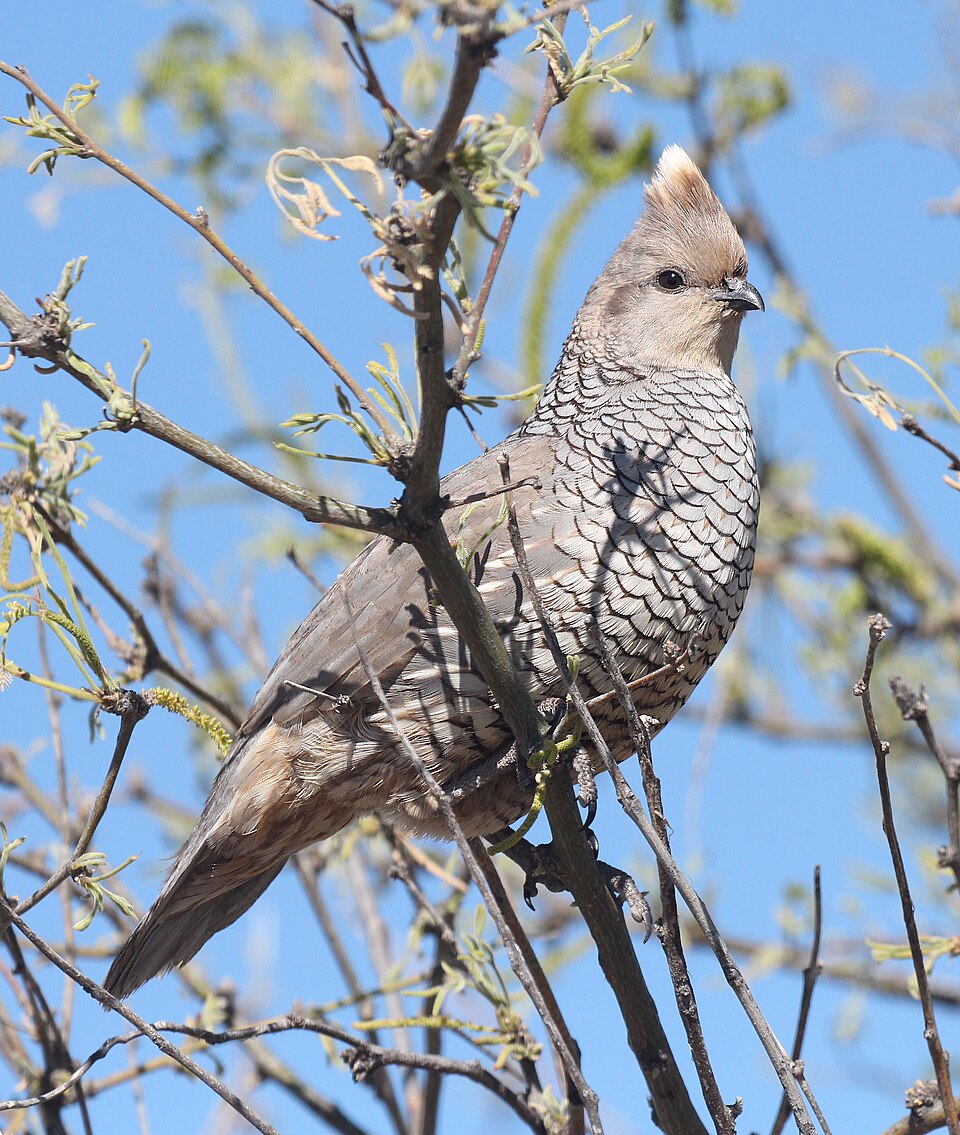
The Scaled Quail is a pale, ground-loving game bird of the dry grasslands, deserts, and brushy rangelands of the American Southwest and the Mexican Plateau. Birders and ranchers alike know it by the affectionate nickname "cottontop," a nod to the white-tipped crest that bobs on its head as it scurries through the scrub. Where the California and Gambel's quail of neighboring regions are showy and richly marked, the Scaled Quail is a study in subtle elegance: soft blue-gray feathers edged in dark crescents create the dense, scaly pattern that gives the species its name.
This is a bird built for running rather than flying. Coveys of a dozen to several dozen birds typically prefer to dash away on foot through bunchgrass and cholla, flushing into the air only as a last resort. Hardy and well adapted to heat and aridity, the Scaled Quail thrives in country where water is scarce and cover is thin, making a covey of "blue quail" one of the signature sights of the Chihuahuan Desert and the southern shortgrass plains.
Look for a plump, rounded, chicken-like bird about the size of a small dove, standing upright on the ground with a short tail and a distinctive pointed crest tipped in white. The overall impression is pale and frosty blue-gray, with no bold facial markings, which sets it apart at a glance from its more colorful quail relatives.
| Plumage pattern | Blue-gray to grayish-brown feathers on the breast, nape, and back, each edged with a dark crescent that creates a fish-scale or chain-mail look |
| Crest | Bushy, erect crest tipped with cottony white - the source of the nickname "cottontop" |
| Head and face | Plain gray-brown head lacking the bold black-and-white face pattern of Gambel's or California quail |
| Belly | Buffy to pale belly; the Texas subspecies ("chestnut-bellied") shows a dark chestnut patch on the lower belly |
| Size and shape | Stocky, round body, short legs, short squared tail; runs with head and crest held high |
| In flight | Short, whirring bursts on rounded wings showing plain grayish underparts; rarely flies far |
Male vs. female
Male and female Scaled Quail look very similar, and the species is far less sexually dimorphic than Gambel's or California quail, where males sport bold black faces. Both sexes share the scaly body pattern and white-tipped crest. With a good look, males tend to show a cleaner, plainer gray throat and face, while females often have a slightly buffier, faintly streaked throat and a marginally shorter crest. In the field, distinguishing the sexes is genuinely difficult, and most birders simply enjoy the covey without sorting them out.
Juveniles
Juvenile Scaled Quail are duller and more mottled than adults, with a shorter, less developed crest and a softer, less crisply defined scaling. They show fine pale spotting and streaking on brownish upperparts that help them blend into bare desert ground. Young birds reach adult-like plumage by their first fall, and broods of fast-running chicks following the adults through the brush are a common late-summer sight after the monsoon rains.
The Scaled Quail is not a songbird, but it is vocal in a distinctive way. Its signature call is a low, nasal, two-syllable note often written as "pe-cos" or "chip-churr," with a guttural, slightly grating quality - some listeners hear it as the bird's old folk name "Pecos quail." This contact call carries across open ground and helps scattered covey members stay in touch.
When alarmed or separated, birds give sharper, more urgent clucking and chipping notes. Coveys also produce soft conversational murmurs as they forage, and a flushing bird may burst up with a startled whir and rapid alarm clucks. The voice is gruffer and less musical than the rolling chi-ca-go of the California quail.
The Scaled Quail is a year-round resident of the arid interior Southwest. In the United States its range centers on western Texas, New Mexico, and southeastern Arizona, extending north onto the shortgrass plains of southeastern Colorado, the Oklahoma and Texas panhandles, and western Kansas. South of the border it occupies much of the dry Mexican Plateau down to central Mexico.
This is essentially a non-migratory bird. Coveys may shift locally in response to rainfall, food, and cover, gathering at favorable sites in dry years, but they do not undertake long seasonal journeys. Populations fluctuate with drought cycles, surging in years with good monsoon rains and declining sharply during prolonged dry spells.
Scaled Quail are primarily seed-eaters, foraging on the ground for the seeds of forbs, grasses, and desert shrubs such as mesquite, ragweed, and various annual weeds. They also take green shoots, leaves, and the fruits of cactus and other desert plants, which provide valuable moisture in a habitat where standing water is unreliable.
Insects become an important part of the diet in spring and summer, especially for laying females and growing chicks that need extra protein - grasshoppers, beetles, and other arthropods are eagerly hunted during the warm months. Coveys feed in the cooler hours of morning and late afternoon, scratching and pecking through bare ground and the litter beneath shrubs, and will dig into the soil or scratch in dung for seeds and insects.
Scaled Quail nest on the ground, typically tucked against the base of a shrub, clump of bunchgrass, cactus, or even man-made cover like old machinery or fence-line debris that offers shade and concealment. The nest is a shallow scrape lined with grasses, leaves, and feathers. Breeding is closely tied to rainfall, and pairs may delay or forgo nesting in severe drought, then nest vigorously after good monsoon moisture.
The female lays a fairly large clutch and does most of the incubation, which lasts a little over three weeks, while the male stands guard nearby. The downy chicks are precocial - able to leave the nest and feed themselves within hours of hatching - and are tended by both parents. Families merge into the larger coveys that hold together through fall and winter.
Scaled Quail are not typical backyard feeder birds, but if you live within their range in the arid Southwest and your property borders open desert, grassland, or brushy rangeland, you can genuinely improve your odds of hosting a covey. They respond to habitat far more than to a single feeder.
- Provide low, dense cover. Leave brush piles, native shrubs, cholla, and bunchgrass clumps - quail need escape and roosting cover near any feeding area or they won't linger.
- Offer water in dry country. A low, ground-level water source or shallow guzzler is a strong draw during drought, when natural moisture is scarce.
- Scatter seed on the ground. Quail forage low; spread millet, milo (sorghum), and cracked grains on bare ground near cover rather than using elevated feeders.
- Plant or protect native seed plants. Forbs, weedy annuals, and desert legumes like mesquite produce the wild seeds these birds prefer.
- Keep cats indoors and minimize disturbance. Ground-feeding coveys are wary and vulnerable; a quiet, predator-free yard edge is far more inviting.
- Manage rangeland lightly. Avoid overgrazing and clearing all brush - patchy cover with bare feeding ground between is ideal Scaled Quail habitat.
- Gambel's Quail: Overlaps in the Southwest but has a bold black-and-white face, rusty crown, comma-shaped teardrop plume, and (in males) a black belly patch - far more boldly marked than the plain, scaly cottontop.
- California Quail: More richly colored with a scaly belly but a brown crown, black face outlined in white, and a forward-curving teardrop plume; ranges mostly west of the Scaled Quail and gives a rolling chi-ca-go call.
- Northern Bobwhite: Browner and more reddish overall with a strong white (male) or buff (female) eyebrow and throat, no crest, and the famous whistled bob-WHITE call; overlaps on the eastern edge of the Scaled Quail's range.
- Montezuma Quail: A small, secretive quail of Southwest oak-grassland with a bizarre harlequin-patterned face and spotted flanks; lacks the scaly body and white crest, and prefers grassier mountain slopes.
Why is the Scaled Quail called the "cottontop" or "blue quail"?
"Cottontop" refers to the bushy crest tipped with cottony white that bobs on the bird's head, while "blue quail" describes the soft blue-gray cast of its scaly plumage. Both are common folk names used by hunters and ranchers across the Southwest.
What does a Scaled Quail's call sound like?
Its signature call is a low, nasal, two-note "pe-cos" or "chip-churr" with a guttural quality, used to keep covey members in contact. Alarmed birds add sharper clucking and chipping notes. It is gruffer and less musical than other Western quail.
Where can I find Scaled Quail?
Look in arid grasslands, deserts, and brushy rangeland of western Texas, New Mexico, southeastern Arizona, and the shortgrass plains of southeastern Colorado, the panhandles, and western Kansas, plus much of the Mexican Plateau. They are year-round residents that prefer open ground with scattered shrub cover.
How is a Scaled Quail different from a Gambel's Quail?
Scaled Quail are plain-faced and frosty gray with dark-edged "scaly" feathers and a white-tipped crest. Gambel's Quail are boldly marked with a black-and-white face, rusty crown, a comma-shaped head plume, and (in males) a black belly patch. The two overlap but look very different.
Will Scaled Quail come to a backyard?
They are not classic feeder birds, but in their desert range a yard bordering open habitat can attract a covey with ground-scattered millet or milo, a low water source, and plenty of nearby brushy cover. Habitat and safety from cats matter far more than the feeder itself.