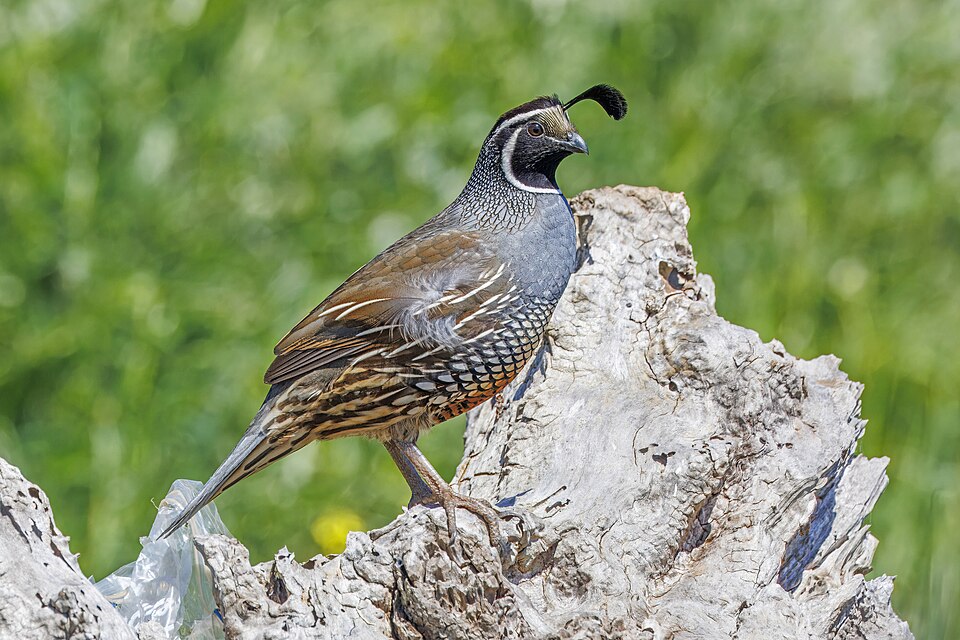
The California Quail is the round, short-tailed ground bird that scurries across trails and suburban yards throughout the West, almost always in a chattering, fast-walking group. Its most famous feature is the forward-curving black topknot, or plume, that bobs above the head like a comma, actually a cluster of six overlapping feathers, not a single one as it appears. Plump, gray-and-brown, and scaled across the belly, this is the official state bird of California and one of the most beloved residents of the region's chaparral, oak woodland, and brushy backyards.
Quail are intensely social. Outside the breeding season they gather in groups called coveys that can number from a dozen to over fifty birds, foraging together on the ground and bursting into low, whirring flight only when alarmed. They prefer to run rather than fly, threading through dense cover with surprising speed. A covey usually posts a sentinel, often a male on a fence post or low branch, who watches for hawks and cats while the others feed, giving sharp alarm notes at the first sign of danger.
Look for a chunky, pear-shaped bird about the size of a slim pigeon, with a small head, short neck, and a stubby tail it often carries cocked. The teardrop-shaped head plume is unique among common backyard birds and instantly identifies the species when present. Plumage is intricate up close: clean gray and warm brown above, with a distinctive scaled, scalloped pattern across the lower breast and belly.
| Head plume | Forward-curving black teardrop topknot; larger and bolder on the male |
| Face (male) | Black throat and face bordered by a bold white stripe and white forehead band |
| Belly | Scaly, scalloped pattern with a chestnut patch in the center on males |
| Body | Plump and round, gray breast, brown back, gray-brown overall |
| Flanks | Brown sides streaked with white vertical lines |
| Tail | Short, square, dark gray, often held cocked |
Male vs. female
Males and females are fairly easy to separate. The male is the showier bird: a black face and throat framed by crisp white lines, a white band across the forehead, a brown cap, and a rich chestnut patch on the belly within the scaled pattern. His head plume is large and obvious. The female is plainer and grayer-brown overall, with a smaller, shorter plume and a soft gray-brown face lacking the male's bold black-and-white mask. She still shows the scaled belly, just muted, without the chestnut centerpiece. In a covey, the high-contrast males stand out at a glance.
Juveniles
Juveniles look like washed-out, mottled versions of the female. They are smaller, grayer, and finely speckled or streaked, with a very short, stubby plume that may be hard to see. Young chicks are tiny, downy, and striped, and run on foot within hours of hatching, following the parents in single file. By late summer, immatures traveling with the family covey can be told from adults by their duller, fuzzier plumage and incomplete head markings.
The signature sound is the covey rally call, a loud, emphatic three-note Chi-CA-go (sometimes written qua-quer-go), with the accent on the middle syllable. Birds use it to regroup when separated, and once you learn it you'll hear quail you never see. It carries well across brushy hillsides and suburban gardens.
Beyond the rally call, quail keep up a steady, soft conversational chatter of clucks and pit-pit notes as a covey feeds. When a hawk or cat appears, the sentinel gives a sharp, metallic alarm note, a sudden pit! pit! or a louder squawk, that sends the whole group running or flushing into cover.
The California Quail is a year-round resident, not a migrant, found along the West Coast from southern Oregon through California into Baja California, and inland through parts of Nevada and the Great Basin. It has also been widely introduced and is now well established in places such as Washington, Idaho, Utah, and even Hawaii, New Zealand, and Chile. It favors chaparral, oak woodland edges, sagebrush, agricultural margins, parks, and brushy suburban neighborhoods, almost always near a mix of dense cover for hiding and open ground for feeding.
Movements are local rather than seasonal. Coveys break up in spring as pairs go off to nest, then reassemble into larger groups in fall and winter. Birds may wander short distances seeking food and water but generally spend their whole lives within a small home range.
California Quail are mainly seed-eaters, foraging on the ground for the seeds of grasses, legumes, weeds, and wildflowers, which they scratch up with their feet much like chickens. They also eat leaves, buds, flowers, berries, and acorns, and in spring and summer they take insects, especially feeding them to growing chicks for protein. They have a remarkable digestive trick: the gut harbors microbes that let them break down vegetation, and these gut bacteria can change with the diet to help them digest available plant foods.
Coveys feed in the early morning and again in the late afternoon, moving steadily across the ground in a loose flock with one or more birds watching for danger. They need regular access to water in dry country, though they can get a surprising amount of moisture from succulent green vegetation and insects when surface water is scarce.
Nesting happens in spring and early summer. The nest is a simple shallow scrape on the ground, lined with grass and leaves, tucked under a shrub, beside a log, or in tall grass, occasionally even in a raised spot like a planter or low tree fork. The female does most of the incubating while the male stands guard nearby.
Clutches are large, typically around a dozen eggs, which are creamy and heavily blotched with brown. Incubation lasts roughly three weeks, and the downy chicks leave the nest almost immediately, feeding themselves under both parents' watch. Pairs usually raise one brood a year but may attempt a second if conditions are good, and several females sometimes lay in a single nest, producing very large combined broods.
Yes, California Quail readily visit yards within their range, especially properties bordering open space, brushy lots, or natural cover. They are ground feeders, so the key is offering food low and providing dense shrubs they can dash into for safety.
- Scatter millet, cracked corn, and mixed seed on the ground or use a low platform feeder, quail rarely use hanging tube feeders.
- Provide dense, low cover such as native shrubs, hedgerows, or brush piles within a quick dash of the feeding area; quail won't linger in the open.
- Offer a ground-level water source like a shallow dish or low birdbath, which is especially valuable in dry summer months.
- Leave a patch of weedy, unmown ground or native bunchgrasses where they can forage and dust-bathe naturally.
- Keep cats indoors and be patient, quail are wary, and a covey may take time to decide your yard is safe.
- Avoid pesticides so insects remain available for chicks in spring and summer.
- Gambel's Quail: Desert species of the Southwest; male has a chestnut crown and unscaled, plain buff belly with a black belly patch, versus California's scaled belly.
- Mountain Quail: Larger, with a long straight head plume (not curved), chestnut throat, and bold white bars on the flanks; lives in higher mountain brush.
- Scaled Quail: Pale gray with a cottony white-tipped crest rather than a teardrop plume; found in arid grasslands east of California's range.
- Northern Bobwhite: Eastern bird with no head plume and a whistled bob-WHITE call; ranges don't normally overlap.
What is the difference between California Quail and Gambel's Quail?
Both males have the curved black topknot, but California Quail has a scaly, scalloped belly with a chestnut central patch, while Gambel's Quail has a plain, unscaled buff belly with a solid black patch and a chestnut crown. They also differ by habitat: California Quail favors coastal chaparral and woodland, while Gambel's is a true desert bird of the Southwest.
Do California Quail fly?
Yes, but reluctantly and not far. They prefer to run from danger and will only burst into a fast, low, whirring flight when seriously alarmed, usually flying just far enough to reach cover before dropping back to the ground.
What does the California Quail call sound like?
The classic call is a loud three-note Chi-CA-go with the emphasis on the middle syllable, used to gather the covey. They also make soft clucking chatter while feeding and sharp pit-pit alarm notes when a predator is near.
What do California Quail eat in a backyard?
They eat seeds on the ground, millet, cracked corn, and mixed birdseed work well on a low platform or scattered under shrubs. They also eat greens, berries, and insects. They rarely use hanging feeders, so keep food low and near cover.
Is the topknot on a California Quail one feather or several?
It looks like a single curved plume but is actually a cluster of about six overlapping feathers that droop forward together. The plume is larger and more prominent on males than on females.