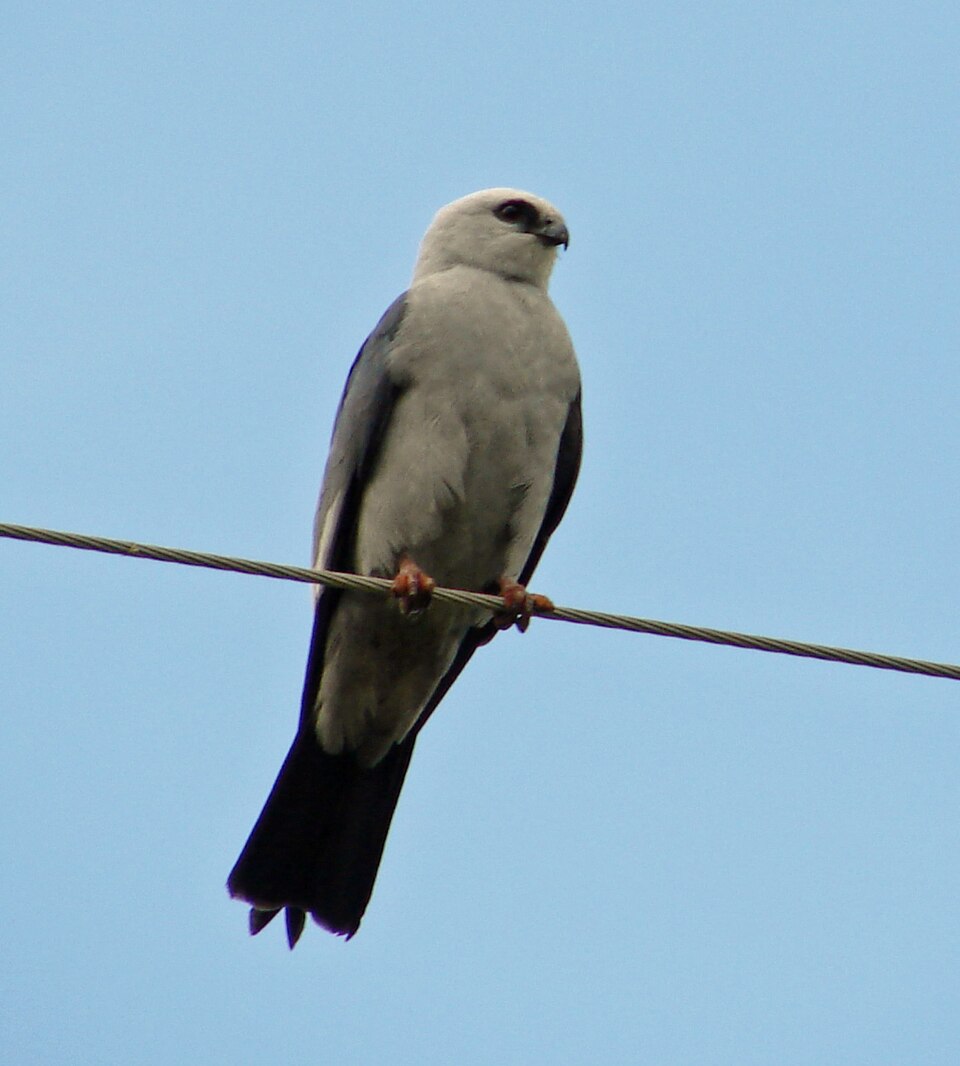
The Mississippi Kite is one of North America's most elegant raptors, a slim gray bird of prey that seems built for the air. On a warm summer afternoon in the South, you might catch one hanging almost motionless against the wind, then peeling off in a long, effortless glide to snatch a dragonfly clean out of the sky. Unlike the heavy, soaring style of buteo hawks, kites fly with a light, falcon-like grace that makes them a joy to watch overhead.
Despite the name, this kite is far from confined to the Mississippi River. It breeds across the southern Great Plains and Southeast, often nesting in surprising numbers in towns, golf courses, and shelterbelts. It is a long-distance migrant, spending the northern winter deep in South America. For many backyard birders, the Mississippi Kite is the rare raptor that hunts insects rather than birds or rodents, which gives it a calm, almost swallow-like presence in the summer sky.
Look for a small, slender raptor with long, pointed, swept-back wings and a fairly long, square-tipped tail. In flight the silhouette suggests a cross between a falcon and a small gull, and the overall impression is of a pale gray bird gliding and circling with very few wingbeats. Perched, it sits upright and trim, often on a bare branch at the top of a tall tree.
| Overall color | Soft pale to medium gray body; adults look almost dove-gray at a distance |
| Head | Pale, often whitish-gray head that contrasts with darker back and wings |
| Eyes | Striking deep red eyes in adults (visible at close range) |
| Wings | Long, narrow, pointed wings; in flight a pale patch shows on the secondaries (trailing edge of inner wing) |
| Tail | Blackish, square-tipped, with no bands in adults; flared and twisted in flight to steer |
| Size | Small for a raptor, roughly the bulk of a Rock Pigeon but slimmer |
Male vs. female
Males and females look essentially alike, and you cannot reliably tell them apart in the field by plumage. Both sexes are gray with a pale head and dark tail. Females tend to average slightly larger and heavier, as is typical for raptors, but the difference is subtle and only useful when a pair is seen side by side. Behavior at the nest is often the better clue: the female does most of the incubating while the male brings food.
Juveniles
Juveniles look quite different from the clean gray adults and confuse many observers. Young birds are heavily streaked brown below with a streaked, mottled head and back, and the tail shows several pale bands rather than being solid black. Their eyes are dark or brownish rather than red. In their first spring they begin molting toward adult gray, so subadults can look patchy and intermediate. A streaky brown raptor with kite-like flight in late summer is almost always a young Mississippi Kite.
The Mississippi Kite is not a songbird, but it is vocal around the nest. The typical call is a thin, high, two-noted whistle often written as phee-phew or ti-tee, with the second note dropping in pitch. It carries a clear, slightly plaintive quality and is easy to overlook against summer cicada noise.
Birds call most in flight and near the nest, especially when defending territory or greeting a mate. Listen for a quick descending whistle from a kite circling overhead; once you learn it, the sound is a reliable way to detect kites you might otherwise miss high in the sky.
Mississippi Kites breed across the southern United States, with two general strongholds: the southern Great Plains (Texas, Oklahoma, Kansas, and surrounding states) and the Southeast from Arizona's riparian zones east through the Gulf states and up the Atlantic coastal plain. The breeding range has been expanding northward and into more urban and suburban areas over recent decades.
This is a true long-distance migrant. Birds arrive in the U.S. in spring (roughly April to May), nest through summer, and then funnel south in large, swirling flocks called kettles in late summer and early fall. They winter in central and southern South America, with much of the population reaching the area around Paraguay, northern Argentina, and southern Brazil. They are essentially absent from the U.S. in winter.
The Mississippi Kite is primarily an insect hunter, which sets it apart from most North American raptors. Its diet is dominated by large flying insects, especially cicadas, dragonflies, grasshoppers, katydids, and beetles. Much of its hunting is done on the wing: the bird catches prey in its talons in mid-air and often eats while still flying, lifting the food to its bill in a smooth motion.
It will also take prey from foliage and the ground, and occasionally captures small vertebrates such as frogs, lizards, small snakes, and the odd small bird or bat. Kites often forage in loose groups where insects are abundant, and they are frequently drawn to areas where mowing, fires, or grazing flush insects into the open.
Pairs build a fairly small, flimsy stick nest high in a tree, often near the top and frequently in the same tree or grove used in past years. In the Great Plains they readily use isolated trees, shelterbelts, and town plantings; in the Southeast they nest in tall pines and bottomland hardwoods. They often nest in loose colonies, with several pairs in the same patch of trees.
The female lays a small clutch, usually one to two eggs (occasionally three), which are dull bluish-white. Both adults incubate, though the female does the larger share, and both feed the young. Mississippi Kites are famously defensive at the nest and will dive at people who pass too close, a behavior that occasionally makes news around golf courses and parks. The single annual brood fledges in mid to late summer, just in time to join the southbound migration.
The Mississippi Kite is not a feeder bird, so you will not lure one with seed, suet, or nectar. It eats flying insects and hunts on the wing, which means the way to "attract" kites is to make your area appealing to them as habitat rather than as a feeding station.
- Provide tall trees for nesting and perching - mature shade trees, pines, or a planted grove are exactly what kites look for in towns and on golf courses.
- Keep the skies insect-rich by avoiding heavy broad-spectrum insecticide use; cicadas, dragonflies, and grasshoppers are the kite's main food.
- Maintain open areas nearby such as fields, lawns, or pastures where the birds can spot and chase flying insects.
- If kites already nest near you in summer, simply give the nest tree space - they are sensitive and may dive-bomb if approached.
- Watch overhead on warm afternoons, especially during late-summer migration, when kettles of kites may drift over even outside their usual breeding spots.
- White-tailed Kite: Also gray and graceful, but has a clean white tail, white underparts, and black shoulder patches, and hovers in place while hunting rodents rather than chasing insects.
- Peregrine Falcon: Similar pointed-wing silhouette but stockier, with a dark helmet and barred underparts, and it flies with powerful wingbeats to chase birds rather than buoyant insect-hawking glides.
- Northern Harrier: Slim raptor with long wings and tail, but flies low over fields with a white rump patch and a dihedral (V-shaped) wing posture, very different from the kite's high circling flight.
- Swallow-tailed Kite: Shares the elegant kite flight but is unmistakable with bold black-and-white plumage and a deeply forked tail.
Are Mississippi Kites dangerous to people or pets?
They are not dangerous in the sense of being predators of people or pets - they eat insects. However, they can be aggressively defensive near their nests in summer and may dive at people walking close by, occasionally striking a hat or head. The behavior is harmless intimidation; giving the nest tree a wide berth solves it.
Why is it called a kite if it isn't from Mississippi?
The name comes from the bird's buoyant, hovering flight, which reminded early observers of a flown kite, and the species was first formally described from a specimen collected near the Mississippi River. Its actual range covers much of the southern U.S., far beyond that one state.
What do Mississippi Kites eat?
Mainly large flying insects - cicadas, dragonflies, grasshoppers, katydids, and beetles - usually caught and eaten in mid-air. They occasionally take small frogs, lizards, snakes, and the rare small bird or bat, but insects make up the bulk of their diet.
Where do Mississippi Kites go in winter?
They are long-distance migrants that leave the U.S. entirely in fall and winter in central and southern South America, reaching as far as Paraguay, northern Argentina, and southern Brazil. They return to the southern states to breed in spring.
How can I tell a Mississippi Kite from a falcon?
Both have pointed, swept-back wings, but the kite is slimmer and paler gray with a whitish head and red eyes, and it flies with light, gliding, almost lazy circles while hunting insects. Falcons are stockier, fly with strong, snappy wingbeats, and chase birds or other prey at high speed.