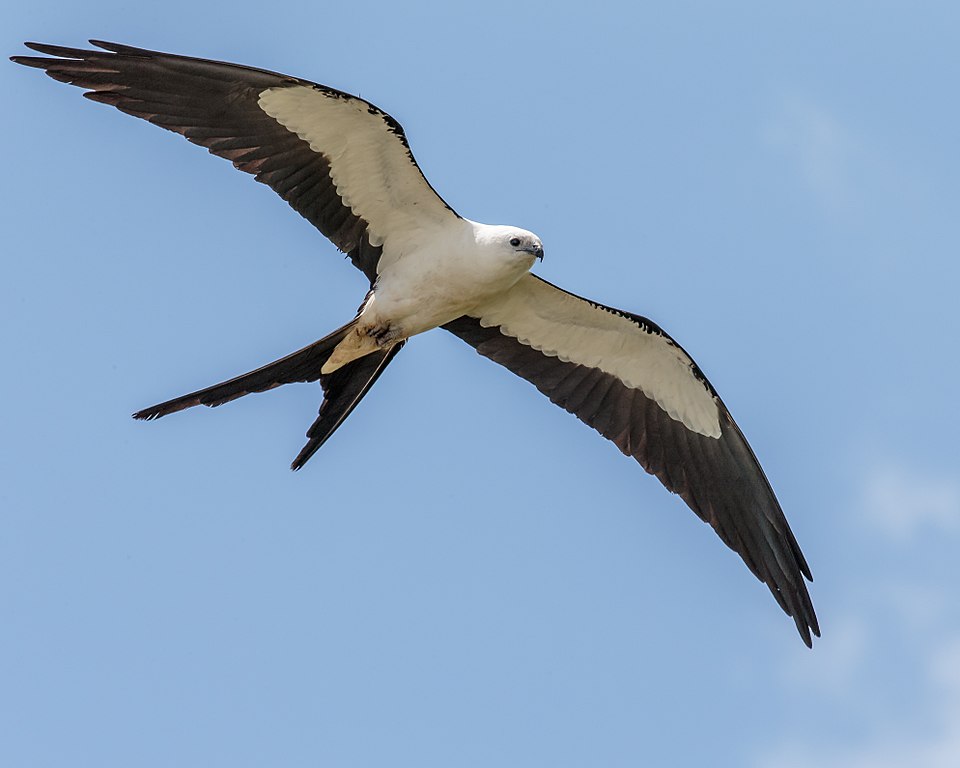
Few birds in North America stop you in your tracks the way a Swallow-tailed Kite does. This large but impossibly buoyant raptor floats over southeastern swamps and pinelands on long, pointed wings, steering with a deeply forked tail that opens and closes like a pair of scissors. The crisp contrast of its snow-white head and underparts against glossy black wings and tail makes it unmistakable, and its effortless, banking flight has earned it a reputation as the most elegant bird of prey on the continent.
Swallow-tailed Kites are long-distance migrants that spend the breeding season in the Deep South of the United States and winter deep in South America. They are birds of wetlands, river floodplains, and tall forest, where they snatch insects and small animals from the canopy without ever landing. Once far more widespread across the eastern U.S., they retreated to the Gulf and South Atlantic coastal states after habitat loss, but populations there remain healthy and the sight of one wheeling overhead is a highlight of any southern spring or summer.
This is one of the easiest large birds to identify once you see the shape: a slim, long-winged raptor with a tail forked far more deeply than any other North American bird of prey. In flight the body looks small relative to the enormous wingspan, and the whole bird seems weightless, tilting and gliding with barely a wingbeat.
| Tail | Extremely long and deeply forked, opening and twisting in flight like scissors - the single best field mark |
| Plumage | Brilliant white head, neck, and underparts contrasting with black back, wings, and tail |
| Wings | Long, slender, and pointed; white underwing coverts with black flight feathers create a sharp two-toned look from below |
| Flight | Buoyant and graceful, with long glides and effortless banking; rarely seen flapping hard |
| Size | Large wingspan over four feet but a light, slim body that makes it look smaller than it is |
| Bill and feet | Small dark hooked bill and short legs - this is an aerial hunter, not a perch-and-pounce raptor |
Male vs. female
Males and females look alike. There is no reliable plumage difference between the sexes in the field, and both show the same striking black-and-white pattern and forked tail. Females average slightly larger and heavier than males, but the difference is too small to judge on a lone soaring bird. For practical purposes, treat any Swallow-tailed Kite you see as unsexable in the field.
Juveniles
Juveniles look much like adults and share the bold black-and-white pattern and forked tail, so a young bird is still easy to name. The differences are subtle: fresh juveniles have a shorter tail fork than adults, faint pale streaking on the head and breast, and narrow whitish tips to the flight and tail feathers that wear away over time. By their first migration they are flying and hunting capably, and within a year they are essentially indistinguishable from adults at a distance.
Swallow-tailed Kites are not especially vocal, and you will often watch one soar in complete silence. When they do call, it is a high, thin, whistled klee-klee-klee or kee-kee-kee, sometimes rendered as a wheezy peet or tii-tii-tii. The notes are clear and slightly squeaky rather than harsh.
Calling picks up around the nest and during interactions between birds, especially when a mate or rival is nearby or when adults are attending young. Outside of the breeding season and away from the nest, they are usually quiet, so birders far more often locate this species by its unmistakable silhouette than by sound.
In the United States, breeding Swallow-tailed Kites are concentrated in Florida and along the Gulf and South Atlantic coastal plains, reaching into Georgia, South Carolina, Alabama, Mississippi, Louisiana, and east Texas. Florida holds the largest share of the U.S. population. They favor low, wet country - cypress swamps, river bottomlands, pine flatwoods, and the edges of marshes and forests where there is tall timber for nesting and open air for hunting.
This is a true long-distance migrant. Birds arrive in the Southeast in late winter and early spring, breed through the summer, then gather in large pre-migration roosts before heading to South America for the winter, with many reaching as far as Brazil, Paraguay, and beyond. They are gone from North America for much of the year, so the window to see one in the U.S. runs roughly from March into August. Outside the breeding range, occasional wanderers turn up well north of the usual area, particularly in spring.
Swallow-tailed Kites are aerial specialists that do most of their hunting on the wing. In the air they catch flying insects - dragonflies, beetles, wasps, cicadas, and the like - often eating them in flight without ever stopping. They also glide low over the treetops and pluck prey directly from the outer foliage, snatching tree frogs, lizards, snakes, nestling birds, and large insects from leaves and branches without landing.
Much of their food is eaten in flight, held in one foot and brought to the bill as they glide. They drink and bathe on the wing too, skimming low over a pond or river to scoop water or wet their bellies. This entirely aerial lifestyle is part of why the species is so mesmerizing to watch: a hunting kite may circle, dip, twist, and feed for long stretches without ever touching down.
Swallow-tailed Kites nest high in the tallest available trees, often pines or cypress, placing a relatively small, flimsy stick nest near the very top of the canopy. They line it with Spanish moss, lichens, and fine plant material. In many areas they nest in loose association with others, and several pairs may breed in the same general stretch of forest.
The female typically lays two eggs, occasionally one or three, and both parents are involved in raising the young, with incubation lasting roughly four weeks. Pairs raise a single brood per season. Chicks remain in the nest for several weeks before fledging, and after leaving they continue to depend on the adults while they master the aerial hunting that defines the species. Soon after the young are independent, families and other kites gather into communal roosts ahead of the long flight south.
The honest answer is that this is not a backyard or feeder bird, and there is no feeder, birdhouse, or seed that will bring one in. Swallow-tailed Kites catch live prey entirely on the wing and need large blocks of wet southern forest, so attracting one to a typical yard isn't realistic. What you can do is put yourself in the right place at the right time and support the habitat they depend on.
- Look during the breeding season, roughly March through August, since these birds are in South America the rest of the year
- Focus on the right habitat: cypress swamps, river floodplains, pine flatwoods, and forest edges in Florida and the Gulf and South Atlantic states
- Scan the sky on warm afternoons when kites ride thermals and hunt flying insects over the treetops
- If you have tall pines or large trees near wetlands on your property, leaving them standing helps provide nesting habitat
- Visit known hotspots and wildlife refuges in the Southeast where pre-migration roosts can concentrate dozens or more birds in late summer
- Support land conservation in southern bottomland forests - protecting habitat does far more for this species than anything at a feeder
- Mississippi Kite: Similar buoyant aerial-insect hunter in the South but overall gray, smaller, with a squared (not forked) tail and no bold black-and-white contrast
- White-tailed Kite: Also white-bodied with black wing markings, but has a square white tail, hovers over fields, and lacks the long forked tail
- Magnificent Frigatebird: A coastal seabird with a deeply forked tail and long wings, but much larger, all-dark, and seen over the ocean rather than over forest
- Northern Harrier: Another low-flying raptor, but brown or gray with a white rump patch, longer body, and a long unforked tail; quarters over marshes rather than soaring buoyantly
Where can I see a Swallow-tailed Kite in the United States?
They breed in the southeastern U.S., mainly Florida and the Gulf and South Atlantic coastal plains, including Georgia, South Carolina, Louisiana, and east Texas. Look in cypress swamps, river floodplains, and pine flatwoods. They are present in the U.S. only during the breeding season, roughly March through August, and spend the rest of the year in South America.
How do I tell a Swallow-tailed Kite from a Mississippi Kite?
The tail is the giveaway. A Swallow-tailed Kite has a long, deeply forked tail and bold black-and-white plumage with a white head and body. A Mississippi Kite is overall gray with a squared, unforked tail and no white-and-black contrast. The two often share the same southern skies in summer, but the forked tail and crisp pattern make the Swallow-tailed unmistakable.
What does a Swallow-tailed Kite eat?
Mostly flying insects like dragonflies and beetles, plus tree frogs, lizards, snakes, and nestling birds plucked from the treetops. It catches and often eats prey entirely in flight and rarely lands while hunting. It even drinks and bathes on the wing by skimming low over water.
Are Swallow-tailed Kites rare or endangered?
They are listed as Least Concern globally and remain locally common in their core southeastern range, so they are not endangered. However, they disappeared from much of their former range in the eastern U.S. due to habitat loss, and they depend on large blocks of wet forest, so habitat protection matters for keeping populations healthy.
Why does a Swallow-tailed Kite have a forked tail?
The deeply forked tail acts like a precise rudder, letting the bird twist, bank, and steer with remarkable agility as it hunts insects and snatches prey from the canopy in flight. Combined with long, slender wings, the forked tail gives the kite its famously buoyant, effortless flight.