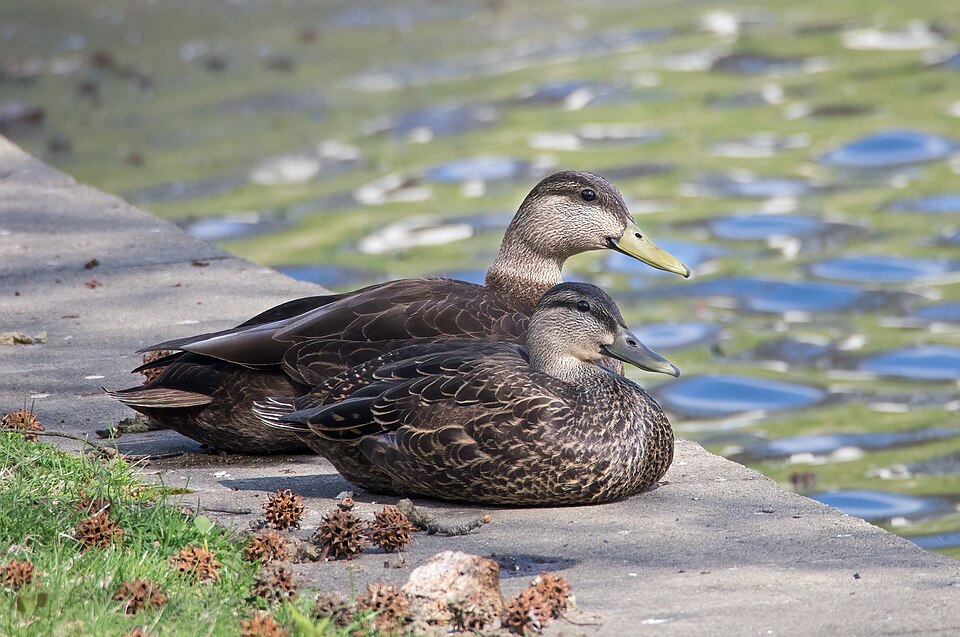
The American Black Duck is the dark, smoky cousin of the Mallard, a heavy-bodied dabbling duck of eastern North America that looks at first glance like a Mallard hen who never got the memo about color. Despite the name, it isn't truly black but a deep sooty chocolate-brown, with a contrasting pale grayish head and neck that make the body look even darker by comparison. In flight, the flash of brilliant white underwings against that dark plumage is one of the most reliable and beautiful field marks you'll find on any duck.
This is a bird of wild, watery places: tidal salt marshes, brackish estuaries, beaver ponds, flooded timber, and quiet freshwater wetlands. Once the most abundant dabbling duck in the East, the Black Duck has declined over the past century, squeezed by habitat loss and by widespread hybridization with the expanding Mallard. It remains a prized sighting for birders and a classic quarry for waterfowlers, and learning to pick it out from look-alike female Mallards is a satisfying rite of passage in duck identification.
Look for a large, bulky dabbling duck the size and shape of a Mallard, with a notably dark body that contrasts sharply with a paler head. The overall impression is of a uniformly dark duck with a "lighter cap" on top, swimming low and heavy in the water.
| Body color | Deep sooty brown to dusky black-brown overall, much darker than any female Mallard |
| Head & neck | Distinctly paler grayish-tan, finely streaked, contrasting strongly with the dark body |
| Underwing | Bright flashing white wing linings, very visible in flight against the dark body |
| Speculum | Iridescent violet-blue patch on the wing, bordered black with little or no white edging |
| Bill | Olive-yellow to dull green in males; duller olive, often flecked with dark, in females |
| Legs & feet | Reddish-orange to coral, brightest in adult males |
Male vs. female
The sexes look very similar and far less distinct than in most ducks, since neither has the bright drake plumage of a male Mallard. The best clue is the bill: adult males (drakes) show a clean, bright olive-yellow to greenish-yellow bill, while females have a duller, darker olive bill that is usually mottled or flecked with black or dusky markings. Males also tend to run slightly darker overall with a slightly grayer, more contrasting head, and their leg color is a brighter coral-red. These differences are subtle, so the bill is your most dependable tell in the field.
Juveniles
Juveniles closely resemble adult females but look even plainer and more uniformly dusky, with slightly buffier feather edges that give a faintly scaled appearance early on. Young birds have duller, more olive-gray bills and somewhat paler, more yellowish legs than adults. By their first fall they are difficult to separate from adult females in the field, and they reach full adult-like plumage within their first year.
The American Black Duck is essentially a Mallard in voice. The female gives a loud, descending series of quacks, a classic "quack-quack-quack-quack" that drops in volume and falls in a hearty cackling laugh, used in flight and to gather young. Listen for this carrying call ringing across a marsh at dawn.
The male is much quieter and never gives the loud quack. Instead he produces a low, reedy, single-noted "raeb" or soft burping "kreep," easily missed unless you're close. Both sexes are most vocal during courtship in late winter and on the breeding grounds.
The American Black Duck is a bird of eastern North America. It breeds across eastern Canada and the northeastern United States, from the Atlantic provinces and Quebec west to the Great Lakes and south through New England and the Appalachians. In winter it shifts and concentrates along the Atlantic Coast from the Maritimes south to the Carolinas and the Gulf states, with the mid-Atlantic salt marshes and Chesapeake Bay region holding especially large numbers.
It is a short- to medium-distance migrant, moving south only as far as open water and ice conditions force it. Coastal birds in particular are hardy and will linger through cold months wherever tidal marshes and estuaries stay ice-free. West of the Great Plains the species is genuinely rare, so a "Black Duck" reported out West deserves a careful second look.
Like other dabbling ducks, the Black Duck feeds at or near the surface, tipping up tail-in-the-air to reach submerged plants and invertebrates rather than diving. Its diet shifts with the seasons and habitat: in freshwater wetlands it eats seeds, the leaves and tubers of aquatic plants, pondweeds, sedges, and waste grain in nearby fields, while breeding birds and ducklings take large quantities of aquatic insects, snails, and other invertebrates for protein.
On the coast in winter, it becomes much more of a marsh forager, feeding heavily on the seeds and shoots of saltmarsh grasses along with mussels, small clams, snails, and amphipods exposed at low tide. Black Ducks often feed most actively around dawn and dusk and at night, especially where they are hunted, resting in flocks on open water during the day.
Black Ducks nest on the ground, usually well hidden in dense vegetation, marsh grass, brush, or under a shrub, and sometimes surprisingly far from water in woodlands. The female builds the nest as a shallow bowl of grasses and leaves, lining it generously with down plucked from her own breast. Pairs form on the wintering grounds and during migration, and the species nests as solitary, dispersed pairs rather than in colonies.
The female lays a clutch of roughly 9 to 11 creamy to greenish-buff eggs and incubates them alone for about 26 to 28 days. The drake departs once incubation is underway. The ducklings are precocial, leaving the nest within a day of hatching and following the hen to water, where she tends them until they fledge at around 6 to 9 weeks. There is normally a single brood per year, though a female may re-nest if an early clutch is lost.
The American Black Duck is a wild wetland duck, not a backyard feeder bird, so you won't draw it to a seed feeder. That said, if you live near suitable water there are real ways to encourage it, and habitat-friendly choices matter for a species in long-term decline.
- If you have a pond, marsh edge, or beaver wetland on your property, protect natural shoreline vegetation rather than mowing to the water's edge, which provides feeding and nesting cover.
- Avoid feeding ducks bread or processed scraps at local ponds; it harms their health and encourages hybridization-prone, semi-tame flocks. Let wild birds forage naturally.
- Support or visit wetland and salt-marsh conservation, the single biggest factor in keeping Black Ducks around, since habitat loss drives their decline.
- In rural wetland settings, leaving shallow flooded areas and unharvested grain edges can attract dabblers in fall and winter.
- Bring binoculars or a spotting scope to coastal marshes and estuaries in winter, where Black Ducks gather; early morning and late afternoon offer the best viewing.
- Mallard: Female Mallards are paler, warmer brown with a clean orange-and-black bill, a buffy (not dark) body, and a white-bordered blue speculum; Black Ducks are far darker with little or no white in the wing patch.
- Mottled Duck: A southern coastal look-alike; slightly paler and warmer brown with an unmarked yellow bill and a buffy throat, and its range (Gulf Coast, Florida) barely overlaps the Black Duck's.
- Gadwall: Grayer and more delicately patterned, with a distinctive white speculum patch and a steeper forehead; lacks the dark body and pale head contrast of a Black Duck.
- Northern Pintail: Females are slimmer and longer-necked with a gray bill and a more pointed tail; warmer, more scalloped brown plumage and no dark-body-pale-head contrast.
Are American Black Ducks actually black?
No. They appear very dark from a distance, but up close the body is a deep sooty chocolate-brown, not true black. The contrast between the dark body and the noticeably paler grayish head is what makes them look so dark in the field.
How do I tell an American Black Duck from a female Mallard?
Look at the body and bill. A Black Duck is much darker, with a body nearly as dark as the wings and a contrasting pale head; a female Mallard is a warmer, lighter brown overall. A Mallard's speculum is blue with bold white borders, while the Black Duck's violet-blue speculum has little or no white. The Black Duck also flashes bright white underwings in flight.
Why are American Black Duck numbers declining?
Two main reasons: loss of wetland and salt-marsh habitat, and widespread hybridization with Mallards, which have expanded eastward into Black Duck range. Crossbreeding and competition with the more adaptable Mallard have steadily eroded pure Black Duck populations, especially in the western and southern parts of their range.
Where is the best place to see an American Black Duck?
Eastern coastal salt marshes and estuaries in winter are prime, especially the mid-Atlantic and Chesapeake Bay region, along with the New England coast. In summer, look in beaver ponds, freshwater marshes, and flooded woodlands across the northeastern U.S. and eastern Canada. Dawn and dusk are the best times.
Do American Black Ducks and Mallards interbreed?
Yes, frequently, which is a major conservation concern. The two are closely related and produce fertile hybrids, so you'll often see intermediate-looking birds, especially ones with a touch of green on the head or extra white in the speculum. These hybrids can make field identification tricky and dilute the pure Black Duck gene pool.