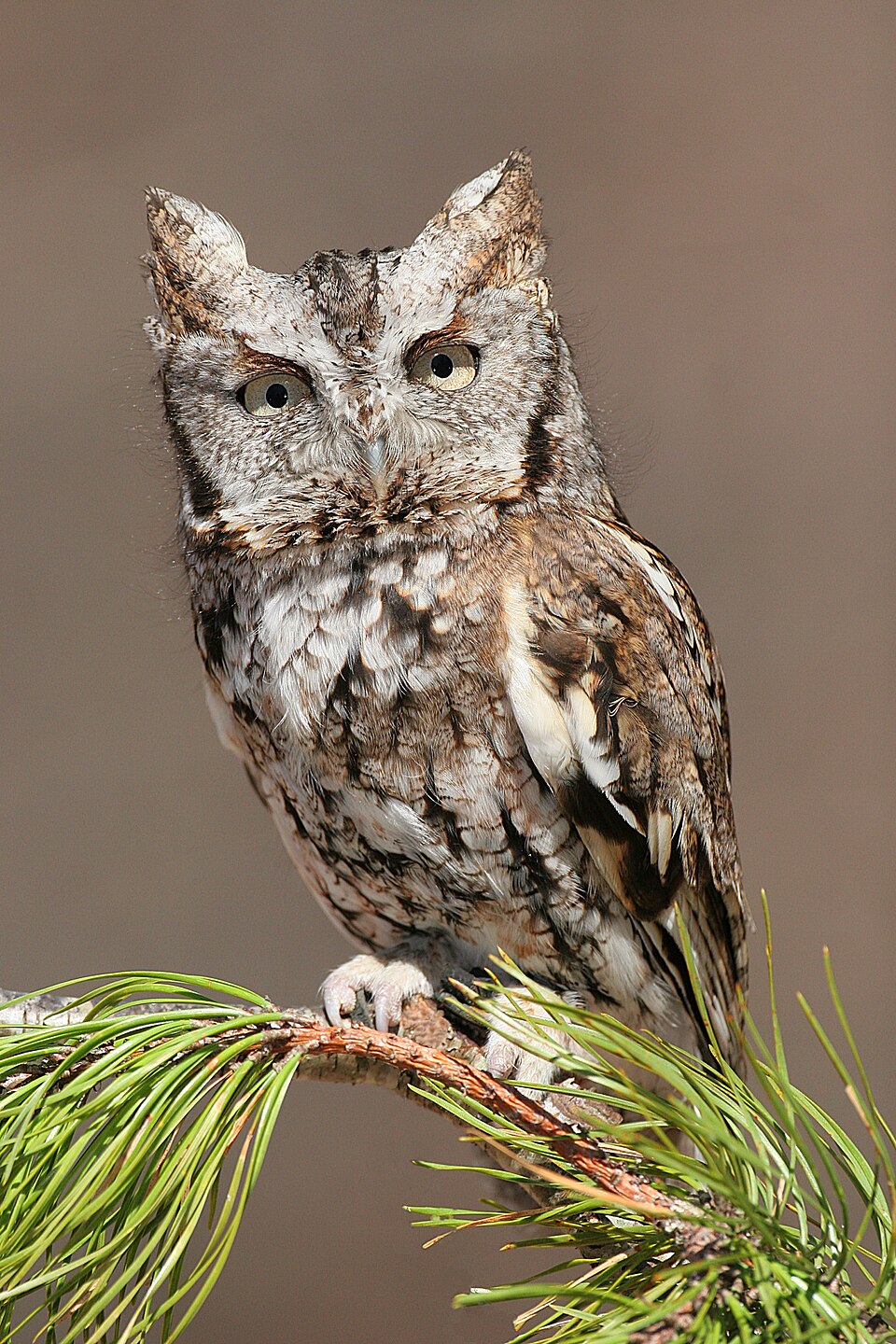
The Eastern Screech-Owl is one of the most widespread owls in eastern North America, yet most people who share their neighborhood with one never know it. Barely taller than a soda can, this stocky little owl with prominent ear tufts spends its days roosting motionless in tree cavities or pressed against a trunk, its bark-patterned plumage making it nearly invisible. It comes alive at dusk, hunting from low perches in woodlots, parks, orchards, and leafy suburban yards.
What makes this species especially fascinating is that it comes in two distinct color forms, or morphs: a rusty red morph and a gray morph (plus rare intermediate brown birds). Both can hatch in the same nest. Despite its name, the Eastern Screech-Owl does not actually screech. Its voice is a soft, descending whinny and a steady, even-pitched trill, far more haunting than harsh. For backyard birders, it is one of the few owls genuinely likely to move into a nest box, making it a beloved and attainable species to host.
This is a small, compact owl with a large rounded head, conspicuous ear tufts that can be raised or flattened, and a short, stubby tail. When alarmed it stretches tall and thin against a trunk; when relaxed it looks round and squat. Size and shape are usually the first clues, followed by the intricately streaked, bark-like plumage.
| Size | Tiny and stocky, robin-sized but heavier-bodied, about 6-10 inches tall |
| Ear tufts | Pointed feather tufts on the head, raised when alert, lowered when calm (not actual ears) |
| Color morphs | Rufous-red or cool gray overall; both have the same dark streaking pattern |
| Eyes & bill | Bright yellow eyes and a pale yellowish-green bill |
| Underparts | Pale below with vertical dark streaks crossed by finer bars, mimicking tree bark |
| Facial disk | Subtle pale facial disk bordered by a darker edge, with a pale 'eyebrow' line |
Male vs. female
Males and females look essentially identical in plumage, so you cannot reliably tell them apart by sight in the field. Females are noticeably larger and heavier, as is typical for owls, but this is only apparent when a pair is seen side by side. Voice offers a better clue: the male's call is lower-pitched than the female's, and during courtship and nesting the pair often duets, with the slightly higher-voiced female answering the male.
Juveniles
Recently fledged young are covered in soft grayish down marked with fine horizontal barring rather than the crisp vertical streaks of adults, and their ear tufts are barely developed, giving them a rounder, fuzzier-headed look. Juveniles already show the yellow eyes and will eventually settle into either the red or gray morph as they molt into adult feathering. Begging fledglings give rough, raspy notes and are often found perched in the open near the nest tree in early summer while the adults continue to feed them.
The Eastern Screech-Owl has two signature vocalizations, neither of which is a screech. The first is the descending whinny, a wavering, horse-like series of notes that drops in pitch toward the end, often used to defend territory. The second is the trill (sometimes called the bounce song or tremolo), a steady, even-pitched purring trill that lasts several seconds and is used between mates and family members. Birders often render the trill as a soft, monotone brrrrrrrr and the whinny as a mournful, falling hu-hu-hu-hu-huhuhu.
Both sexes call year-round, with peak activity in late winter and early spring as pairs establish territories. The voice carries a surprisingly long way on still nights. Imitating the trill, or playing it sparingly, will sometimes draw a curious bird in close, though responsible birders keep playback to a minimum.
The Eastern Screech-Owl is a year-round resident across most of eastern North America, from southern Canada and the Great Plains east to the Atlantic coast and south into Florida, Texas, and northeastern Mexico. It does not migrate, holding the same territory through all seasons. Its range stops roughly at the Rocky Mountains, where it is replaced by the very similar Western Screech-Owl.
It thrives in a wide variety of wooded habitats: deciduous and mixed forests, riverside groves, orchards, city parks, cemeteries, and tree-lined suburban neighborhoods. As long as there are mature trees with cavities for roosting and nesting, it adapts readily to human-altered landscapes, often living unnoticed in busy towns.
This little owl is a versatile, opportunistic hunter with a remarkably broad diet for its size. It takes large insects such as moths, beetles, crickets, and katydids, along with earthworms, crayfish, and other invertebrates. It also captures small mammals like mice, voles, and shrews, plus small birds, songbird nestlings, frogs, lizards, and small snakes. Near water it will even snatch minnows and tadpoles.
Eastern Screech-Owls hunt mostly from a perch, dropping silently onto prey detected by sight and their exceptional hearing. They are most active in the first hours after dusk and again before dawn. Like other owls, they cough up indigestible bones, fur, and insect parts as compact pellets, which can pile up beneath a favored roost or nest hole and are a good clue that an owl is present.
Eastern Screech-Owls are cavity nesters. They use natural tree hollows, old woodpecker holes (especially those of flickers and Pileated Woodpeckers), and readily accept nest boxes. They do not build a nest or add material, laying their eggs directly on the debris at the bottom of the cavity. Pairs are largely monogamous and often reuse the same nesting site year after year.
The female lays a clutch of roughly 2 to 6 white eggs in early spring and does nearly all the incubating, sitting tight for about 26 to 30 days while the male brings her food. The owlets hatch helpless and remain in the cavity for about four weeks before fledging, after which the parents continue to feed and guard them for several more weeks. A famously cooperative quirk: screech-owls sometimes bring live blind snakes into the nest, where the snakes eat insect larvae and help keep the brood cleaner.
Yes! The Eastern Screech-Owl is one of the most realistic owls to attract to a backyard, because it nests in cavities and takes well to nest boxes. You will not lure it with feeders, but a thoughtfully placed box and a bird-friendly yard can genuinely tempt a pair to move in, especially if you have mature trees nearby.
- Put up a screech-owl nest box with an interior floor around 8x8 inches and a 3-inch entrance hole, mounted 10-30 feet high on a tree trunk; line the bottom with a few inches of wood shavings.
- Install the box in late fall or winter so owls can find it and use it as a winter roost before the spring nesting season.
- Keep some mature trees and snags standing where safe, since dead and dying trees provide natural cavities and hunting perches.
- Reduce or eliminate rodenticides in your yard, which can poison owls that eat affected mice and vols and rob them of prey.
- Leave outdoor lights off at night and maintain leafy, brushy areas that support the insects and small mammals owls hunt.
- Provide a quiet water source such as a ground-level birdbath, which owls will visit to drink and bathe.
- Western Screech-Owl: Nearly identical in shape but ranges west of the Rockies; best separated by voice, giving an accelerating series of hoots (a 'bouncing ball' rhythm) rather than the eastern whinny and trill.
- Whiskered Screech-Owl: A southwestern mountain species, slightly smaller with a different call and finer bill; range barely overlaps with the Eastern in Texas.
- Northern Saw-whet Owl: Similar tiny size but lacks ear tufts entirely, has an oversized round head and a rusty-streaked white breast, and gives a monotonous tooting whistle.
- Great Horned Owl: Also has ear tufts but is enormously larger, with deep hooting; a screech-owl is only a fraction of its size.
Do Eastern Screech-Owls actually screech?
No, despite the name they rarely make a harsh screeching sound. Their two main calls are a soft, descending whinny and a steady, even-pitched trill, both more eerie and musical than harsh. The 'screech' name is something of a misnomer.
Why are some screech-owls red and others gray?
Eastern Screech-Owls come in two color morphs, rufous-red and gray, plus rare intermediate brown birds. The morph is genetic, and red and gray siblings can come from the same nest. Red morphs are more common in the humid Southeast, while gray morphs dominate in colder, drier northern and western parts of the range.
Will an Eastern Screech-Owl use a nest box?
Yes. They are among the easiest owls to attract because they readily accept nest boxes. Use a box with roughly an 8x8-inch floor and a 3-inch entrance hole, add a few inches of wood shavings, and mount it 10 to 30 feet up on a tree, ideally installed in fall or winter so owls can find it before nesting season.
Are Eastern Screech-Owls dangerous to pets or people?
No. They are far too small to threaten cats, dogs, or people. They mostly eat insects, small rodents, worms, and small birds. They may defend a nest if you get very close, but they pose no real danger and are beneficial neighbors that help control rodents and insects.
When are Eastern Screech-Owls most active and how do I find one?
They are nocturnal, most active in the first hours after dusk and again before dawn. The best way to find one is to listen for the whinny or trill on calm nights from late winter through spring. During the day, scan tree cavities and nest box entrances, where an owl may sun itself at the opening.