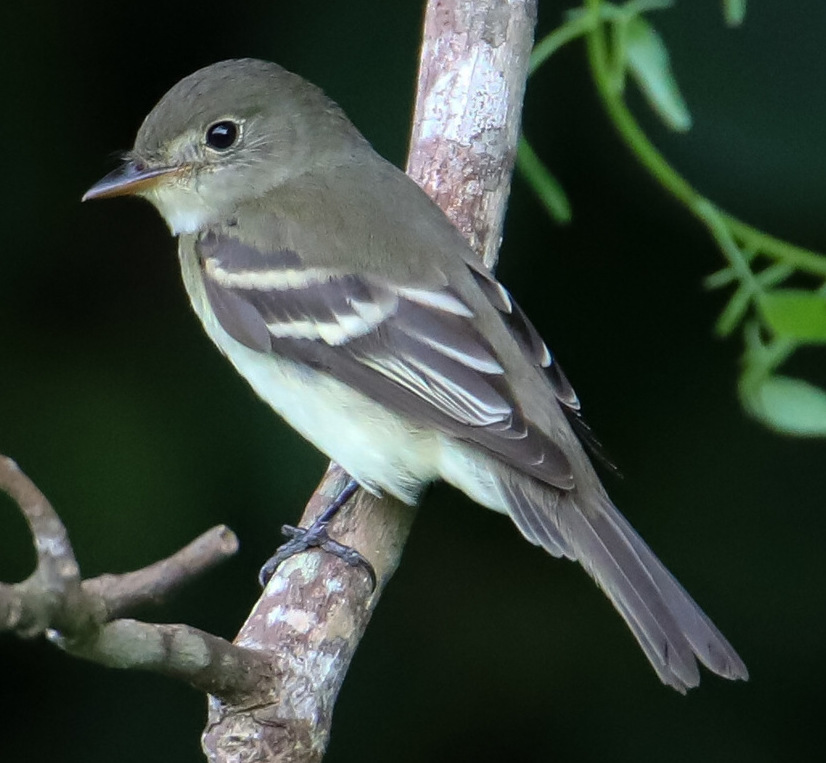
The Acadian Flycatcher is a small, olive-green songbird of the eastern deciduous forest, and it belongs to one of the most notorious groups in all of North American birding: the genus Empidonax. These look-alike flycatchers are so similar in plumage that even seasoned birders often refuse to name them by sight alone, leaning instead on voice and habitat. The Acadian is the Empidonax of the deep woods, specifically the shady, humid interior of mature hardwood forests, ravines, and the wooded edges of swamps and streams.
Despite the name, this bird has nothing to do with Acadia in the Canadian Maritimes; the name is a historical accident, as the species barely reaches the northeastern states and breeds mostly across the Southeast and lower Midwest. What it does have is one of the most distinctive voices in the eastern forest, an abrupt, explosive call that, once learned, instantly separates it from its cryptic cousins. For birders willing to look up into the green gloom of a summer woodland, the Acadian Flycatcher is a rewarding reminder that intact, mature forest still holds quiet specialists.
This is a compact, large-headed flycatcher with a fairly long primary projection (the wingtips extend well down the tail), an upright posture, and the typical flycatcher habit of perching quietly and sallying out after insects. Among the eastern Empidonax, it is the greenest above and tends to look long-winged and clean-faced.
| Upperparts | Olive-green back and crown, the greenest of the eastern Empidonax flycatchers |
| Eyering | Bold, complete whitish to pale yellow eyering, fairly thin and even |
| Wingbars | Two crisp whitish to buffy wingbars on dark wings |
| Underparts | Whitish throat and breast washed pale yellow, with a faint olive vest across the chest and yellowish belly |
| Bill | Broad-based and fairly long, with a bright orange-yellow lower mandible |
| Wings | Long primary projection, giving a long-winged, attenuated look compared to other Empidonax |
Male vs. female
Males and females look alike. There is no visible difference in plumage, size, or color between the sexes in the field, both show the same olive-green upperparts, pale eyering, and yellow-washed underparts. Behavior offers the best clue during breeding season: the male is the one delivering the loud, explosive song from a high perch, while the female does the building and incubating at the nest. To confirm sex, researchers rely on in-hand measurements, a brood patch, or behavior, not appearance.
Juveniles
Freshly fledged juveniles resemble adults but look softer and warmer, with buffy rather than crisp white wingbars and a slightly more washed-out, fluffy appearance. In late summer and fall, fresh-plumaged immatures (and adults) can show stronger yellow tones below and buffier wing markings than worn breeding birds. As with most Empidonax, young birds are best identified by the company they keep and by habitat rather than by any single field mark.
Voice is the single most reliable way to identify this species. The male's song is an emphatic, almost violent "PEET-sah!" or "pee-DZEET," sometimes rendered as "PIZZA!", a sharp, upslurred explosion that seems too loud for such a small bird and carries surprisingly far through the forest. It is often delivered persistently through the heat of a summer day, when many other birds have gone quiet.
The common call note is a soft, liquid "peet" or "wheet," and an excited bird may give a fast, sputtering series of "ti-ti-ti-ti" notes, especially near the nest or during disputes. The contrast between the abrupt, hiccup-like song and the calmer voices of similar flycatchers like the Least Flycatcher (a dry "che-bek") is the key to telling them apart by ear.
The Acadian Flycatcher breeds across the eastern United States, with its stronghold in the Southeast and lower Midwest, from the Gulf states north through the Appalachians, the Ohio and Mississippi valleys, and into the southern Great Lakes and Mid-Atlantic. It thins out toward the northern edge of its range and is largely absent from New England despite the misleading name. Within this range it is closely tied to mature, shady deciduous and bottomland forest.
It is a long-distance Neotropical migrant. Birds arrive on the breeding grounds in spring (roughly late April into May) and depart by late summer or early fall, wintering in Central America and northwestern South America, where they favor humid lowland forest. Migration is largely nocturnal, and like many forest songbirds, Acadians can turn up at stopover sites away from typical breeding habitat during passage.
The Acadian Flycatcher is an insectivore that hunts mostly in the shaded mid-story and understory of the forest. It perches upright and still, then darts out to snatch flying insects from the air (hawking) or plucks prey directly from leaves and twigs while hovering briefly (gleaning). Caterpillars, flies, beetles, moths, bees, wasps, ants, and spiders all feature in its diet, and it will also take small berries at times, especially outside the breeding season.
Its foraging style is patient and methodical rather than frantic, long pauses on a favored perch, punctuated by quick, agile sallies. This reliance on flying and foliage insects in the forest interior is one reason the species is sensitive to habitat quality and forest fragmentation.
The female builds a distinctive, loosely woven shallow cup suspended in a horizontal fork of a branch, often well out from the trunk and frequently over a stream, trail, or other forest opening. The nest typically looks flimsy and untidy, with grasses, plant fibers, and spider silk, and trailing streamers of material dangling beneath it, a useful field clue when you find one. It is usually placed at low to moderate height in the understory or mid-story.
A typical clutch is three eggs (sometimes two to four), creamy to buff and lightly spotted. The female does the incubating, and both parents feed the young. Acadian Flycatchers are frequent hosts of the Brown-headed Cowbird, which can reduce their nesting success, particularly in fragmented forests with more edge habitat.
This is not a backyard or feeder bird, and no amount of seed or suet will bring one in. It eats live insects and is a specialist of mature forest interior, so the way to "attract" it is really about habitat rather than feeders.
- Protect mature forest: Acadians need large blocks of shady, mostly unbroken deciduous or bottomland woodland, preserving intact forest is the single biggest thing you can do for them.
- Value ravines and streamside woods: They favor humid, shaded ravines and forest along creeks, so keeping wooded buffers along waterways helps.
- Skip the pesticides: A healthy population of flying and foliage insects is their entire food supply; avoiding broad insecticide use supports them and many other forest birds.
- Learn the song instead of luring: Since they won't come to feeders, the best way to enjoy them is to learn the explosive "PEET-sah" and find them on a summer walk through mature woods.
- Support forest conservation: Because they are area-sensitive and cowbird-prone in fragmented woods, backing local land trusts and forest protection efforts does more than anything in a single yard.
- Least Flycatcher: Smaller, grayer, and rounder-headed with shorter wings; bold eyering; gives a dry, snappy 'che-BEK' rather than the Acadian's explosive 'PEET-sah,' and favors more open woods and edges.
- Willow Flycatcher: Browner and drabber with a fainter eyering; prefers shrubby wet thickets rather than forest interior; sneezy 'fitz-bew' song is very different.
- Yellow-bellied Flycatcher: More uniformly yellow below and on the throat with a yellowish eyering; breeds in northern bogs and conifer forest; soft 'che-lek' call differs from the Acadian's sharp song.
- Eastern Wood-Pewee: Larger and grayer with little or no eyering and longer wings; plaintive, slurred 'pee-a-wee' whistle is nothing like the Acadian's abrupt note.
Why is it called the Acadian Flycatcher if it doesn't live in Acadia?
The name is a historical mistake. Early naming associated the bird with Acadia in eastern Canada, but it actually breeds across the southeastern and midwestern United States and is largely absent from the Northeast. The name simply stuck.
What does the Acadian Flycatcher's song sound like?
It gives an explosive, upslurred 'PEET-sah' or 'pee-DZEET', often described as sounding like a sharp 'PIZZA!', that's far louder than you'd expect from such a small bird. This abrupt note is the most reliable way to identify it.
How do I tell an Acadian Flycatcher from other Empidonax flycatchers?
By voice and habitat first. It's the greenest eastern Empidonax with a bold eyering and long wings, but the explosive 'PEET-sah' song and a preference for shady, mature forest interior near streams and ravines are the clinchers. Plumage alone is unreliable in this group.
Will Acadian Flycatchers come to my bird feeder?
No. They eat live insects caught in the air or gleaned from leaves and won't visit seed or suet feeders. To see one, look and listen in mature deciduous forest during spring and summer rather than waiting at a feeder.
Where do Acadian Flycatchers go in winter?
They are long-distance migrants that leave the U.S. by early fall and winter in the humid lowland forests of Central America and northwestern South America, returning to breed the following spring.
What kind of habitat does the Acadian Flycatcher need?
It depends on large blocks of mature, shady deciduous or bottomland forest, especially humid ravines and wooded streamsides. It's sensitive to forest fragmentation and is a frequent cowbird host in broken-up woods, so intact forest is important for its success.