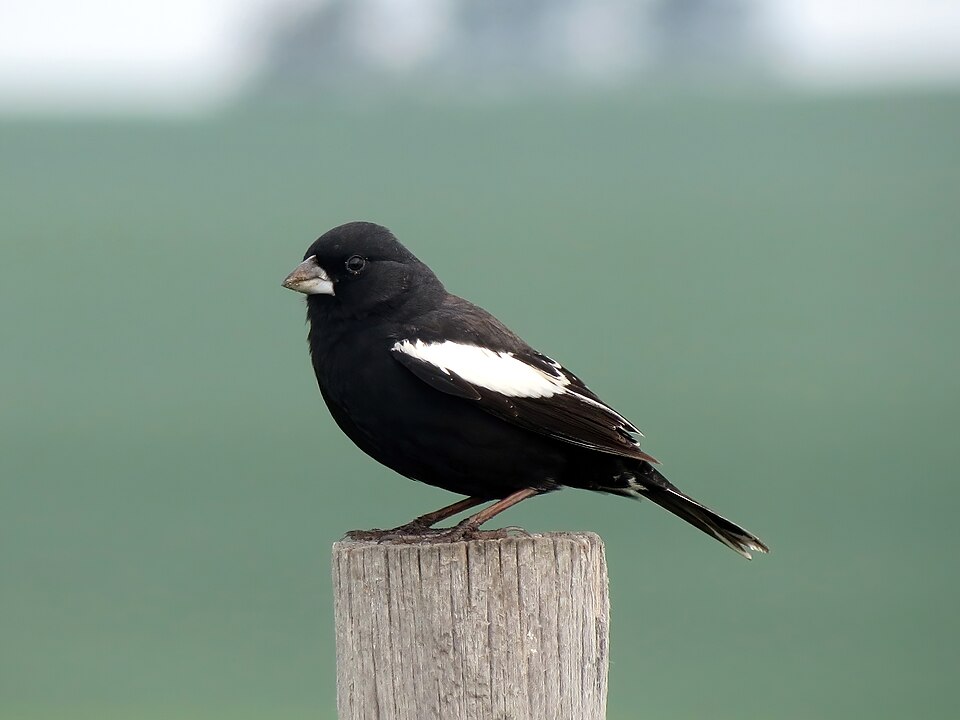
The Lark Bunting is one of the great spectacles of the Great Plains. For most of the year it is a drab, streaky brown sparrow, easy to overlook. But come late spring, the breeding male transforms into something unmistakable: a chunky, coal-black bird with a single bold patch of white on each wing. Flocks of these birds, sometimes hundreds strong, ripple across the shortgrass and sagebrush, and the males rise into the air on fluttering wings to deliver a rich, tumbling song. It is such a celebrated sight that Colorado chose the Lark Bunting as its state bird in 1931.
Despite the name, the Lark Bunting is neither a true lark nor a true bunting in the Old World sense. It is a New World sparrow, the only member of its genus, Calamospiza. It is a bird of the dry interior West, deeply tied to native grassland and the rangeland of the prairie states. Like many grassland birds, it has declined significantly as native prairie has been plowed or overgrazed, which makes every singing male a small reminder of what the open plains once sounded like.
This is a stocky, large-headed sparrow with a notably thick, blue-gray, conical bill built for crushing seeds. The body looks heavy and the tail is fairly short, giving it a front-heavy, no-neck appearance compared with slimmer sparrows. The wing patch is the single most useful field mark in any plumage, though it ranges from a clean white in breeding males to a buffy patch in females and winter birds.
| Breeding male | Entirely black except for a large, clean white patch on the upper wing (the inner wing coverts); white tail tips |
| Bill | Heavy, conical, pale blue-gray - thicker than most sparrows', good for cracking seeds |
| Wing patch | Present in all plumages; bright white in breeding males, buffy or whitish in females and nonbreeding birds |
| Female/nonbreeding | Brown and heavily streaked above and below, with a pale eyebrow and a streaky breast |
| Tail | Short with white corners or tips, often visible in flight |
| Size & shape | Stocky and large-headed; bigger and bulkier than a House Sparrow |
Male vs. female
In breeding plumage the sexes could hardly look more different. The male is solid black with a striking white wing patch and white-edged tail, while the female is a streaky brown sparrow with a buffy wing patch, a pale eyebrow stripe, and a streaked breast. After the breeding season the male molts out of his black plumage and comes to resemble the female, becoming brown and streaky; even then, he usually retains some scattered black feathers and a whiter, more contrasting wing patch than the female. The bill stays distinctively thick and pale in both sexes year-round.
Juveniles
Juvenile Lark Buntings look much like adult females: warm brown above with heavy dark streaking on the back, breast, and flanks, and a buffy wash to the face and underparts. They show the buffy wing patch from an early age, which together with the heavy conical bill helps separate them from other streaky young sparrows. By their first fall, young males begin to look like nonbreeding adults, and they will molt into full black breeding dress before their first nesting season the following spring.
The male's song is one of the finest on the prairie: a long, rich, varied warble built from clear whistles, sweet slurred notes, buzzy trills, and chattering phrases, often delivered in couplets where each phrase is repeated. It can sound something like cheer-cheer, tew-tew-tew, see-see, churr-churr, rambling on for several seconds. Males typically sing during a flight display, launching upward on fluttering, butterfly-like wingbeats and then floating back down with the song spilling out, a behavior that gives the bird its lark-like name.
The most common call is a soft, distinctive hoo-ee or too-ee whistle, gentle and slightly rising, often given by birds in flocks and a good way to detect them. They also give short flat chip notes when alarmed or moving through cover.
The Lark Bunting is a classic Great Plains breeder. In summer it nests across the shortgrass and mixed-grass prairies and sagebrush flats of the interior West, from southern Canada (Alberta, Saskatchewan, Manitoba) south through Montana, the Dakotas, Wyoming, Nebraska, Colorado, Kansas, and into parts of New Mexico and the Texas panhandle. Colorado lies near the heart of its range.
It is highly migratory and somewhat nomadic, shifting its breeding locations from year to year to follow good rainfall and grassland conditions. In winter the entire population moves south to the dry grasslands and desert scrub of the southwestern United States and the northern and central Mexican plateau, where large wandering flocks roam in search of seeds. Migrants pass through in spring and fall, and the species occasionally turns up as a rare vagrant well outside its normal range.
Lark Buntings eat a mix of seeds and insects, with the balance shifting through the year. During the breeding season they take large numbers of insects, including grasshoppers, beetles, ants, true bugs, and caterpillars, and these protein-rich foods are especially important for feeding nestlings. Grasshoppers in particular can make up a major share of the summer diet, making the species a genuine benefit to rangeland.
For the rest of the year, and especially in winter, they rely heavily on seeds, foraging mostly on the ground as they walk and hop through grass and weedy patches. Outside the nesting season they are strongly social, gathering in flocks that can number in the hundreds as they work across fields, roadsides, and weedy edges. In Mexico and the Southwest these wintering flocks can be a striking sight as they swirl up from the ground in unison.
Lark Buntings nest on the ground, which is typical of grassland birds and leaves them vulnerable to trampling and predators. The female builds a cup nest of grasses, plant stems, and rootlets, usually set in a shallow scrape sheltered at the base of a clump of grass, a low shrub, or a sagebrush plant. The nest is often placed so that vegetation provides shade and concealment from above.
The female lays a clutch of usually 4 to 5 pale blue, unmarked eggs and does most or all of the incubation, which lasts a bit under two weeks. Both parents feed the young, which leave the nest after roughly a week to nine days, often before they can fly well, then hide in surrounding vegetation while the parents continue to feed them. Pairs may raise one or sometimes two broods in a season depending on conditions, and like other open-country songbirds they can fall victim to nest parasitism by Brown-headed Cowbirds.
The Lark Bunting is generally not a backyard or feeder bird. It is a specialist of open native grassland and sagebrush, and it forages on the ground in wide-open country rather than at suburban feeders. If you live within its range, your best chance to see one is to go where it lives rather than wait for it to come to you.
- Visit native prairie and rangeland in late spring and summer - shortgrass, mixed-grass, and sagebrush flats in the Plains states are where breeding males display.
- Drive prairie back roads slowly and scan fence lines and tall weed stalks, where singing males often perch between flight displays.
- Listen for the soft rising hoo-ee call from flocks, which often reveals birds before you see them.
- Support grassland conservation - this is a declining species, so protecting and restoring native prairie does far more for it than any feeder could.
- If you have rural acreage in range, keeping native grasses and avoiding heavy overgrazing or mowing during nesting season helps provide the open ground-nesting habitat it needs.
- Bobolink: Breeding male is also black with white markings, but the Bobolink has white on the back and rump and a buffy nape patch, lives in tallgrass hayfields and meadows, and is a blackbird relative, not a sparrow.
- Lark Sparrow: Shares the 'lark' name and grassland habitat, but has a bold chestnut-and-white face pattern, a clean unstreaked breast with a central dark spot, and a rounded white-cornered tail - never solid black.
- Chestnut-collared Longspur: Another black-bellied prairie songbird, but breeding males show a chestnut nape and yellow-buff face; longspurs are smaller and show more extensive white in the tail in flight.
- Brown-headed Cowbird: Female cowbirds are plain gray-brown without the heavy streaking or buffy wing patch of female Lark Buntings, and have a finer bill; male cowbirds are glossy black with a brown head, not a white wing patch.
What does a Lark Bunting look like?
In breeding season the male is unmistakable: a stocky, all-black sparrow with a bold white patch on each wing. Females, young birds, and winter males are streaky brown with a buffy wing patch and a thick, pale, conical bill.
Why is the Lark Bunting the Colorado state bird?
Colorado adopted the Lark Bunting as its state bird in 1931. It nests commonly across the state's eastern plains, and the male's dramatic black-and-white plumage and song-filled flight display made it a fitting symbol of Colorado's prairie.
Where can I see a Lark Bunting?
Look on native shortgrass, mixed-grass, and sagebrush habitats across the Great Plains in spring and summer, from southern Canada down through Colorado, Kansas, and the Dakotas. In winter they move to the grasslands and desert scrub of the southwestern U.S. and northern Mexico.
Do Lark Buntings come to bird feeders?
Rarely. They are open-country, ground-foraging birds that feed on seeds and insects in native grassland rather than at suburban feeders. To see one, visit prairie or rangeland within its range instead of waiting at a feeder.
What is the difference between a male and female Lark Bunting?
A breeding male is solid black with a clean white wing patch. A female is brown and heavily streaked with a buffy wing patch and a pale eyebrow. After breeding, males molt to look much like females but keep a whiter wing patch and often some leftover black feathers.