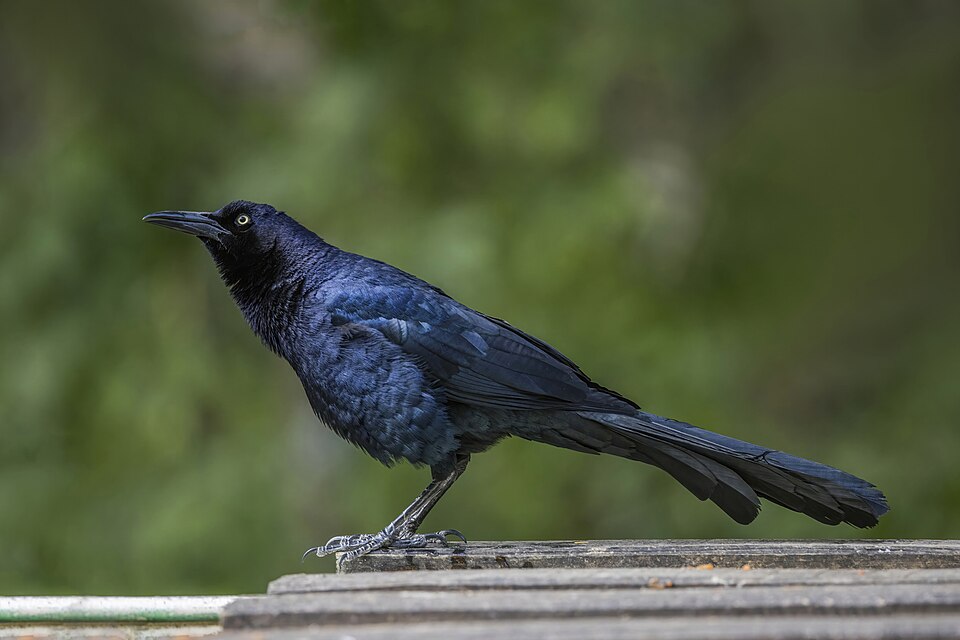
If you have ever sat in a Texas parking lot at dusk and heard what sounded like a flock of rusty gate hinges, broken whistles, and dripping faucets all going off at once, you have met the Great-tailed Grackle. This is one of the most conspicuous birds of the American Southwest and Latin America, big, glossy, brash, and impossible to ignore. Males strut across lawns and gas stations with their enormous keel-shaped tails held like the prow of a boat, while flocks gather by the hundreds in palm trees and shopping-center landscaping to roost.
Once largely a Mexican bird, the Great-tailed Grackle has staged one of the most dramatic range expansions of any North American species over the last century, pushing north and west with irrigation, agriculture, and urban sprawl. It thrives wherever people create open ground, standing water, and easy food. Love it or find it noisy, it is a genuine success story, a smart, adaptable, social bird that has figured out how to live alongside us better than almost any other.
The Great-tailed Grackle is a large, slim, long-legged blackbird best identified by its proportions: a very long tail (especially on males), a long pointed bill, and a flat-headed, lanky silhouette. Size and tail length vary a lot, and there is striking difference between the sexes, the male is far larger and longer-tailed than the female.
| Tail | Very long and keel-shaped (V-folded) on males, held up like a rudder; shorter and flatter on females |
| Bill | Long, straight, and pointed, heavier than a robin's, all black |
| Eyes | Pale staring yellow in adults, dark in juveniles |
| Male plumage | Glossy black with iridescent blue-purple sheen on head and breast in good light |
| Female plumage | Warm brown above, paler buff below, noticeably smaller than the male |
| Legs | Long, dark, and sturdy, gives a confident, striding walk on the ground |
Male vs. female
The sexes look so different that they are often mistaken for two species. The male is large and entirely glossy black, washed with iridescent violet and blue-purple on the head, neck, and breast when the sun hits him, with a dramatically long tail he folds into a deep V. The female is noticeably smaller, with a much shorter tail, and is brown rather than black, dark warm brown above and paler tan or buff below, often with a faint pale stripe over the eye. Both sexes share the pale yellow eye, which is a helpful confirmation at any distance.
Juveniles
Juveniles resemble adult females in their brown tones but look scruffier and more streaked, particularly on the underparts, and they have a dark eye rather than the staring pale yellow of an adult, the eye gradually brightens as the bird matures. Young males begin showing patchy black gloss and lengthening tails through their first year, so late-summer flocks often contain a confusing mix of brown, streaky, and half-iridescent birds of various sizes.
The Great-tailed Grackle has one of the strangest and most varied vocal repertoires of any North American songbird, and it is not remotely musical. Males produce a bizarre medley of sounds: sharp mechanical tic-tic-tic notes, ascending squeals, sliding electronic-sounding whistles, and loud, almost violent cheek! and clack sounds. A common sequence rises into a piercing, almost ear-splitting kee-kee-kee or a series of broken whistles that sound like rusty machinery or a struggling synthesizer.
Calls include a hard, scolding chut or chack and a rolling alarm rattle. When hundreds gather to roost, the combined effect is a deafening, chaotic chorus that carries for blocks. There is no mistaking it for anything subtle, if a bird sounds like a malfunctioning electronic toy in a parking-lot tree, it is almost certainly this one.
The Great-tailed Grackle is found from the southwestern and south-central United States, including Texas, Arizona, New Mexico, California, Oklahoma, and increasingly Kansas, Nebraska, and beyond, south through all of Mexico and Central America into northern South America. Over the past century it has expanded its U.S. range explosively northward and westward, colonizing new states almost decade by decade as irrigation and urban development created the open, watered habitats it favors.
Most populations are year-round residents, especially in the warmer core of the range, though birds at the northern edge may withdraw south or shift locally in winter. Throughout the year they are strongly tied to people: farmland, feedlots, city parks, golf courses, wetland edges, and the landscaped islands of parking lots and strip malls.
This is an omnivore that will eat almost anything. Great-tailed Grackles forage mainly by walking across open ground, lawns, fields, mudflats, and pavement, probing and flipping debris for insects, grubs, spiders, worms, snails, and small lizards or frogs. They readily take grain and waste crops, fruit, and seeds, and they are notorious for raiding outdoor dining areas, dumpsters, and fast-food parking lots for human scraps.
They are also bold opportunists and known nest predators, snatching the eggs and nestlings of smaller birds, and they will wade into shallow water to grab tadpoles, crayfish, and small fish. Some have learned to dunk dry food in water to soften it before eating, a sign of the problem-solving intelligence common in this group.
Great-tailed Grackles are colonial nesters, often packing many nests into a single stand of trees, a clump of cattails, or ornamental palms near water. The species has a polygynous mating system: dominant males defend a cluster of females rather than pairing off one-to-one, and several females may nest within one male's territory.
The female does the work of nest-building and incubation. She constructs a bulky, deep cup of grasses, reeds, twigs, and mud, often lined with finer material, placed anywhere from low in the reeds to high in a tree. She lays a clutch of roughly 3-4 pale bluish eggs marked with dark scrawls, incubates them for around two weeks, and broods the young, which fledge a couple of weeks after hatching. Males contribute little to direct nest care.
You usually do not need to attract Great-tailed Grackles, if you live within their range, they will find you, and many backyard birders actually want fewer of them because they dominate feeders and intimidate smaller birds. That said, if you enjoy their personality, they are easy to host.
- Offer cracked corn, milo, or mixed grain scattered on the ground, grackles are ground feeders and prefer open lawn to perched feeders.
- Keep a birdbath or shallow water source; they love to drink, bathe, and even dunk food, and water reliably draws them in.
- Expect them at platform and tray feeders rather than small tube or cage feeders they cannot balance on.
- To discourage them while feeding smaller birds, switch to safflower or nyjer, use weight-sensitive or caged feeders, and avoid spilling grain on the ground.
- Big trees, palms, or dense shrubs near water provide the roosting and nesting cover they seek out in towns.
- Clean up spilled seed and food scraps promptly if you want to keep numbers in check, since easy food is what draws large flocks.
- Common Grackle: Smaller, with a shorter tail and a bronzy or greenish (not deep blue-purple) gloss; ranges mostly east of the Great-tailed and shows far less size difference between sexes.
- Boat-tailed Grackle: Nearly identical in shape but a coastal bird of the Atlantic and Gulf; often shows a darker eye, and where ranges overlap in Texas the two are best separated by voice and habitat.
- Brewer's Blackbird: Much smaller with a short tail and stubby bill; male is glossy black with a pale eye but lacks the long keel-shaped tail and lanky build.
- Brown-headed Cowbird: Far smaller and chunkier with a short conical bill and short tail; male has a brown head on a black body, nothing like the grackle's uniform gloss.
Are Great-tailed Grackles aggressive or dangerous?
They are bold and noisy but not dangerous to people. Males can be territorial and will dive or scold near nests, and they readily steal food at outdoor tables, but they pose no real threat. They can, however, bully smaller songbirds at feeders and prey on other birds' eggs and nestlings.
Why do grackles gather in such huge, loud flocks?
Outside the breeding season they form large communal roosts, sometimes thousands of birds in city trees, palms, or reedbeds. Roosting together offers safety in numbers, warmth, and shared information about food. The deafening evening chorus is simply the whole flock vocalizing at once before settling for the night.
What is the difference between a Great-tailed Grackle and a Common Grackle?
The Great-tailed is larger with a much longer, keel-shaped tail and an iridescent blue-purple sheen, and shows a big size difference between males and females. The Common Grackle is smaller, shorter-tailed, more bronze or green in gloss, and ranges mostly across the eastern and central U.S. rather than the Southwest.
How do I keep grackles away from my bird feeders?
Use feeders that exclude large birds, weight-sensitive feeders that close under their weight, or caged feeders that let only small birds in. Offer safflower or nyjer seed, which grackles tend to ignore, avoid spreading grain on the ground, and clean up spilled seed promptly so flocks aren't drawn in.
Why is the Great-tailed Grackle spreading so fast?
It thrives on human-made habitat. The spread of irrigated farmland, feedlots, lawns, parks, and urban landscaping created exactly the open ground and standing water it needs, and its flexible diet and intelligence let it exploit our food and structures. Over the last century this combination has driven a rapid push north and west across the U.S.