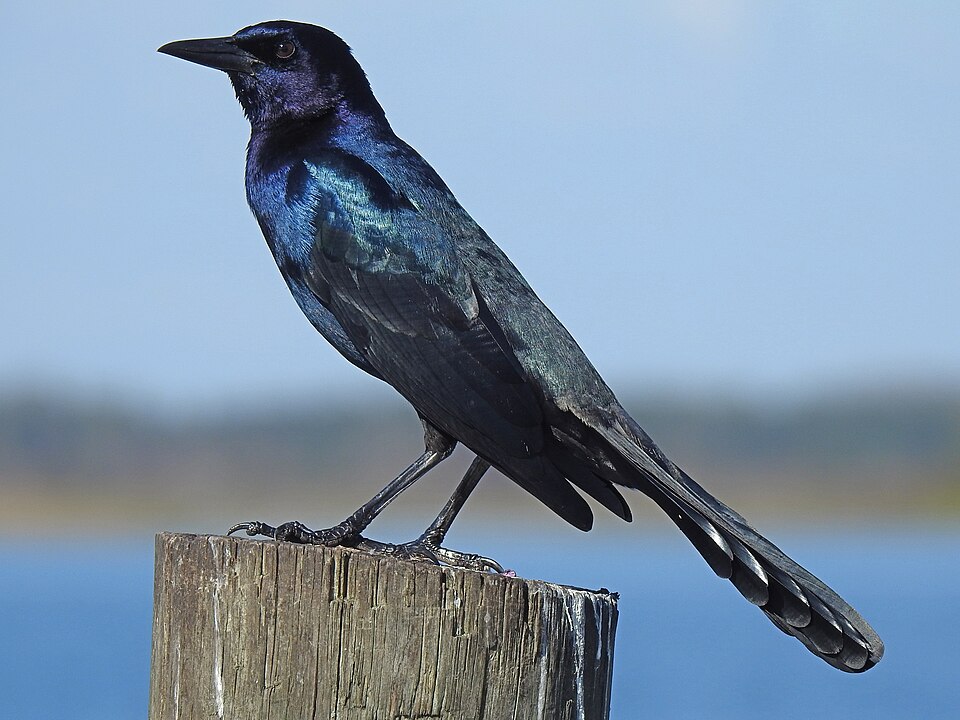
If you've ever sat at a beachside seafood shack along the Gulf or Atlantic coast and watched a long-tailed black bird strut across the railing eyeing your fries, odds are good you met a Boat-tailed Grackle. This is one of America's most theatrical marsh birds: the glossy males flare their enormous wedge-shaped tails, throw their heads skyward, and rattle off a wild medley of squeaks and clatters from the top of a cattail or a lamppost. They are loud, social, and completely at home around people, which makes them a favorite of beginning birders even as their sheer abundance sometimes earns them an eye-roll from folks defending their picnics.
Boat-tailed Grackles are creatures of the coast. Across most of their range they cling to a narrow band of salt and brackish marsh, mangrove, and coastal scrub, rarely venturing far inland, with Florida being the big exception, where they spread across the whole peninsula. They feed in the open, nest in noisy colonies over water, and gather in large, conversational flocks. Once you learn their shape and that unmistakable racket, you'll spot them everywhere from marina pilings to fast-food drive-throughs throughout the Southeast.
Boat-tailed Grackles are big, lanky blackbirds defined by their long legs, stout pointed bill, and the dramatically long, keel-shaped tail the male folds into a deep V, the "boat keel" that gives the species its name. Size and color differ sharply between the sexes, so the first step in any ID is sorting males from females.
| Size & shape | Large and rangy with long legs and a long, broad tail; males noticeably bigger than females, with the tail often half the bird's total length. |
| Male color | Glossy black overall with an iridescent sheen that flashes blue, violet, or steely teal depending on the light. |
| Female color | Much smaller and warm tawny-brown, palest on the throat and breast, darker on the wings, back, and tail. |
| Bill | Long, heavy, and pointed, straight along the top, blackish in adults. |
| Eye color | Varies by region: dark brown along the Gulf, often bright pale yellow in Atlantic-coast and Florida birds. |
| Tail | Long and wedge-shaped; the male creases his into a deep V or keel, especially in flight and display. |
Male vs. female
The sexes look so different they're often mistaken for two species. Males are large, all glossy black with a metallic blue-to-teal shine, and sport that oversized keeled tail. Females are roughly a third smaller, with no iridescence at all, they are warm brown above and paler tawny-buff below, with a shorter, less dramatic tail. In mixed flocks the size difference alone is a giveaway: the hulking shiny birds are males, the dainty brown ones are females.
Juveniles
Juveniles resemble adult females, brown overall and lacking gloss, but look softer and scruffier, with a duller, often dark eye even in regions where adults have pale eyes. Young males darken gradually as they molt toward adult plumage, so late summer and fall flocks often include brownish birds that are larger than the females; these are typically immature males growing into their black, iridescent dress.
Boat-tailed Grackles are vocal showmen rather than singers. The male's display is a rapid, building jumble best described as a series of harsh jeeb jeeb jeeb notes that accelerate into a clattering, mechanical rattle and end in squealing, almost electronic cheek-cheek-cheek whistles. The whole performance is delivered with the bill pointed straight up, wings quivering and tail flared, equal parts song and dance.
Away from display they keep up a constant background chatter of sharp chuck and clack calls, dry rattles, and squeaky wheet notes. A colony in full swing produces a wonderful, slightly unhinged wall of sound that carries across a marsh, and once you've heard it you'll recognize these birds without ever lifting your binoculars.
This is a bird of the southeastern coast. Boat-tailed Grackles occur along the Atlantic seaboard from roughly the New York–New Jersey area south through the Carolinas and Georgia, around all of Florida, and west along the entire Gulf Coast through Texas. Outside Florida they stay tied to coastal salt and brackish marshes and rarely move far from saltwater; in Florida they break that rule and occupy freshwater marshes, lakeshores, suburbs, and city parking lots well inland.
They are essentially year-round residents across their range and are not strong migrants, though birds at the northern edge may shift a bit south in the harshest winter weather and flocks wander locally with the seasons. Their range has been creeping northward up the Atlantic coast over recent decades.
Boat-tailed Grackles are bold, opportunistic omnivores. In their natural marsh habitat they wade and probe for crustaceans, small crabs, shrimp, aquatic insects, snails, frogs, and small fish, and they'll raid other birds' nests for eggs and nestlings. They also take seeds, grains, and fruit, and forage on tidal flats, lawns, and the marsh edge, often flipping debris or striding through shallow water with that long-legged gait.
Like their relatives, they've cheerfully adapted to human food. Around marinas, beaches, picnic areas, and fast-food lots they scavenge scraps, dropped fries, bread, and handouts with confident, almost gull-like nerve. This flexibility is a big reason the species thrives alongside coastal development.
Boat-tailed Grackles nest in colonies, usually in stands of marsh vegetation, shrubs, or small trees over or near water, cattails, reeds, mangroves, and bushes are all favored. The female does essentially all the work: she builds a bulky, deep cup of grasses, reeds, and mud, lays and incubates the eggs, and raises the young largely on her own.
The mating system is unusual and worth knowing about. Rather than forming pairs, dominant males defend display territories and may mate with many females in the colony, while contributing nothing to nest-building or chick-rearing. Females cluster their nests together, and the colony's collective vigilance helps fend off predators. Clutches typically run two to four pale, blotched eggs, and pairs may raise more than one brood in a season in the warm southern climate.
Boat-tailed Grackles aren't a classic feeder bird you cultivate the way you might bluebirds or finches, but if you live within their coastal range they will absolutely show up on their own, sometimes in numbers that can overwhelm a small feeder station. The honest goal for most yards is appreciating them rather than specifically luring them.
- Open ground feeding works best: they prefer to forage on the ground or on platform feeders rather than clinging to small tube feeders.
- Offer cracked corn, milo, mixed seed, or bread scraps on the ground if you genuinely want them, they're not fussy.
- A water source like a birdbath or shallow pool is a reliable draw, especially in hot southern weather.
- Expect them in flocks; if grackles are dominating your feeders, switch to safflower or tube feeders with short perches to favor smaller songbirds.
- If you live near salt marsh, mangroves, or a coastal park, you likely won't need to do anything, just watch the marsh edge and parking lots at dawn.
- Common Grackle: Smaller, with a shorter tail and a glossy bronze or purple-headed sheen; far more widespread inland, while Boat-tailed sticks to the coast.
- Great-tailed Grackle: Very similar and even larger-tailed, but a bird of the Southwest and interior; the two overlap mainly along the Texas Gulf, where Great-tailed males show bright golden eyes and harsher mechanical calls.
- Brewer's Blackbird: Much smaller with a short tail and pale yellow eye in males; lacks the grackle's long keeled tail and oversized look.
- European Starling: Chunky and short-tailed with a yellow bill in breeding season and white spangling in winter; far smaller than a grackle.
What's the difference between a Boat-tailed Grackle and a Common Grackle?
Boat-tailed Grackles are larger with a much longer, keel-shaped tail and are tied to the southeastern coast. Common Grackles are smaller, shorter-tailed, show a bronzy or purple-glossed look, and are widespread across inland North America. If you're on the Gulf or Atlantic coast watching a big, long-tailed grackle in the marsh, it's almost certainly a Boat-tailed.
Why are the male and female Boat-tailed Grackles so different?
This species is strongly sexually dimorphic. Males are big, glossy black, and iridescent because their size and shine help them compete for display territories and mates. Females are smaller and plain brown, which provides camouflage on the nest. The size and color gap is so large the two are often mistaken for separate species.
Are Boat-tailed Grackles aggressive or a problem?
They're bold and noisy, and large flocks can dominate feeders, scavenge picnics, and make a racket near nesting colonies, but they aren't dangerous. They sometimes raid other birds' nests for eggs and chicks, which is natural behavior. Most conflicts are just a matter of their abundance and confidence around people.
Where do Boat-tailed Grackles live?
Along the Atlantic coast from the New York area south, throughout Florida, and west along the entire Gulf Coast to Texas. Outside Florida they stick close to salt and brackish marshes near the ocean. In Florida they range inland across the whole state, including freshwater wetlands, suburbs, and city parking lots.
Do Boat-tailed Grackles migrate?
Mostly no. They're year-round residents across the Southeast. Birds at the northern edge of the range may shift slightly south in severe winter weather, and flocks wander locally, but the species does not undertake long-distance migration the way many songbirds do.