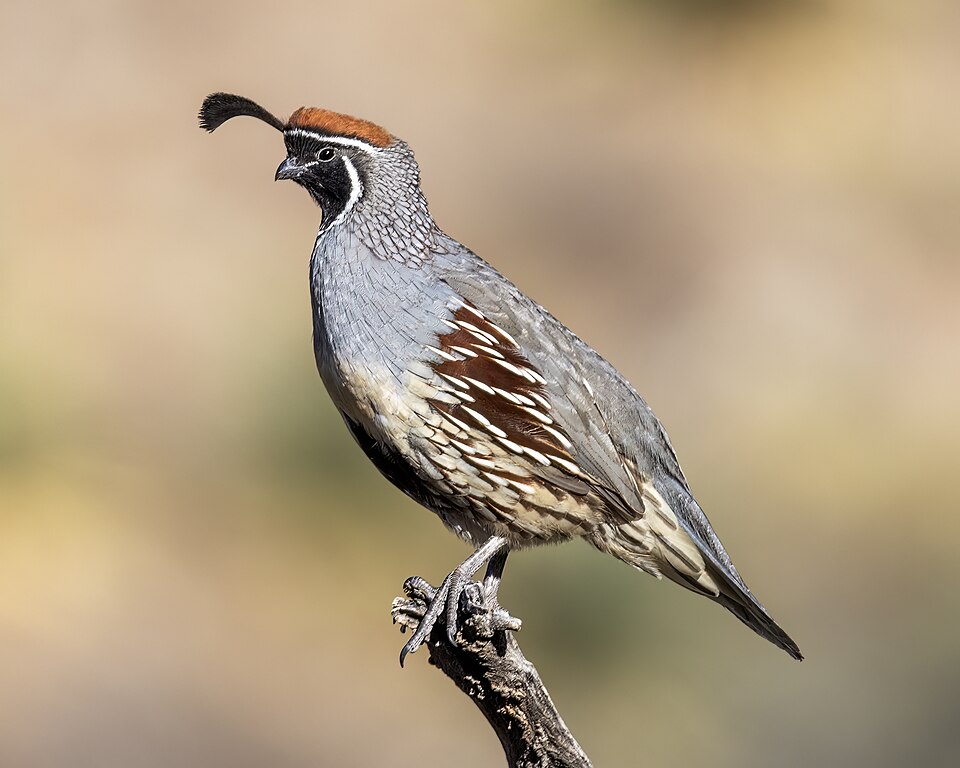
Few desert birds are as instantly endearing as Gambel's Quail. A plump, round-bodied ground bird about the size of a small chicken, it is best known for the curved black topknot that bobs over its forehead like a comma drawn in ink. Coveys of these quail scurry through creosote flats, mesquite washes, and suburban yards across the Sonoran and Chihuahuan deserts, calling to one another in a chorus of clucks and crows as they run rather than fly from trouble. Watching a parade of them cross a dirt road in single file, chicks tumbling behind the adults, is one of the great small pleasures of birding the Southwest.
Named for the 19th-century naturalist William Gambel, this quail thrives where many birds struggle: hot, dry, brushy country with sparse rainfall. It has adapted beautifully to human landscapes too, and in cities like Tucson and Phoenix it is a familiar backyard visitor, drinking at birdbaths and gleaning seed beneath feeders. Its abundance, sociability, and slapstick charm make it a favorite of both seasoned birders and folks who simply notice the funny little birds running around the patio.
Gambel's Quail is a chunky, short-tailed ground bird with a small head topped by a forward-curling plume. On the ground it looks dumpy and top-heavy; in a brief, whirring flight it shows rounded wings and a stubby grayish tail. The forward-drooping black topknot (actually a cluster of six overlapping feathers that looks like one) is the feature that catches every eye.
| Topknot | Black, forward-curving teardrop plume; larger and fuller on the male |
| Body | Plump and gray overall, with a scaled or plain gray breast and warm chestnut flanks streaked with white |
| Male face | Bold pattern: black face and throat outlined in white, with a chestnut crown and a black belly patch |
| Belly | Male shows a distinctive black blotch on a pale belly; female lacks it |
| Bill and legs | Short, stout dark bill and sturdy gray legs built for running |
| Size and shape | Quail-sized, round-bodied, small-headed, with a short tail held low |
Male vs. female
The sexes are easy to separate with a clear look. The male is the showy one: he has a chestnut (rusty) cap, a jet-black face and throat sharply bordered by white lines, and a conspicuous black patch in the center of his pale belly. The female is plainer and grayer overall, with a smaller, shorter topknot, a soft gray face lacking the black-and-white mask, and no black belly patch. Both sexes share the chestnut, white-streaked flanks, but the female's whole look is more subdued and uniform.
Juveniles
Newly hatched chicks are tiny, fast-moving balls of buff and brown down that follow the parents within hours of hatching. Juveniles are mottled grayish-brown and streaky, looking scruffy and unfinished, with only a stubby, barely-developed topknot. They lack the adults' clean facial pattern and chestnut flanks, and young males do not show the black belly patch until they molt into adult-like plumage in their first fall. By their first winter, immatures closely resemble adults.
Gambel's Quail are talkative birds, and their calls are a signature sound of desert mornings. The most familiar is the rallying or assembly call, a loud, ascending four-note chi-ca-go-go often written as ka-KAA-ka-ka, used by separated covey members to regroup. Birds also give a low, conversational chip and a steady series of clucking kut-kut-kut notes as they forage together.
A lone male advertising from a fence post or shrub will deliver a single, plaintive, querulous cow? or kaa note, repeated with an almost questioning lilt. When startled, the covey erupts in sharp alarm cackles before scattering on foot or bursting into short, noisy flight.
This is a bird of the arid Southwest. Gambel's Quail are found across southern Arizona, southern Nevada, and southeastern California, east into New Mexico and far western Texas, and south into the Mexican states of Sonora, Chihuahua, and Baja California. They also extend up the Colorado River corridor into southwestern Utah and along desert drainages. They favor the Sonoran and Chihuahuan deserts, especially mesquite bosques, brushy washes, desert scrub, and the edges of agricultural land and suburbs.
Gambel's Quail are non-migratory and stay on their home range year-round. They do shift their daily movements with the seasons, gathering into large coveys in fall and winter and breaking into pairs in spring. Local populations rise and fall sharply with rainfall: wet winters produce abundant spring greenery and big hatches, while drought years can sharply reduce nesting.
Gambel's Quail are primarily seed-eaters and vegetarians, foraging mostly on the ground as they scratch and peck through leaf litter and bare desert soil. The bulk of their diet is the seeds of desert annuals, grasses, mesquite, and legumes, supplemented heavily by green leaves, buds, and shoots in spring. They also relish cactus fruit, berries, and the flowers and seedpods of desert shrubs.
Insects matter most in the breeding season, when protein-rich bugs help chicks grow quickly; growing young eat far more insect matter than adults. These quail get much of their water from succulent vegetation and dew, but they readily drink from any reliable water source, which is why a birdbath or ground-level water dish is such a powerful draw in dry country. They typically feed in the cool of early morning and again in late afternoon, loafing in shade during the heat of the day.
Gambel's Quail nest on the ground, with the female scraping a shallow depression sheltered beneath a shrub, cactus, grass clump, or brush pile and lining it with grass, leaves, and feathers. Occasionally a pair will use an elevated site such as an old nest or a sheltered ledge. Nesting is timed to spring rains and greenery, so the season runs roughly from March into early summer.
A typical clutch is large, around 10 to 12 buffy eggs blotched with brown, and the female does most of the incubating over about three weeks. The chicks are precocial, leaving the nest within a day of hatching and feeding themselves while the parents lead and guard them. Both adults tend the brood, and in good rainfall years a pair may attempt a second brood. Coveys often merge in late summer, and it is common to see broods of mixed ages traveling together.
Yes, within their range Gambel's Quail are wonderful backyard birds and visit feeding areas readily. They are ground feeders, so the trick is to cater to their habits: low food, reliable water, and dense cover they can dash into.
- Scatter seed on the ground or use a low platform or tray feeder; cracked corn, millet, milo, and mixed seed are favorites since quail rarely use hanging feeders.
- Provide water at ground level in a shallow dish or low birdbath. In the desert, dependable water is often the single biggest attractant.
- Keep dense, brushy cover nearby, such as native shrubs, mesquite, or a brush pile, so coveys feel safe approaching open feeding spots.
- Plant native desert plants like mesquite, hackberry, and seed-bearing wildflowers and grasses that supply natural food and shelter.
- Feed in early morning and late afternoon to match their natural foraging schedule.
- Keep cats indoors and minimize disturbance, since these are wary ground birds that flush easily.
- California Quail: Very similar plumed shape, but male has a brown (not chestnut) crown, a scaly belly with a chestnut patch rather than a clean black blotch, and a strongly scaled belly. Ranges barely overlap; California Quail favors coastal and interior California foothills.
- Scaled Quail: Shares desert grassland habitat but is pale gray with a scaly breast and belly and a fluffy white-tipped crest (the 'cottontop'), lacking any topknot plume or black face.
- Montezuma Quail: A secretive quail of oak grasslands with a round, crestless head; the male has a bold harlequin black-and-white face pattern and spotted flanks, very different from Gambel's clean plume and chestnut sides.
- Northern Bobwhite: A rounder, crestless quail of the East and Midwest with a bold white (male) or buffy (female) eyebrow and throat; ranges do not overlap with Gambel's desert haunts.
What is the bird with the curl on its head in Arizona?
That is almost certainly Gambel's Quail, the common desert quail of Arizona and the Southwest. Its forward-curling black topknot, plump gray body, and chestnut flanks are unmistakable. Males also show a black face and a black belly patch.
Do Gambel's Quail fly?
They can, but they prefer to run. Quail spend most of their time on the ground and escape danger by sprinting into cover on their strong legs. When pressed, they burst into a short, fast, whirring flight on rounded wings, then drop back to the ground quickly. They are not long-distance fliers.
What do Gambel's Quail eat and what should I feed them?
In the wild they eat mostly seeds, green shoots, leaves, cactus fruit, and insects (especially when raising chicks). To feed them in your yard, scatter cracked corn, millet, milo, or mixed seed on the ground or on a low tray, since they rarely use hanging feeders. A ground-level water dish is just as important in the desert.
What is the difference between Gambel's Quail and California Quail?
They look very alike, but check the belly and crown. Male Gambel's Quail has a chestnut crown and a clean black patch on a pale, unscaled belly, while male California Quail has a brown crown and a scaly belly with a chestnut patch. Their ranges barely overlap, so location is a strong clue: Gambel's is the desert Southwest quail, California Quail is the West Coast bird.
Why do Gambel's Quail run around in groups?
Outside the breeding season they live in social flocks called coveys, often a dozen or more birds, which improves safety through many watchful eyes and helps them find food and water together. In spring, coveys break up into pairs to nest, then families and coveys regroup again by late summer.