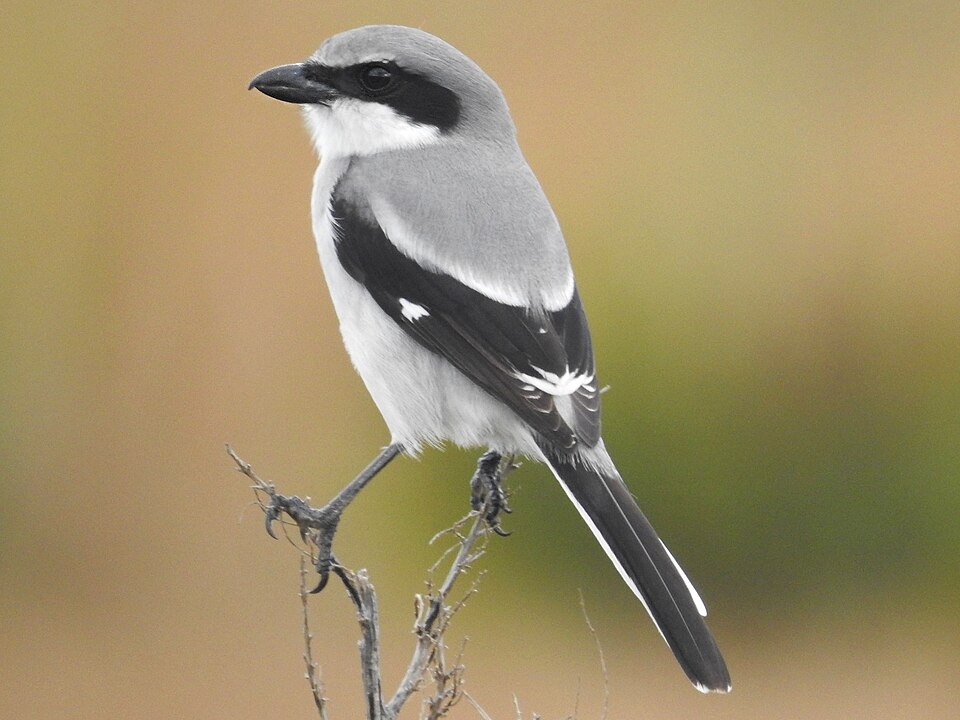
The Loggerhead Shrike is one of North America's most surprising birds: a gray-and-white songbird, roughly the size of a Northern Mockingbird, that behaves like a small bird of prey. Songbirds aren't supposed to be predators, but the shrike never got that memo. It perches upright on a fence wire or the tip of a bare branch, scanning open ground, then drops onto grasshoppers, beetles, lizards, mice, and even other small birds. Lacking the powerful talons of a true raptor, it solves the problem with a notorious habit: impaling its prey on thorns, barbed wire, or the spike of a yucca, which earns it the old nickname "butcher bird."
Once a familiar sight across open country from coast to coast, the Loggerhead Shrike has been quietly disappearing for decades, especially in the Northeast and upper Midwest. Loss of pastureland, hedgerows, and shrubby fields, along with pesticide effects on insect prey, has pushed it onto watch lists across much of its range. It remains reasonably common in parts of the South, the Great Plains, and the arid Southwest, where birders still find it surveying its territory from a roadside wire with that distinctive thick-headed, big-headed silhouette.
Look for a compact, big-headed gray bird perched bolt upright in the open. The Loggerhead Shrike's name refers to that oversized, blocky head ("loggerhead" being an old word for a thick-headed or blockheaded thing). At a distance it can read like a mockingbird, but the heavy black mask, hooked bill, and habit of perching low over open ground give it away.
| Mask | Bold black mask running across the eyes and over the top of the bill, thicker and more solidly black than a mockingbird's face |
| Bill | Short, thick, and distinctly hooked at the tip with a small tooth, like a miniature raptor's beak |
| Body | Clean gray crown and back, paler gray to whitish underparts, with a slightly hunched, large-headed posture |
| Wings | Black wings with a bold white patch (the primary patch) that flashes conspicuously in flight |
| Tail | Black tail with white outer edges and white corners, obvious as it flies away |
| Size & shape | About mockingbird-sized but stockier and bigger-headed, with a shorter, thicker neck |
Male vs. female
Male and female Loggerhead Shrikes look essentially identical in the field, both showing the same gray back, black mask, and white wing patches. There are no reliable plumage differences a backyard birder can use to separate the sexes at a distance. In the hand, males sometimes average slightly more extensive black in the mask and a touch more contrast, but this is subtle and overlapping. Behavior offers the best clue during the breeding season, when the male sings persistently from a high perch and feeds the incubating female.
Juveniles
Recently fledged juveniles look like washed-out, slightly scruffy versions of the adults. They show a brownish-gray cast rather than clean gray, and their underparts and back are finely barred or vermiculated with faint gray scaling, giving a subtly "dirty" or scalloped look. The mask is present but duller and browner, and the bill takes time to develop its full hook. By their first fall and winter, young birds have molted into a plumage close to the crisp gray-and-white of adults.
For a bird that hunts like a hawk, the shrike has a surprisingly varied, if not exactly musical, voice. The song is a deliberate, somewhat halting series of short phrases, paired or repeated notes mixed with harsh trills and squeaky warbles, often rendered as queedle-queedle or a repeated tsurp-tsurp, see-saw, see-saw. It tends to sound like a creaky, unoiled hinge or a mockingbird that has lost interest halfway through.
Calls are harsher and more attention-grabbing: a grating, scolding shack-shack or jaaa, and a variety of rasping, buzzy notes used in alarm and territorial disputes. In late winter and early spring, males sing from exposed perches to advertise territory, which is often the easiest time to detect them by ear.
The Loggerhead Shrike is found only in North America, from southern Canada through the United States and into Mexico. It favors open and semi-open habitats: pastures, grasslands, sagebrush, desert scrub, agricultural fields with hedgerows and scattered shrubs, and other places with low perches overlooking short vegetation. Across the southern United States and Mexico it is a year-round resident.
Northern populations are migratory, withdrawing from the upper Midwest, the northern Plains, and southern Canada in fall to winter farther south. The species has declined sharply across the northeastern and north-central parts of its range, where it is now rare or locally extirpated, while remaining more reliable in the South, the Great Plains, Texas, the Southwest, and California. A separate population on California's San Clemente Island is federally endangered.
Loggerhead Shrikes are sit-and-wait predators with a broad menu. In warm months, large insects dominate, especially grasshoppers, crickets, beetles, and cicadas. The rest of the year, and whenever the chance arises, they take small vertebrates: lizards, frogs, small snakes, mice and voles, and small birds. They hunt by perching on a wire, fence post, or bare branch, then pouncing onto prey on the ground or snatching it in midair, killing with that hooked, tooth-edged bill aimed at the neck.
The shrike's signature behavior is caching, or larder-hoarding. Because it lacks strong gripping feet, it wedges or impales prey on thorns, sharp twigs, and barbed-wire fences. This lets it tear apart prey too large to swallow whole, anchor a meal for later, and store surplus food during good times. Finding a grasshopper or a vole skewered on a fence barb is often the first sign that a shrike is working a particular stretch of road.
Pairs nest in dense shrubs, small trees, or thorny thickets, frequently choosing thorny species like hawthorn, mesquite, or Osage orange that offer protection. The nest is a bulky, well-built cup of twigs lined thickly with rootlets, bark strips, plant down, feathers, and animal hair, placed several feet off the ground and often well hidden within the foliage.
The female lays a clutch of roughly four to six grayish or buff eggs spotted with brown and gray, and she does most of the incubation while the male brings her food. Eggs hatch in about two and a half weeks, and the young fledge a couple of weeks later, after which the parents continue to feed and teach them to hunt. In the warmer parts of the range, pairs often raise two broods in a season, which helps offset high losses to predators and weather.
The Loggerhead Shrike is not a feeder bird and won't visit seed, suet, or nectar. It's an open-country predator, so attracting one is really about habitat rather than handouts. If you live near grassland, pasture, or desert scrub, you can make a property more shrike-friendly, but in typical suburban yards it will only ever be an occasional flyover or winter visitor.
- Provide open, short-grass habitat such as mowed pasture, fields, or large lawns where shrikes can spot ground prey from a perch.
- Leave or install elevated hunting perches, fence lines, isolated bare branches, wires, and posts overlooking open ground are exactly what shrikes look for.
- Keep some thorny shrubs and hedgerows (hawthorn, mesquite, native thorny species) for nesting cover and natural impaling sites.
- Avoid pesticides on lawns and fields; grasshoppers, beetles, and other large insects are the foundation of the shrike's diet.
- Don't expect feeder visits, instead, scan roadside wires and fence posts in open country, especially in the South and West, to find them.
- If you have acreage, maintain a patchwork of short grass for hunting and scattered shrubs for perching and nesting rather than uniform tall growth.
- Northern Mockingbird: Slimmer and longer-tailed with a thin pointed bill, no black mask, and a grayer overall look; it forages actively in trees and shrubs rather than perching motionless over open ground.
- Northern Shrike: A larger, paler northern cousin that visits the northern U.S. mostly in winter; it has a thinner mask that does not cross above the bill, faint barring on the breast, and a longer bill.
- Loggerhead vs. Gray Catbird: The catbird is uniformly slate-gray with a black cap and rusty undertail, lacks the mask and white wing patches, and skulks in dense thickets instead of perching in the open.
Why does the Loggerhead Shrike impale its prey on thorns and barbed wire?
Shrikes are songbirds, so they lack the strong grasping talons that hawks and owls use to hold food. Impaling prey on a thorn, sharp twig, or fence barb gives the shrike an anchor so it can tear apart animals too big to swallow whole. It also lets the bird cache surplus food for later, essentially building a larder it can return to when hunting is poor.
Is the Loggerhead Shrike a bird of prey?
Not in the technical sense. It's a true songbird (a passerine), not a raptor, so it's only distantly related to hawks, falcons, and owls. But it has evolved a predatory lifestyle, hunting insects and small vertebrates with a hooked, tooth-edged bill, which is why people often call it a 'predatory songbird' or 'butcher bird.'
How do I tell a Loggerhead Shrike from a Northern Mockingbird?
Look at the head and bill. The shrike has a bold black mask through the eye and a short, thick, hooked bill, while the mockingbird has a plain face and a slender, pointed bill. The shrike is stockier and bigger-headed, perches upright and motionless over open ground, and shows cleaner black-and-white wings. Mockingbirds are slimmer, longer-tailed, and constantly active in shrubs and trees.
Where can I see a Loggerhead Shrike?
Scan open country, pastures, grasslands, sagebrush, desert scrub, and farm fields with fences and scattered shrubs. They like to perch on wires, fence posts, and bare branch tips overlooking short vegetation. They're most reliable in the southern U.S., the Great Plains, Texas, the Southwest, and California, and much rarer in the Northeast and upper Midwest, where they have declined steeply.
Why are Loggerhead Shrikes declining?
Their numbers have dropped across much of North America, especially in the Northeast and north-central regions. The main drivers appear to be loss of open grassland, pasture, and hedgerow habitat to development and intensive farming, along with pesticide impacts on the large insects they depend on. Collisions with vehicles along the roadsides where they hunt and perch add to the losses.