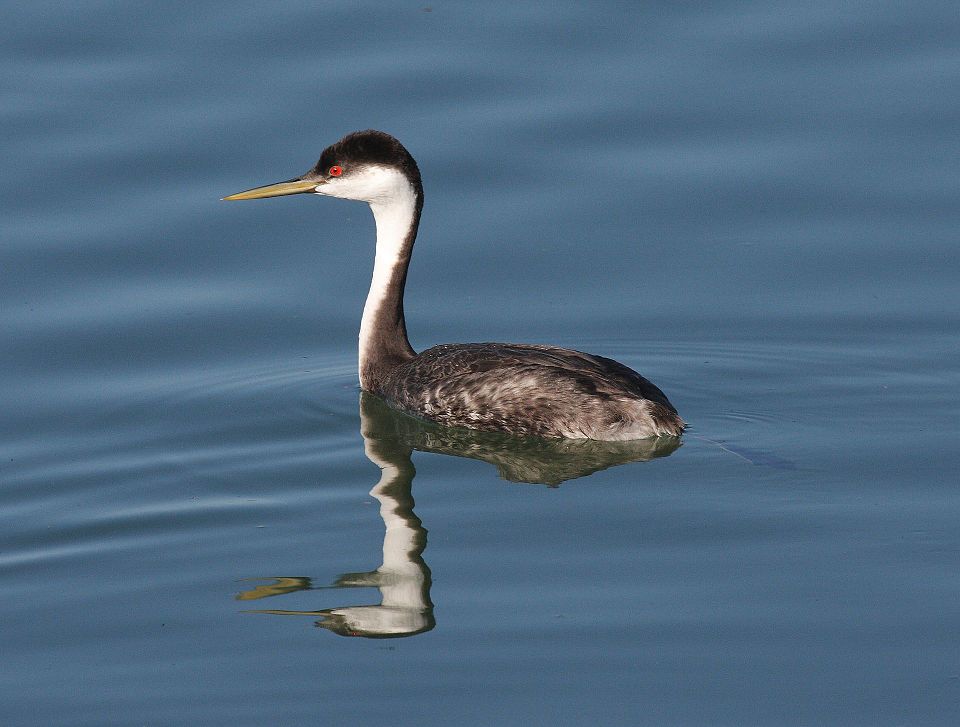
The Western Grebe is the largest of North America's grebes and one of its most elegant water birds. Long and slender, it rides low in the water with a snaky black-and-white neck held in a graceful S-curve, looking almost like a small loon or a miniature swan crossed with a dagger-billed diver. It is a bird of open water, spending essentially its entire life afloat, and it is so committed to swimming and diving that it can barely walk on land.
For most people the Western Grebe is unforgettable for one reason: its courtship "rushing" display, in which pairs and even small groups suddenly rear up and sprint side by side across the surface of the lake, necks arched and wings held back, before plunging gracefully forward. It is one of the most spectacular courtship rituals of any North American bird and a highlight of spring on western lakes and marshes.
Western Grebes are big, long-necked, and strikingly two-toned. Look for a low-slung body, a very long thin neck, and a needle-like yellowish bill. The clean break between the black upperparts and the bright white underparts runs the full length of the bird, giving it a sharp formal appearance even at a distance.
| Overall pattern | Crisp black above, white below, with a long swan-like neck that is dark on the back and white on the front |
| Head | Black cap that extends down to or below the level of the red eye; the black surrounds the eye in most birds |
| Bill | Long, thin, and dagger-like, dull yellowish to greenish-yellow (never bright orange) |
| Eye | Deep red, set within the dark of the face |
| Size & shape | Largest North American grebe; rides low in the water with a slim, elongated profile |
| In flight | Rarely seen flying; shows white wing patches, trailing legs, and a drooped neck, looking distinctly loon-like |
Male vs. female
Males and females look alike in plumage, so you cannot reliably sex them by color in the field. Males average slightly larger and longer-billed, and during the rushing display the difference can sometimes be glimpsed, but in practice telling a single bird's sex by eye is not possible. Pairs are best identified by behavior rather than appearance.
Juveniles
Downy chicks are pale gray rather than boldly striped, and famously ride on a parent's back, tucked into the feathers between the wings, often for the first few weeks of life. Immature birds resemble washed-out adults: the black areas are duller and grayer, the boundary between dark and light is less crisp, and the face pattern is softer, so the eye does not stand out as sharply against the cap.
The Western Grebe's voice is one of the classic sounds of western marshes. Its signature call is a loud, rolling, two-note kreee-kreeet or creet-creet, often described as a grating, crreaking whistle that carries well across open water. Pairs frequently call back and forth, and on a busy breeding lake the overlapping calls create a constant, almost mechanical chorus.
This two-syllable call is one of the best ways to separate it from the very similar Clark's Grebe, which typically gives a single-note kreeed rather than the doubled phrase. Outside the breeding season Western Grebes are mostly silent, so spring and summer are the times to listen.
Western Grebes breed across western North America, from the prairie provinces of Canada south through the Great Plains, Great Basin, and intermountain West, favoring large freshwater lakes and marshes with both open water and stands of emergent vegetation like cattails and bulrushes. Strongholds include lakes in the Dakotas, the northern Rockies region, the Great Basin, and the interior West.
In winter they shift largely to the Pacific Coast, where big flocks gather on sheltered bays, estuaries, and nearshore ocean waters from British Columbia south to Baja California and into western Mexico. Some also winter on large ice-free interior lakes and reservoirs. Migration happens mostly at night, which is part of why this strong swimmer is so seldom seen in the air.
Western Grebes are pursuit divers that feed almost entirely on fish, supplemented by aquatic invertebrates such as crustaceans, insects, and the occasional worm or salamander. They dive from the surface and chase prey underwater, propelled by their powerful lobed feet set far back on the body. The long neck and spear-shaped bill work together as a striking mechanism: the bird thrusts its head forward to seize or, at times, impale small fish.
Like other grebes, they habitually swallow their own feathers, which collect in the stomach and are thought to protect the gut from sharp fish bones and aid in forming pellets of indigestible material. Feeding is most active in open water, where flocks may spread out and dive repeatedly, disappearing for long seconds before popping up some distance away.
Western Grebes are colonial nesters, often gathering in loose groups among emergent marsh vegetation. The nest is a floating or anchored platform of soggy plant material, built up from reeds, stems, and aquatic plants and attached to standing vegetation so it rises and falls with the water. Both members of the pair help construct it.
A typical clutch is three to four pale eggs, which soon become stained brown by the wet nest material. Both parents share incubation, and the precocial chicks climb onto a parent's back almost immediately after hatching, riding there for warmth and safety while the adults continue to swim and dive. This back-brooding is a hallmark of grebes and one of the most charming sights on a breeding lake.
The Western Grebe is not a backyard or feeder bird in any sense. It cannot use seed or suet, almost never comes to land, and lives its entire life on open water hunting fish. You will not draw one to a yard, but you can reliably enjoy them by going to the right water at the right time of year.
- Visit large freshwater lakes, reservoirs, and marshes in the western U.S. and Canada during spring and summer for breeding birds and courtship displays.
- In late winter and early spring, watch for the spectacular rushing display, when pairs sprint upright across the water together.
- In winter, scan sheltered Pacific Coast bays, harbors, and estuaries, where large rafts gather offshore.
- Bring a spotting scope or good binoculars; grebes ride low and often stay well out in open water.
- Support healthy lakes and wetlands, since clean water and undisturbed marsh vegetation are what these birds truly need.
- Clark's Grebe: Nearly identical but the black cap sits above the red eye, leaving the eye surrounded by white; bill is brighter orange-yellow, and its call is a single note rather than two.
- Red-necked Grebe: Stockier with a shorter, thicker neck and a yellow-based bill; in breeding plumage shows a rusty-red neck and pale cheek, lacking the long swan-like black-and-white neck.
- Common Loon: Much bulkier with a heavy dagger bill and a thicker neck; breeding birds show a checkered back and black head, not the slim two-toned grebe profile.
- Eared Grebe: Far smaller with a short upturned bill and a peaked head; never shows the long elegant neck or large size of the Western Grebe.
What is the difference between a Western Grebe and a Clark's Grebe?
They are extremely similar and were once considered one species. The key marks: in the Western Grebe the black cap extends down to surround the red eye, the bill is a duller greenish-yellow, and the call is a two-note kreee-kreeet. In Clark's Grebe the black stays above the eye so white surrounds it, the bill is brighter orange-yellow, and the call is a single note. They sometimes interbreed where their ranges overlap.
Why do Western Grebes run across the water?
That is their famous courtship 'rushing' display. A pair, or sometimes several birds, suddenly rears upright and sprints side by side across the surface with necks arched and wings swept back, covering many yards before diving forward. It strengthens the pair bond and is one of the most dramatic courtship rituals of any North American bird.
Can Western Grebes walk on land?
Barely. Their legs are set so far back on the body for efficient diving that they are nearly helpless on land and almost never come ashore. They swim, dive, build floating nests, and even sleep on the water, spending essentially their whole lives afloat.
Where can I see a Western Grebe?
In spring and summer, look on large freshwater lakes, reservoirs, and marshes across the western U.S. and Canadian prairies, where they breed in colonies. In winter, most move to the Pacific Coast, gathering in big rafts on sheltered bays and estuaries from British Columbia to Mexico.
What do Western Grebes eat?
Mostly fish, which they catch by diving and chasing underwater, using their long neck and spear-like bill to seize prey. They also take crustaceans, aquatic insects, and other small invertebrates, and like all grebes they swallow feathers that help protect the stomach and form pellets.