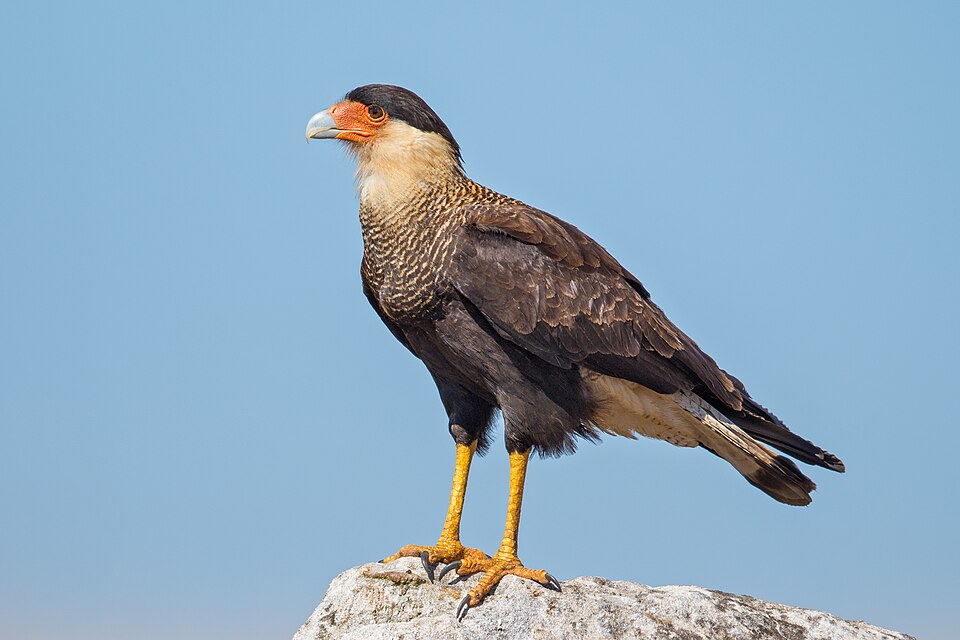
The Crested Caracara is one of North America's most unmistakable raptors, a long-legged bird that behaves more like a vulture than the falcon it actually is. With its black cap, bare red-orange face, pale neck, and bold pied plumage, it looks like nothing else sharing its territory. You are far more likely to see one walking purposefully across an open pasture or standing beside roadkill than perched in a treetop hunting. It is the national bird of Mexico, often called the "Mexican eagle," and the striking raptor depicted on the Mexican flag is widely believed to be a caracara rather than a true eagle.
In the United States, caracaras occupy a curiously patchy range: the prairies and ranchlands of central Florida, the brush country and coastal plains of Texas, and small pockets of Arizona. Across the border they are abundant throughout Mexico, Central America, and much of South America. Wherever they live, they thrive in open, semi-arid country with scattered trees, and they have adapted readily to working ranchland, where livestock, fences for perching, and reliable carrion suit them perfectly.
A large, leggy raptor with a heavy, hook-tipped bill and a distinctly long neck. On the ground it stands tall and walks with a confident, almost rooster-like gait; in flight it shows long, broad wings and a long tail with flashy white "windows" near the wingtips that are visible at a great distance.
| Head | Flat black crown and shaggy crest contrasting with a pale, creamy face and throat; large bare facial skin ranging from bright orange-red to dull yellow depending on mood and age |
| Bill | Heavy, pale bluish-gray, deeply hooked - much stouter than a typical falcon's |
| Body & breast | Pale buff neck and upper breast finely barred, transitioning to a solid blackish-brown belly and back |
| Wings in flight | Conspicuous whitish patches ('windows') at the base of the primaries near each wingtip, a key long-distance mark |
| Tail | Long, pale and finely barred with a broad black band at the tip |
| Legs | Long, bright yellow-orange legs, giving it a tall, walking-bird profile unlike most raptors |
Male vs. female
Males and females look essentially identical in plumage and coloration, so you cannot reliably tell them apart in the field. Females average slightly larger and heavier than males, as is typical for raptors, but the difference is subtle and only obvious when a pair is seen side by side. Both sexes share the same black cap, pale face, and bold pied pattern.
Juveniles
Juveniles are duller and browner overall, lacking the crisp black-and-white contrast of adults. Their crown and back are brown rather than black, the barring on the neck and breast appears as streaking instead of clean bars, and the bare facial skin is a pale pinkish or grayish color rather than the adult's red-orange. The legs are also paler, often grayish. It takes a couple of years for young birds to acquire full adult coloration.
Caracaras are not songbirds, but they do make a remarkable sound that gives the family its name. The signature vocalization is a low, dry, rattling cackle - a guttural krrr-r-r-r-r-r or "cackle" that sounds like a wooden rattle being shaken. While giving this call, the bird throws its head back dramatically until the crown nearly touches its back, a striking display worth watching for.
Aside from the rattle, caracaras are fairly quiet and lack the sharp screams and whistles you might expect from a falcon. The throw-back rattle is most often heard around the nest, in territorial encounters, and when birds gather at a food source.
In the United States, the Crested Caracara has three disjunct populations: central and south-central Florida, southern Texas, and a small foothold in south-central Arizona. The Florida population is non-migratory and somewhat isolated, occupying the dry prairies and improved pastureland of the peninsula's interior. South of the border, the species ranges continuously through Mexico, Central America, and across much of South America to the southern tip of the continent.
Caracaras are largely resident and do not undertake long seasonal migrations. Young birds disperse to find new territory, and individuals will wander widely in search of food, which occasionally produces vagrants well north of the usual range. The overall population is stable to increasing in many areas, helped by the spread of open ranchland.
The Crested Caracara is a true generalist and opportunist, which is the secret to its success. Carrion is a mainstay of its diet, and it is often the first bird at a carcass in the morning, regularly seen sharing roadkill or dead livestock with Black and Turkey Vultures. Unlike vultures, though, it is also an active predator and forager, taking insects, reptiles, amphibians, small mammals, fish, crabs, eggs, and nestlings. It will follow farm machinery and grass fires to snatch up fleeing or exposed prey.
Much of its hunting is done on foot. A caracara will walk steadily across open ground, flipping over debris and dung with its bill and feet to find beetles, grubs, and other hidden prey. It is also a confident kleptoparasite, using its size and boldness to bully vultures and other birds off their food. This blend of scavenging, predation, and theft lets it exploit almost any food source it encounters.
Caracaras form long-term pair bonds and defend a territory year-round. The nest is a bulky, somewhat messy bowl of sticks, grasses, and other vegetation, often built atop a cabbage palm, a low tree, a large cactus, or another commanding spot with a clear view of the surroundings. Both members of the pair contribute to building and maintaining the structure, and the same nest site may be reused and added to over successive years.
The female typically lays two to three eggs, which are heavily blotched with brown and reddish markings. Both parents share incubation duties over roughly a month, and both feed the young after they hatch. Pairs usually raise a single brood per year, though they may re-nest if an early attempt fails. The young remain dependent on their parents for some weeks after fledging.
The Crested Caracara is not a backyard or feeder bird, and there is no realistic way to draw one to a typical yard. It is a bird of wide-open ranchland and prairie, so the best approach is to go where it lives rather than trying to bring it to you. If you are within its range, a little knowledge of its habits goes a long way.
- Search open pasture, dry prairie, and ranchland with scattered trees and fence posts - the caracara's preferred habitat - rather than dense woods or suburban yards.
- Drive rural roads early in the morning and scan roadsides and carcasses; caracaras are often the first scavenger to arrive and frequently feed near pavement.
- Watch for a bird walking on the ground in fields - its long-legged, strutting gait is a giveaway no vulture shares.
- Check the tops of cabbage palms, lone trees, and utility poles in open country, where caracaras like to perch and survey for food.
- In Florida, the dry prairie region of the south-central peninsula (such as around Lake Okeechobee and the Kissimmee Prairie) is a classic place to find them.
- Bring binoculars and look for the white wing 'windows' and black-capped, red-faced head to confirm an ID from a distance.
- Turkey Vulture: Soars on raised, V-shaped wings with a teetering flight and a small bare red head; lacks the caracara's black cap, white wing windows, banded tail, and ground-walking habits.
- Black Vulture: All-black with a short tail and whitish patches only at the wingtips; flies with quick flaps and short glides on flat wings, and lacks the caracara's pale neck and long yellow legs.
- Bald Eagle: Much larger with a fully white head and tail as an adult, a massive yellow bill, and no black cap or red face; soars on flat, plank-like wings without the caracara's leggy ground habits.
- Osprey: A fish-eating raptor with a white underside, dark eye-stripe, and crooked wings held in a shallow M; hunts over water and never walks pastures scavenging carrion like a caracara.
Is the Crested Caracara a hawk, falcon, or vulture?
It is actually a falcon - a member of the falcon family - despite acting much like a vulture. It scavenges carrion and walks on the ground far more than typical falcons, but it is not closely related to true vultures or hawks.
Why is the Crested Caracara called the 'Mexican eagle'?
It is the national bird of Mexico, and the bold raptor shown on the Mexican flag perched on a cactus is widely believed to be a caracara rather than a true eagle. Its size and striking appearance earned it the eagle nickname even though it is a falcon.
Where can I see a Crested Caracara in the United States?
Look in three main areas: the dry prairies and ranchland of central and south Florida, the brush country and coastal plains of southern Texas, and small pockets of south-central Arizona. Open pasture with scattered trees is the key habitat.
What does a Crested Caracara eat?
Almost anything. It feeds heavily on carrion and roadkill but also actively hunts insects, reptiles, amphibians, small mammals, fish, and eggs, and it will steal food from vultures. This versatile, opportunistic diet is a big reason it thrives.
How do I tell a Crested Caracara from a vulture at a distance?
Look for the white patches near the wingtips, the long banded tail, and the black-capped head with a pale neck and red-orange face. Vultures lack these marks. If the bird is walking confidently across open ground on long yellow legs, it is almost certainly a caracara.