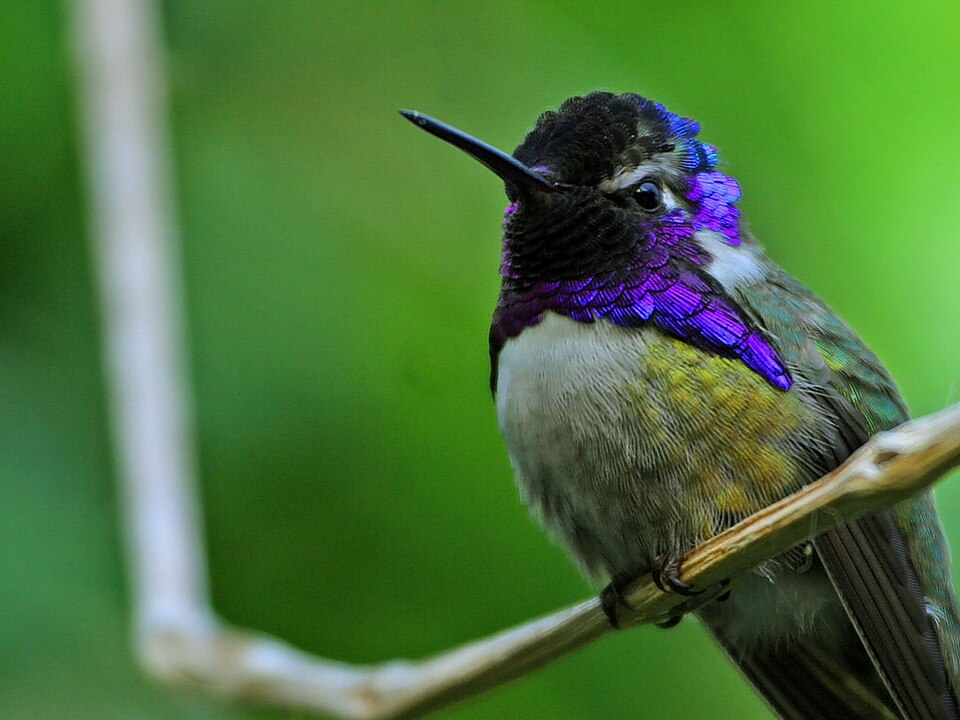
Costa's Hummingbird is the signature hummingbird of the American Southwest's hottest, driest country. While other hummingbirds chase the lush gardens and mountain meadows, Costa's thrives in the spare beauty of the Sonoran and Mojave deserts, threading among ocotillo, chuparosa, and agave. It is a tiny bird even by hummingbird standards, compact and large-headed, and the adult male wears one of the most extravagant adornments in North America: a deep amethyst-purple gorget that sweeps down the sides of the throat into long, flaring "mustache" points.
This is a bird tuned to scarcity. Costa's breeds early, often in late winter and spring when the desert briefly blooms, then largely clears out before the brutal heat of midsummer. Birders prize it both for the male's jewel-toned display and for the otherworldly, high whistle he produces during courtship dives. Where its range overlaps with the more widespread Anna's and Black-chinned hummingbirds, sorting them out is a satisfying field-ID challenge.
Costa's is small and stocky with a notably short tail and a relatively large, rounded head, giving it a front-heavy, "no-neck" look. At rest the wingtips often reach about to the tail tip. The bill is medium-length, straight, and slender. Size and proportions matter as much as color, since females and immatures are plainly marked.
| Adult male gorget | Glittering amethyst to violet-purple, extending well down the sides of the throat into long, pointed, flaring 'mustache' projections |
| Crown | Same iridescent purple as the gorget on adult males, so the whole face can flash violet in good light |
| Underparts | Whitish to pale grayish below, with greenish flanks; clean and unstreaked |
| Upperparts | Dull metallic green back and crown (green on females) |
| Size and shape | Very small and compact, large-headed, with a short tail; looks stubby compared to other hummers |
| Bill | Straight, slender, medium length and black |
Male vs. female
The sexes look quite different. The adult male is unmistakable when the light hits him: a vivid purple crown and a purple gorget that flares out at the sides into trailing points, like a drooping mustache. In poor light the gorget can look black, so watch for the shape rather than relying on color. The female lacks all the purple. She is plain green above and grayish-white below, with a pale, unmarked throat (sometimes a few faint dusky dots) and rounded tail feathers tipped with white. Female Costa's are genuinely tricky and are often identified by their small size, short tail, and large-headed shape as much as by plumage.
Juveniles
Juveniles resemble the adult female: green above, pale and grayish below, with a plain throat. Immature males begin showing scattered purple feathers on the throat as they mature, often appearing as a few stray glinting spots before the full gorget and crown come in. Young birds also tend to show slightly buffy or pale edges to the back feathers, giving a faintly scaled look up close.
The most distinctive sound is the courting male's display whistle, a high, thin, eerie note that rises and then slides downward, often written as a long zing or tssssseeeooo. He delivers it during steep, looping dive displays, and the whistle seems to swell and fade as he swings past, an almost ventriloquial, science-fiction quality unlike any other North American hummingbird.
Away from display, Costa's gives the usual hummingbird vocabulary of soft, dry chip and tik notes, sometimes run together into a light, ticking chatter when birds squabble at flowers. These calls are easy to overlook, so the dive whistle is the sound worth learning.
Costa's Hummingbird is a bird of the arid Southwest. Its core range covers the Sonoran and Mojave deserts of southern California, southern Nevada, Arizona, the Baja California peninsula, and northwestern Mexico, with breeding reaching into desert scrub and coastal sage habitats. It favors dry washes, desert flats with ocotillo and chuparosa, arid hillsides, and increasingly suburban desert gardens.
Its movements track the desert's brief productivity. Many Costa's breed early, in late winter and spring, then drift away from the hottest interior deserts as summer sets in, with some moving to coastal southern California and others wandering to chaparral and higher slopes before heading into Mexico. A portion of the population is present year-round in milder coastal and southern areas. They are short-distance migrants and partial wanderers rather than long-haul travelers.
Like all hummingbirds, Costa's runs on flower nectar and on the small insects and spiders that supply protein. In the desert it leans heavily on the blooms of chuparosa, ocotillo, desert lavender, agave, fairy duster, and various cacti and desert mints, timing its breeding to coincide with these flowering pulses. It also takes tree sap and laps insects from spiderwebs and foliage.
It forages with the typical hovering hummingbird style, probing flowers and hawking tiny gnats and flies out of the air. Males defend favored flowering patches, perching conspicuously on a bare twig to keep watch and chasing off rivals. Because desert flowers are patchy and short-lived, Costa's must constantly move to follow the bloom.
The female does all the nest work. She builds a tiny, soft cup of plant down and fibers bound with spider silk and often camouflaged on the outside with bits of lichen, leaves, or bark. Nests are usually placed in a low shrub, small tree, cactus, or even a dead yucca stalk, typically only a few feet off the ground in the open desert.
She lays two white, jellybean-sized eggs and incubates them alone for roughly two and a half weeks. The chicks fledge a few weeks after hatching, again cared for entirely by the female. Costa's often nests early in the year to match the spring desert bloom, and in good conditions a female may raise more than one brood in a season.
Yes, Costa's will visit yards within its desert range, and a thoughtfully planted garden plus a clean feeder can bring them in. Because they key on native desert blooms, the most reliable approach is to combine nectar plants with a well-maintained sugar-water feeder.
- Hang a feeder with a simple 4:1 water-to-white-sugar solution (no red dye, no honey), and clean it every few days, more often in desert heat, to prevent dangerous mold and fermentation.
- Plant native desert nectar sources such as chuparosa, ocotillo, desert lavender, fairy duster, and penstemon to draw birds the natural way.
- Provide a perch, a bare twig or thin branch near the feeder gives territorial males a lookout spot they love.
- Add a mister or shallow dripper; hummingbirds bathe in fine spray and a moving water source is a strong draw in dry country.
- Skip pesticides, since Costa's needs small insects and spiders to feed itself and its young.
- Put feeders out early in the year (late winter into spring) to catch Costa's during its peak desert breeding season.
- Anna's Hummingbird: Larger and bulkier with a rose-pink (not purple) gorget and crown that does not flare into long mustache points; Anna's also gives a buzzy, scratchy song from a perch.
- Black-chinned Hummingbird: Slimmer and longer-tailed; male shows a black throat with a thin violet base band rather than a full purple gorget, and lacks the purple crown.
- Ruby-throated Hummingbird: An eastern bird that rarely overlaps; male has a red throat and green crown, never purple, and lacks the flaring gorget shape.
- Calliope Hummingbird: Even tinier, with a streaked magenta gorget that flares into thin rays on a white background rather than a solid purple sheet, and no purple crown.
How do I tell a Costa's Hummingbird from an Anna's Hummingbird?
Look at color and shape. Costa's males have a deep purple crown and gorget that flares into long mustache-like points at the sides, while Anna's males show rose-pink on a rounded gorget and crown. Costa's is also noticeably smaller, shorter-tailed, and more compact, and Anna's gives a raspy perched song rather than Costa's eerie dive whistle.
What does a female Costa's Hummingbird look like?
Plain. She is dull green above and grayish-white below with an unmarked pale throat and white-tipped outer tail feathers. The best clues are her small size, short tail, and large rounded head, since females of related species look very similar.
Where do Costa's Hummingbirds live?
They are desert specialists of the American Southwest, mainly the Sonoran and Mojave deserts of southern California, Nevada, Arizona, Baja California, and northwestern Mexico, favoring dry washes, desert scrub with ocotillo and chuparosa, and desert gardens.
When is the best time to see Costa's Hummingbirds?
Late winter through spring is prime time, because Costa's breeds early to match the desert bloom. Many birds leave the hottest interior deserts by midsummer, so a spring visit to desert habitat or a backyard feeder gives you the best odds.
How do I attract Costa's Hummingbirds to my yard?
In their range, hang a clean feeder with a 4:1 water-to-sugar mix (no dye), provide a bare perch and a fine mister, and plant native desert nectar flowers like chuparosa, ocotillo, and desert lavender. Avoid pesticides so the birds can find the insects they need.