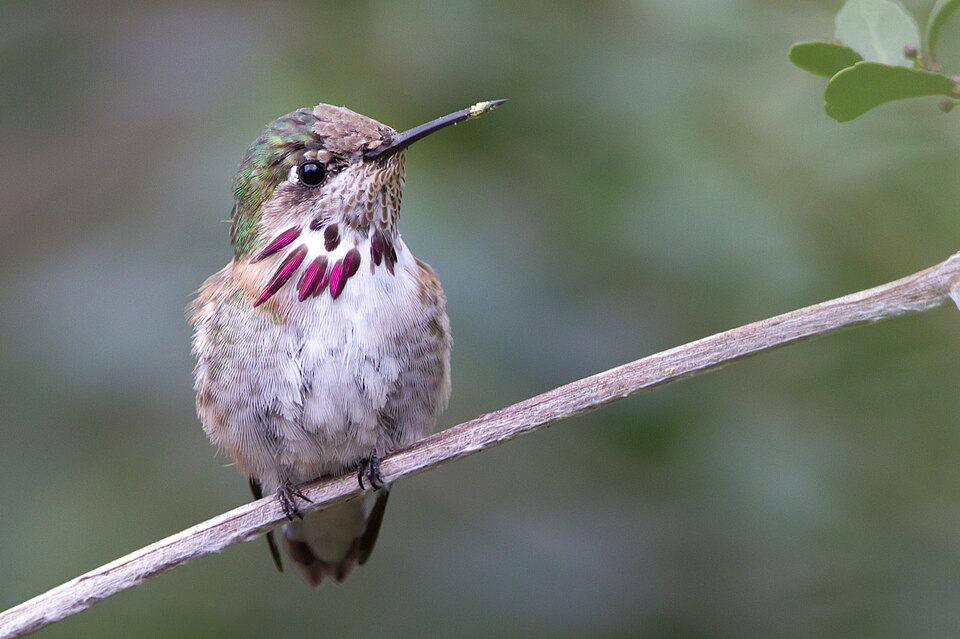
The Calliope Hummingbird is the smallest breeding bird in the United States and Canada, and one of the smallest long-distance migrant birds in the world. Weighing about as much as a penny, this tiny mountain dweller breeds in the cool, open forests and brushy meadows of the Pacific Northwest and northern Rockies, then makes a remarkable journey of several thousand miles to spend the winter in Mexico. For its size, it is astonishingly tough, often arriving on its breeding grounds while snow still lingers and nesting at elevations where frosty nights are routine.
What the Calliope lacks in size it makes up for in flair. The breeding male wears a unique gorget of wine-red or magenta feathers that flare outward into distinct rays or streaks rather than forming a solid bib, a look found in no other North American hummingbird. Quiet and easy to overlook, this species rewards patient backyard birders, especially those in the West who keep nectar feeders stocked during spring and fall migration.
Even among hummingbirds, the Calliope reads as exceptionally small and compact, with a short tail and a short, fine bill. At rest the wingtips reach to or slightly beyond the tail tip, giving it a stubby, hunched silhouette. The combination of tiny size, short bill, and short tail is the first clue before you ever see color.
| Size | Smallest bird in North America - noticeably tinier and more compact than other western hummingbirds |
| Male gorget | Wine-red to magenta streaks that flare outward into separate rays over a white throat, unlike a solid gorget |
| Bill | Short and fine for a hummingbird, all black |
| Tail | Short; at rest the folded wingtips extend to or past the tail tip |
| Underparts | Whitish below with buff or cinnamon wash on the flanks, especially in females and immatures |
| Upperparts | Metallic bronze-green back and crown in both sexes |
Male vs. female
Males and females look distinctly different. The adult male is unmistakable when seen well: glittering green above with a white throat marked by flaring magenta-red rays that he can fan dramatically during display, set off by a clean white collar across the upper chest. Females and immatures lack any red and are easily confused with other small hummingbirds. They are green above and whitish below with a peachy or cinnamon wash along the flanks, fine dark spotting on the throat, and a short tail with white-tipped outer feathers. The female's tiny size, short bill, and overall compact shape are the best clues to separate her from similar species.
Juveniles
Juveniles closely resemble adult females, with green upperparts, pale underparts, and buffy-washed flanks. Young males begin showing scattered dark or reddish flecks on the throat as they mature, eventually developing the streaked magenta gorget over their first year. Freshly fledged birds often look especially round and short-tailed, with neat pale fringes on the back feathers giving a slightly scaly appearance.
The Calliope Hummingbird is largely silent and does not sing a true musical song. Its vocalizations are limited to thin, high, insect-like chip notes, often given as a soft tsip or a light, dry chew. These calls are quiet and easy to miss against the sounds of a mountain meadow.
The most distinctive sounds come from the male's display rather than his voice. During courtship he climbs high into the air and dives in a steep U-shaped arc toward a perched female, producing a faint pfft or buzzy sputter at the bottom of the dive, generated by his tail and wings. His wings also make a soft, light buzz in flight, noticeably quieter and less trilling than the loud wing-whir of some other western hummingbirds.
Calliope Hummingbirds breed across the mountainous West, from interior British Columbia and Alberta south through Washington, Oregon, Idaho, Montana, and into the higher country of California, Nevada, Utah, Wyoming, and Colorado. They favor mid- to high-elevation open coniferous forest, willow and alder thickets along streams, brushy montane meadows, and areas regrowing after fire or logging.
This is a true long-distance migrant. In late summer and fall, most birds move south along the spine of the Rocky Mountains, timing their journey to bloom-rich mountain meadows, and winter in the pine-oak highlands of central and southern Mexico. Spring migration brings them north earlier and largely up the Pacific coast and lowlands. A small but growing number now turn up in the Southeast and along the Gulf Coast in fall and winter, making the Calliope a sought-after rarity at feeders far outside its normal range.
Like all hummingbirds, the Calliope runs on nectar and the small insects and spiders it catches to fuel its high-energy lifestyle. It feeds heavily on tubular wildflowers such as paintbrush, penstemon, currant, columbine, and various mints, favoring red and pink blooms but readily visiting many colors. Despite its tiny size it can be fiercely territorial at rich flower patches, though it is also a frequent "trap-liner," quietly visiting a circuit of scattered blossoms rather than defending one spot.
Insects are an essential protein source, especially for nesting females and growing young. Calliopes glean tiny insects from foliage, snatch them from the air in short sallies, and pick small prey from spider webs. At nectar feeders they sip sugar water and will also hawk gnats and other insects nearby.
The female builds and tends the nest entirely on her own. She constructs a tiny cup of plant down, moss, and bark bound together with spider silk and camouflaged with bits of lichen and bark on the outside. Calliopes have a clever habit of placing the nest under an overhanging branch or against a larger structure such as an old pine cone, which shelters it from rain and cold and can make it look like a small knot or cone on the limb.
The typical clutch is two white, jellybean-sized eggs. The female incubates them for about two weeks and broods the young, which fledge roughly three weeks after hatching. Females will reuse or build atop old nest sites in following years, and the well-insulated cup is critical to surviving the cold nights of high-elevation breeding habitat.
Yes, you can attract Calliope Hummingbirds, though mostly in the West and most reliably during spring and fall migration rather than as long-term summer residents. They readily visit nectar feeders and flower gardens, especially if you live in or near their mountain breeding range or along their migration routes.
- Hang a nectar feeder filled with a 1 part white sugar to 4 parts water solution - never use red dye, honey, or artificial sweeteners.
- Keep the solution fresh: change it every few days, more often in hot weather, to prevent harmful mold and fermentation.
- Plant tubular native flowers like penstemon, paintbrush, currant, columbine, and bee balm to draw them in naturally.
- Because Calliopes are small and easily bullied, offer several feeders spaced out of sight of each other so larger hummingbirds can't monopolize them all.
- In the West, put feeders out early in spring and leave them up through fall migration to catch passing Calliopes.
- Provide a gentle mister or dripper - hummingbirds love to bathe and fly through fine spray.
- Rufous Hummingbird: Larger with extensive bright orange-rufous on the back, flanks, and tail; male has a solid orange-red gorget, not flaring magenta streaks.
- Allen's Hummingbird: Similar to Rufous with rufous flanks and tail and a solid coppery-red throat; bigger and more orange overall than the tiny, green-backed Calliope.
- Broad-tailed Hummingbird: Larger with a longer tail and a rose-red solid gorget; male's wings produce a loud metallic trill, very unlike the Calliope's quiet wingbeats.
- Anna's Hummingbird: Larger and stockier with a longer tail; male shows a rose-pink crown and throat rather than flaring red streaks on white.
What is the smallest bird in North America?
The Calliope Hummingbird is the smallest bird in the United States and Canada, measuring only about 3 inches long and weighing roughly the same as a penny. It is also one of the smallest long-distance migratory birds in the world.
How do I tell a Calliope Hummingbird from a Rufous Hummingbird?
Calliopes are noticeably smaller and more compact, with a green back and (in males) magenta throat streaks that flare outward over white. Rufous Hummingbirds are larger, washed in bright orange on the back, flanks, and tail, and males have a solid orange-red gorget.
Where do Calliope Hummingbirds live?
They breed in the mountains of the Pacific Northwest and northern Rockies, from British Columbia and Alberta south to California and Colorado, favoring open forest and brushy meadows. In winter they migrate to the pine-oak highlands of Mexico.
Will Calliope Hummingbirds come to feeders?
Yes. They readily visit nectar feeders filled with a 1:4 sugar-water solution, especially during spring and fall migration in the West. Because they are small and easily bullied, offering several spaced-out feeders helps them get a turn.
How can I identify a female Calliope Hummingbird?
Female Calliopes lack red and look like other small hummingbirds: green above, whitish below with a peachy-cinnamon wash on the flanks, fine dark throat spotting, and a short tail with white-tipped corners. Their very small size and short bill are the best clues.