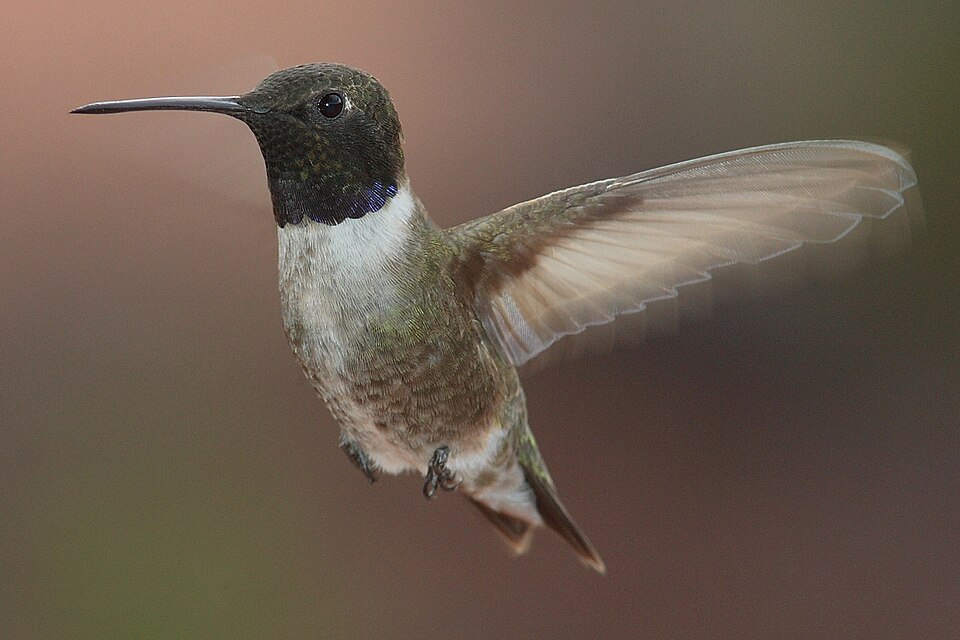
The Black-chinned Hummingbird is the workaday hummingbird of the American West, a small, adaptable sprite that turns up everywhere from desert canyons and cottonwood-lined rivers to suburban backyards and city parks. At first glance it can seem almost drab compared to the dazzling males of some western species, but that understatement is exactly what makes it interesting. The male's throat looks plain black in most light, then catches the sun at just the right angle and reveals a thin band of glowing violet-purple along its lower edge. It is a bird that rewards patience and a good angle of view.
Few hummingbirds tolerate human company as gracefully as this one. Black-chinneds readily nest in ornamental trees, sip from garden flowers, and become daily fixtures at sugar-water feeders across the Southwest and intermountain West. Their constant tail-pumping while hovering, their dry chittering calls, and the male's distinctive low buzzy wing trill make them recognizable even when their colors are not cooperating. For many western birders, this is the hummingbird of summer mornings.
This is a small, slim hummingbird with a slightly down-curved bill, a fairly long tail, and a habit of pumping or wagging that tail almost constantly while it hovers at flowers and feeders. Its overall impression is metallic green above and dingy grayish-white below, with no rufous or rusty tones anywhere on the body.
| Size | Tiny; about 3.5 in long with a slender build and proportionately long tail and bill |
| Upperparts | Dull metallic green on the back, crown, and rump in both sexes |
| Male throat | Looks velvety black, with a narrow band of iridescent violet-purple along the lower border that flashes only in good light |
| Underparts | Grayish-white below with dusky green flanks; no rufous tones anywhere |
| Behavior | Pumps its tail steadily while hovering, a key behavioral fieldmark |
| Bill | Black, fairly long, and slightly decurved (gently downward-curved) |
Male vs. female
Males and females are easy to separate when the male shows his gorget. The adult male has the black-and-purple throat patch, a clean white collar below it, and a slightly forked, dark tail. The female lacks any throat color, showing instead a plain whitish throat that may be finely flecked with dusky spots; her underparts are pale grayish-white, and her tail is rounded with white tips on the outer feathers. Females are notoriously hard to tell from female Ruby-throated and Costa's Hummingbirds and often require range, voice, or in-hand measurements to confirm.
Juveniles
Juveniles closely resemble adult females, with green upperparts, pale underparts, and a plain throat. Young birds often show neat buffy or pale fringes on the back feathers, giving a faintly scaly look in fresh plumage. Immature males may begin to show a few scattered dark or iridescent feathers on the throat by late summer and fall, hinting at the gorget they will develop, but a full violet band is not present until they molt into adult plumage.
Black-chinned Hummingbirds are not true songsters. Their main vocalizations are dry, soft, slightly husky chips and a rapid chittering or twittering, often given in chases and at feeders. A typical call is a low tchew or a tumbling series of chi-chi-chi-dit notes during territorial squabbles.
The most distinctive sound is mechanical, not vocal: in courtship the male climbs and then swoops in a wide pendulum-shaped dive, and his wings and tail produce a low, buzzy, whirring hum at the bottom of each arc. Even in ordinary flight, his wings make a softer, lower-pitched buzz than the high musical trill of an Anna's or the loud cricket-like trill of a male Broad-tailed Hummingbird.
This is a long-distance migrant of western North America. Breeding range stretches from southern British Columbia and the interior Pacific Northwest south through California, the Great Basin, the Rocky Mountain states, the Southwest, and into Texas and northern Mexico. It favors lowland riparian woodlands, desert washes, oak and pinyon-juniper foothills, canyons, and well-watered towns and suburbs.
Black-chinneds arrive on western breeding grounds in spring, roughly March in the south and April into May farther north, and most depart by September. The bulk of the population winters along the Pacific slope and lowlands of western Mexico. A small but growing number now linger through winter along the Gulf Coast and Southeast, where it has become one of the more regular "winter hummingbirds" found at feeders far outside the normal range.
Like all hummingbirds, the Black-chinned runs on a high-energy diet of nectar and small invertebrates. It feeds at a wide variety of tubular flowers, including ocotillo, agaves, desert willow, tree tobacco, penstemons, scarlet bugler, and many garden plants, and it readily visits sugar-water feeders. It is not especially fussy about flower color and will work whatever is blooming and rich.
Protein comes from tiny insects and spiders, which the bird gleans from foliage, plucks from spiderwebs, or catches in mid-air with quick hawking flights. This insect-hunting is essential for feeding nestlings and for the birds' own nutrition, so a healthy yard with insects is as valuable to them as any feeder. They will also drink at sap wells drilled by sapsuckers.
The female alone builds the nest, incubates, and raises the young; the male's role ends after mating. She constructs a tiny, deep cup, typically saddled on a small horizontal branch of a tree or shrub, often over or near water and frequently surprisingly low and in plain sight in suburban yards. The nest is made of plant down and fine fibers bound together with spider silk, which lets it stretch as the chicks grow. Unlike many hummingbirds, she often decorates the outside sparingly and the nest can look fairly plain.
A clutch is usually two tiny white eggs, and a female may raise two or even three broods in a season, sometimes starting a new nest while still tending fledglings from the last. Incubation lasts roughly two weeks, and the young leave the nest about three weeks after hatching.
Yes, the Black-chinned is very much a backyard and feeder bird across the West, and a little planning will make your yard a regular stop. The combination of clean feeders, the right flowers, and a nearby water feature is hard for them to resist.
- Hang a sugar-water feeder filled with a 4:1 ratio of water to plain white sugar. Never use honey, red dye, or artificial sweeteners.
- Clean feeders every few days in hot weather (every 1-2 days in extreme heat) to prevent mold and fermentation that can sicken birds.
- Plant tubular, nectar-rich flowers such as penstemon, salvia, desert willow, agave, and trumpet-shaped vines to provide natural food.
- Provide moving water like a mister, dripper, or small fountain. Hummingbirds love to bathe by flying through fine spray.
- Skip the insecticides. Hummingbirds rely on small insects and spiders for protein, especially when feeding chicks.
- Put feeders out by early to mid spring in your region to greet the first returning migrants.
- Ruby-throated Hummingbird: The eastern counterpart; males have a brilliant red (not purple) gorget. Females are nearly identical to female Black-chinneds, but ranges barely overlap, so location is the best clue.
- Anna's Hummingbird: Stockier, with the male showing a rose-pink throat AND crown. Anna's is a year-round resident on the Pacific Coast and gives a scratchy buzzy song, unlike the silent Black-chinned.
- Costa's Hummingbird: A desert species; the male's vivid purple gorget flares out into long pointed corners on the sides of the neck, versus the Black-chinned's neat narrow violet band.
- Broad-tailed Hummingbird: Overlaps in the Rockies; the male has a rose-red throat and produces a loud, metallic cricket-like wing trill in flight that the Black-chinned never makes.
How do you tell a Black-chinned Hummingbird from a Ruby-throated?
The clearest difference is the male's throat color: Black-chinned shows black with a thin violet-purple lower band, while Ruby-throated shows brilliant ruby-red. Females and immatures look almost identical, so the easiest tell is geography. Black-chinneds are western birds and Ruby-throats are eastern, with only a narrow overlap zone on the Great Plains.
Why does the male's throat look black instead of purple?
The color comes from iridescence, not pigment. The throat feathers reflect violet light only when sunlight hits them at the right angle relative to your eye. From most viewpoints, the feathers simply absorb light and look flat black. Wait for the bird to turn its head and you may catch the purple flash.
When should I put out my hummingbird feeder for Black-chinned Hummingbirds?
Put feeders out a couple of weeks before you expect the first arrivals. In the southern parts of the range that can mean March, while farther north April or even early May is right. Leaving a feeder up a little early helps catch the first returning migrants and signals that your yard is a reliable stop.
What does a Black-chinned Hummingbird sound like?
They do not really sing. You will mostly hear dry chittering and soft chip notes during chases at feeders. The male's signature sound is mechanical: a low buzzy wing hum, especially noticeable at the bottom of his swooping courtship dives. It is lower and softer than the loud cricket-like trill of a Broad-tailed Hummingbird.
Do Black-chinned Hummingbirds reuse the same nest or area each year?
Females often return to the same general nesting areas in successive years and may build a new nest on top of an old one or very near a previous site. They also frequently raise two or three broods in a single season, sometimes starting a fresh nest while still feeding fledglings from the previous brood.