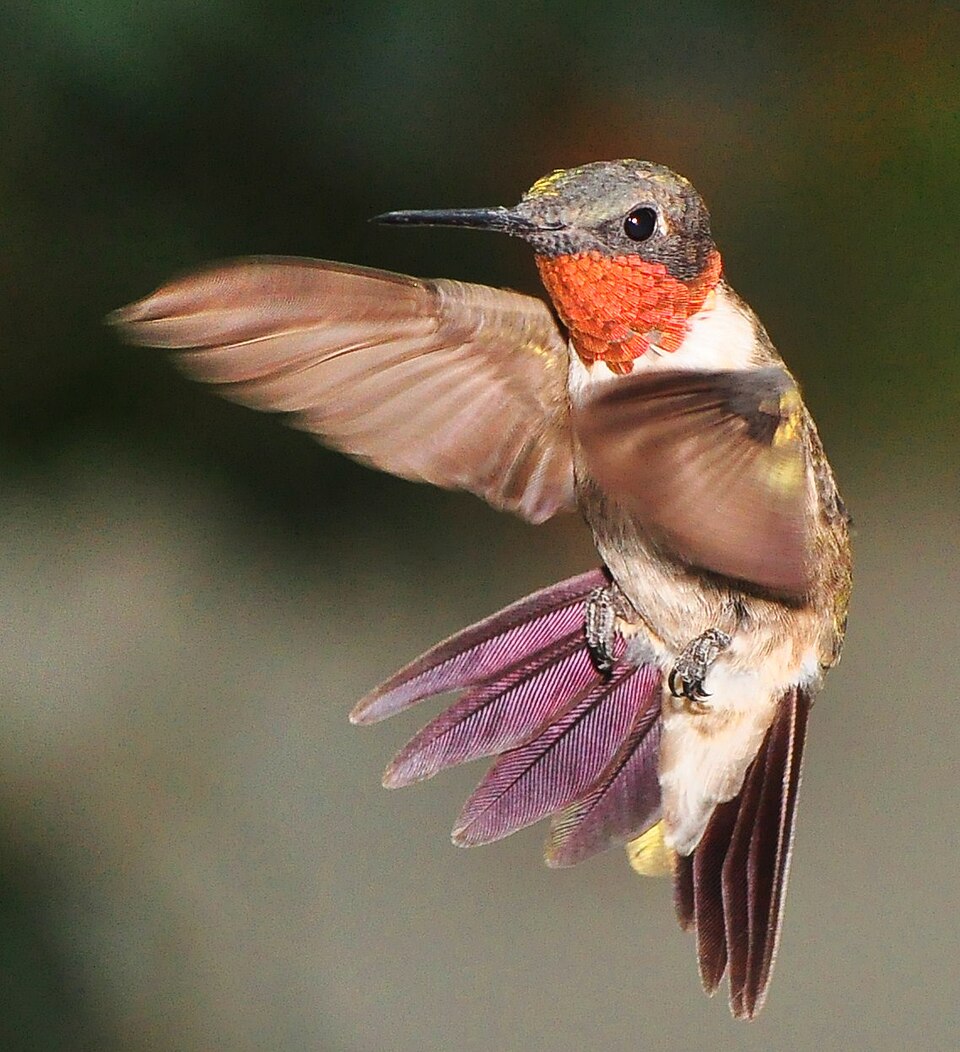
The Ruby-throated Hummingbird is the tiny, hyperactive sprite that visits flower gardens and nectar feeders across the eastern United States and southern Canada. For most people living east of the Great Plains, this is the hummingbird, it is the only species that breeds regularly in the region, so any hummer hovering at your bee balm in June is almost certainly this one. Weighing about as much as a penny, it can beat its wings more than 50 times a second, producing the distinctive insect-like hum that gives the family its name.
Despite its delicate appearance, this is a bird of astonishing endurance. Each fall, many Ruby-throats cross the Gulf of Mexico in a single nonstop flight of roughly 500 miles, fueled by fat reserves that nearly double their body weight before departure. That combination of fragility and toughness, plus a willingness to come right up to a porch feeder, makes the Ruby-throated Hummingbird one of the most beloved backyard birds in North America.
A Ruby-throat is unmistakable as a hummingbird, minuscule, with a long needle-like bill, a stubby body, and wings that blur in flight. The challenge is rarely "is it a hummingbird?" but "which one?" In the East that question is usually easy, since this is the default species. Look first at the back, which is bright metallic emerald-green in good light on birds of all ages and sexes.
| Size | Tiny, roughly 3 inches long; among the smallest birds in North America |
| Upperparts | Glittering metallic green on the back, crown, and rump |
| Throat (male) | Brilliant iridescent ruby-red gorget that can look black until light strikes it |
| Throat (female) | Plain whitish, sometimes with faint dusky streaking |
| Underparts | Grayish-white with greenish flanks; no rusty or buffy wash |
| Tail | Male's tail is forked and all-dark; female's is rounded with white tips on the outer feathers |
Male vs. female
The sexes are easy to separate when seen well. The adult male has the namesake gorget, a throat patch of intense iridescent red that flashes ruby, orange, or even gold depending on the angle, and looks flat black in poor light. He also has a slightly forked, all-dark tail and a cleaner green-and-white look overall. The female lacks any red on the throat, showing instead a plain pale throat (occasionally finely speckled), grayish-white underparts, and a broader, rounded tail tipped with white on the outer corners. Females also tend to look a touch larger and bulkier than males.
Juveniles
Juveniles closely resemble adult females: green above, pale below, with white-tipped outer tail feathers and a plain or lightly streaked throat. Young males in late summer and fall often show a few scattered dark or reddish flecks on the throat, the first hints of the gorget they will fully develop by the following spring. Because of this overlap, a streaky-throated bird at an August feeder could be a female or an immature male, and the two can be very hard to tell apart in the field.
Ruby-throated Hummingbirds are not songbirds in the musical sense; their vocalizations are a rapid series of high, squeaky, twittering chip notes, a thin, dry chee-dit, chee-dit or a fast tchew-tchew-tchew often given during chases. When two birds skirmish over a feeder, you will hear an excited, scratchy chittering as they dart and dive at each other.
Much of the "sound" of this species is mechanical rather than vocal. The wings produce a steady, insect-like hummmm in flight, and during his courtship display the male's wings and tail create a distinctive buzzy whir as he traces a wide, pendulum-like U-shaped arc in front of a perched female.
The Ruby-throated Hummingbird breeds across the eastern half of North America, from the Gulf Coast north through the Midwest and Northeast and into much of southern and central Canada, reaching as far as the boreal edge in places. It favors open woodlands, forest edges, gardens, parks, and orchards, anywhere with flowers and a mix of trees and open space.
It is strongly migratory. Birds arrive in the southern states in March and reach the northern breeding grounds by May, following the bloom of early nectar plants northward. In fall, most withdraw to Mexico and Central America, with the Gulf-crossing flight being a famous feat of endurance. A small but growing number of Ruby-throats now linger along the Gulf Coast and Southeast through winter, especially where feeders are kept up.
Nectar is the high-octane fuel of a hummingbird's life, and Ruby-throats visit a huge range of flowers, they especially favor red and orange tubular blooms like trumpet creeper, bee balm, cardinal flower, jewelweed, and salvia, though they will sample many colors. They feed by hovering and lapping nectar with a long, forked, brushy-tipped tongue that flicks in and out many times per second.
Sugar alone cannot build muscle or feed nestlings, so a large part of the diet is small insects and spiders: gnats, mosquitoes, aphids, tiny flies, and spiders plucked from webs. You will often see a hummingbird hawking insects in midair or gleaning them from foliage. They also drink tree sap from the wells drilled by sapsuckers, and they readily come to sugar-water feeders.
The female alone builds the nest, chooses the site, and raises the young, males play no part after mating. The nest is a tiny, deep cup, only about the size of a thimble or half a walnut shell, usually saddled on a slender downward-sloping branch several feet to many feet above the ground. She constructs it from plant down and fibers bound together with spider silk, then camouflages the outside with bits of lichen and bark. The spider silk lets the nest stretch as the chicks grow.
A typical clutch is two white, pea-sized eggs, which the female incubates for about two weeks. The chicks hatch naked and helpless and are fed regurgitated nectar and insects; they fledge roughly three weeks after hatching. In the warmer parts of the range, a female may raise two broods in a single season.
This is one of the easiest and most rewarding birds to bring to a yard. A clean nectar feeder plus the right plants will reliably draw Ruby-throats throughout the warm months, and once a bird finds a good spot it often returns year after year.
- Fill feeders with a simple 4:1 ratio of water to white table sugar, no honey, no dye. Red food coloring is unnecessary and may be harmful; a red feeder is plenty.
- Clean feeders every few days in hot weather (and replace the sugar water), since fermentation and mold can make hummingbirds sick.
- Plant native nectar flowers, especially red and orange tubular blooms like trumpet creeper, cardinal flower, bee balm, and salvia, to provide natural food and draw birds in.
- Put up feeders by early-to-mid spring to catch returning migrants, and leave at least one up well into fall for stragglers, feeders do not stop birds from migrating.
- Offer multiple feeders spaced apart, since a dominant male will fiercely defend a single feeder and chase others away.
- Provide a gentle mister or shallow moving water; hummingbirds love to bathe by flying through fine spray.
- Rufous Hummingbird: The most likely look-alike in fall and winter in the East; adults and many young show rusty-orange on the back, flanks, and tail, which Ruby-throats never have.
- Black-chinned Hummingbird: A close western relative that overlaps slightly in the south-central states; the male's gorget is violet-purple at the bottom edge rather than ruby-red, and it is extremely similar to female Ruby-throats.
- Anna's Hummingbird: A western species; the male has a rose-red crown AND throat (not just the throat), and it is bulkier. Rare in the East but possible as a winter vagrant.
Why is my hummingbird's throat black instead of red?
It's still a male Ruby-throat, the gorget is iridescent, not pigmented, so it only flashes ruby-red when light hits it at the right angle. From the side or in shade it looks dull black or dark.
What is the right sugar-water recipe for hummingbird feeders?
Mix four parts water to one part plain white table sugar, stir until dissolved, and skip honey, brown sugar, and red dye. There's no need to boil it for short-term use, but clean the feeder and refresh the mix every few days in warm weather.
When should I put up and take down my feeder?
Put feeders out in early to mid spring to greet returning migrants, and leave at least one up two or three weeks past your last sighting in fall. Feeders do not prevent hummingbirds from migrating on schedule.
How can I tell a male from a female Ruby-throated Hummingbird?
Look at the throat and tail. Males have a brilliant red (or black-looking) gorget and a forked all-dark tail. Females have a plain pale throat and a rounded tail with white tips on the outer feathers.
Do Ruby-throated Hummingbirds really cross the Gulf of Mexico?
Many do. Before migration they pack on fat reserves and then fly roughly 500 miles nonstop across open water, a remarkable feat for a bird that weighs about as much as a penny. Others take an overland route around the Gulf.