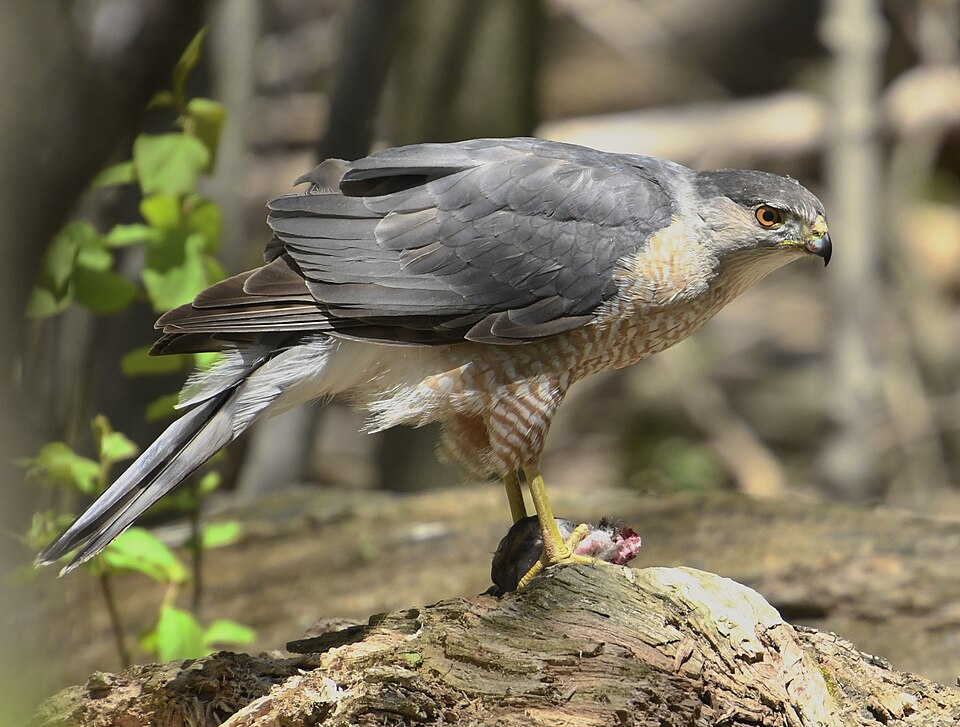
The Cooper's Hawk is a medium-sized, bird-eating hawk that has become one of the most familiar raptors of North American backyards, parks, and tree-lined neighborhoods. Built for ambush rather than soaring, it has short, rounded wings and a long, rudder-like tail that let it twist through dense branches at high speed in pursuit of songbirds and doves. For many people, their first sighting is dramatic: a gray-backed hawk suddenly scattering the feeder flock and snatching a startled bird in a blur of feathers.
Once persecuted and hit hard by the pesticide era of the mid-1900s, Cooper's Hawks have rebounded strongly and now thrive in cities and suburbs across the continent. Bird feeders, abundant pigeons and doves, and mature shade trees have effectively created ideal habitat. As a result, this once-shy woodland predator is now a regular, if sometimes unwelcome, visitor to the very yards where people gather songbirds.
Cooper's Hawk is an accipiter, and the whole bird is shaped for maneuvering: a relatively small head, broad chest, short rounded wings, and a notably long tail with a rounded, white-tipped end. In flight it shows a distinctive flap-flap-glide pattern, and the head often projects well out beyond the leading edge of the wings, giving it a "flying cross" look.
| Size & shape | Crow-sized accipiter with short rounded wings and a long, rounded tail; small head on a broad chest. |
| Adult upperparts | Blue-gray to slate above with a distinctly darker crown, giving a 'capped' look that contrasts with a paler nape. |
| Adult underparts | Clean white below with fine, warm reddish-orange barring across the breast and belly. |
| Eyes | Adults have deep red to orange eyes; younger birds show yellow eyes that darken with age. |
| Tail | Long, with bold dark bands and a rounded tip edged in a noticeable white terminal band. |
| Flight style | Stiff, quick wingbeats then a glide; head projects well beyond the wrists. |
Male vs. female
Male and female Cooper's Hawks look alike in plumage, but they differ dramatically in size, which is typical for bird-hunting raptors. Females are considerably larger and heavier than males, sometimes by a third or more, and a big female can rival a small Red-shouldered Hawk in bulk. A lone bird is hard to sex by size alone, but when a pair is seen together the size gap is obvious. This difference also shapes their diet, with larger females able to tackle bigger prey like pigeons and doves while males more often take smaller songbirds.
Juveniles
Juvenile Cooper's Hawks look strikingly different from adults. They are brown above rather than blue-gray, and their underparts are white with crisp, thin brown streaks that are heaviest on the upper breast and fade out toward the lower belly, leaving the rear underparts looking clean. Their eyes are pale yellow rather than red. This brown-and-streaked plumage is held through the first year, and the neat, fine streaking (rather than thick blobs or heavy barring) is a useful clue separating young Cooper's from young Red-shouldered or Red-tailed Hawks.
Cooper's Hawks are most vocal around the nest in spring and early summer. The signature call is a loud, harsh, repeated cak-cak-cak-cak, sometimes described as kek-kek-kek, delivered in rapid bursts that ring through the trees and often give away a nest's location. The notes are flatter and more nasal than the higher, faster scream of the Sharp-shinned Hawk.
Around the nest, females and begging young also give a drawn-out, whining kik... kik... or a wheezy whistle when food is being delivered. Outside the breeding season the species is largely silent, which is part of why it can slip into a yard, hunt, and leave without ever announcing itself.
Cooper's Hawks are found across much of North America, breeding from southern Canada through the United States and into northern Mexico. They occupy a wide range of wooded habitats, from mature forests and riparian corridors to suburban neighborhoods and city parks with scattered tall trees.
Movement varies by population. Birds breeding in the northern part of the range tend to migrate south for winter, sometimes well into Mexico and Central America, while many in milder regions are year-round residents. During fall migration, watch hawk-watch sites and ridgelines where Cooper's Hawks stream past, often mixed with the smaller Sharp-shinned Hawks. In winter, the population in southern and urban areas swells as northern migrants move in.
This is a bird hunter through and through. Medium-sized birds make up the bulk of the diet, including doves, pigeons, robins, jays, starlings, flickers, and the assorted songbirds that gather at feeders. Larger females regularly take prey up to the size of a Rock Pigeon, while smaller males specialize in sparrows, finches, and similar small birds. Cooper's Hawks will also take small mammals such as chipmunks, squirrels, and mice, and occasionally lizards or other prey.
Their hunting style is fast and stealthy rather than soaring. A Cooper's Hawk typically perches quietly in cover, then makes a sudden, low, accelerating dash, weaving through branches and around obstacles to surprise its target. They are known to grip prey with their powerful feet and may carry it to a perch or even hold it underwater or on the ground until it stops moving. At feeders, the hawk itself is the reason the songbirds suddenly vanish.
Cooper's Hawks nest in trees, often in a tall deciduous or coniferous tree where a sturdy fork or horizontal limb can support a bulky stick platform. The male does much of the construction, building a substantial nest of sticks lined with bark flakes and greenery, frequently placed against the trunk well up in the canopy. Pairs sometimes build a new nest atop an old one or reuse the same general area in successive years.
The female lays a clutch of roughly three to five pale bluish-white eggs and does most of the incubating, which lasts around a month, while the male hunts and brings food. After hatching, the young remain in the nest for several weeks before fledging, then stay nearby being fed by the parents as they learn to hunt. Pairs typically raise a single brood per year.
Cooper's Hawk is not a feeder bird in the usual sense, and you cannot bait one with seed or suet. What attracts it is the songbirds at your feeders, so a busy yard is its own invitation. Many backyard birders find this thrilling, others alarming. Here is how to think about it.
- A well-stocked feeding station naturally draws Cooper's Hawks because concentrations of songbirds and doves are exactly the prey they seek, the hawk is following the buffet, not the seed.
- Mature trees and tall shrubs give a hawk the perches and cover it needs to hunt, so leafy, layered yards see them more often.
- If you'd rather not host the drama, place feeders within about 10 feet of dense cover so songbirds can dive for safety, or move feeders right up close to windows to break up a hawk's attack run.
- If a Cooper's Hawk is dominating your feeders, take the feeders down for a week or two, the songbirds disperse and the hawk usually moves on to easier hunting.
- Remember that a hunting hawk in the yard is a sign of a healthy, well-fed bird community, and predation on common feeder birds is natural and sustainable.
- Keep a respectful distance from any nest you discover; nesting Cooper's Hawks can be defensive and the law protects them.
- Sharp-shinned Hawk: Smaller and more delicate, with a small head that barely projects past the wings, squared-off tail tip, and thin 'pencil' legs; in flight looks more compact and flits more buoyantly.
- Northern Goshawk: Much larger and bulkier accipiter with broader wings, a bold white eyebrow stripe in adults, and pale gray underparts finely vermiculated rather than rufous-barred.
- Red-shouldered Hawk: A buteo with broader wings and a shorter tail; soars more, shows rusty shoulders and translucent wing 'windows,' and gives a clear screaming kee-aah rather than a barking cak-cak.
- Merlin: A small falcon with pointed wings and fast, direct flight; lacks the rounded wings and long banded tail of an accipiter and powers along rather than flap-glide weaving through trees.
How do I tell a Cooper's Hawk from a Sharp-shinned Hawk?
It's one of the toughest ID challenges in birding. Cooper's Hawks are larger (closer to crow-sized) with a bigger, more block-shaped head that projects well past the wings in flight, a rounded tail tip with a broad white band, and thicker legs. Sharp-shinned Hawks are smaller and rangier with a tiny head, a squared or notched tail tip, and thin legs. Behavior helps too: Cooper's flies with stiffer, more deliberate wingbeats, while Sharp-shinned looks flighty and buoyant.
Is the hawk that's eating birds at my feeder a Cooper's Hawk?
Very often, yes. Cooper's Hawks have adapted beautifully to suburbs and routinely raid feeders for doves, pigeons, and songbirds. If a gray-backed or brown, streaky hawk with a long banded tail keeps clearing your feeders, a Cooper's Hawk is the most likely culprit, sometimes alongside the smaller Sharp-shinned Hawk.
Should I take my feeders down if a Cooper's Hawk shows up?
You don't have to, but you can. Predation on feeder birds is natural and the songbird population can absorb it. If it bothers you or the hawk is killing birds daily, take the feeders down for a week or two; the songbirds will spread out and the hawk will usually move along. Placing feeders near dense cover also gives songbirds a fighting chance to escape.
Will a Cooper's Hawk attack my pets or chickens?
Cooper's Hawks focus on birds and small mammals roughly up to pigeon or chipmunk size, so they are not a threat to dogs or cats. They can take small backyard chickens or chicks, especially bantams, so covered runs are wise if you keep poultry. A healthy adult cat or a medium-to-large dog is far too big to interest them.
Are Cooper's Hawks rare or protected?
They are common and have actually increased in recent decades, especially in towns and cities. Like nearly all native North American birds, they are protected under the Migratory Bird Treaty Act, so it is illegal to harm, capture, or disturb the birds, their nests, or their eggs.