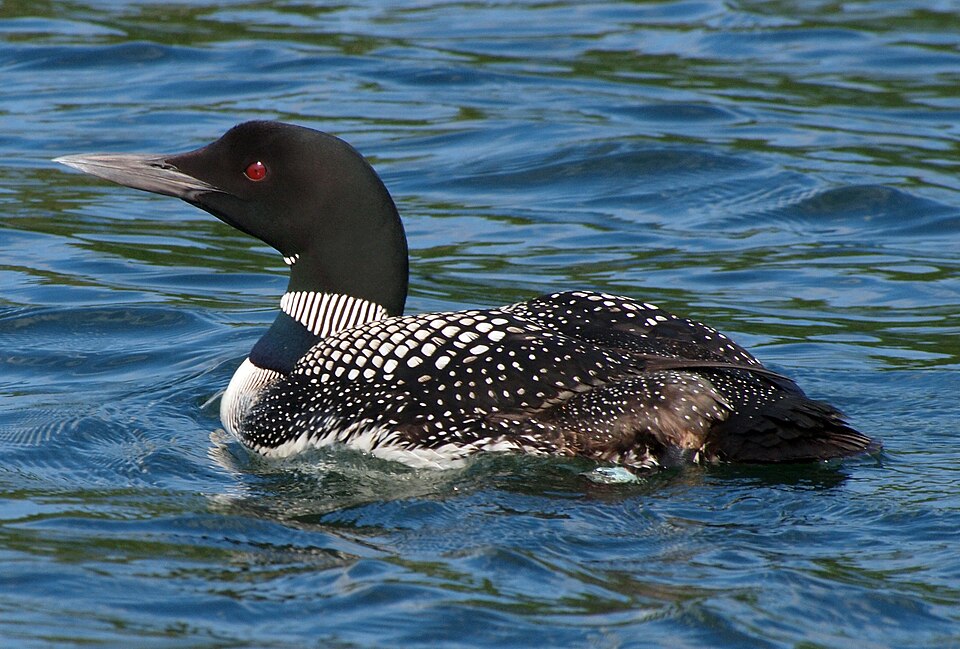
Few sounds say "northern wilderness" quite like the wail of a Common Loon carrying across a misty lake at dusk. Heavy-bodied, dagger-billed, and built for diving, this is one of North America's most beloved waterbirds, the emblem of clean boreal lakes from the Upper Midwest and New England up through Canada and Alaska. In summer its breeding plumage is unmistakable: a glossy black head, a checkerboard back of white spots, and a striped collar of white slashes around the neck, all set off by an eerie blood-red eye.
Loons are not ducks, despite the superficial resemblance. They belong to an ancient lineage of foot-propelled divers with dense, heavy bones that help them sink and chase fish underwater. That same heavy build makes them clumsy on land, where their legs are set so far back on the body that walking is little more than an awkward shove. They come ashore only to nest, and they need a long, splashing runway of open water to get airborne. On the water, though, they are graceful, powerful, and endlessly watchable.
Look for a large, low-riding waterbird with a thick neck, a long body that often sits deep in the water, and a heavy, straight, spear-like bill held level. Loons float lower than ducks and dive frequently, often slipping under without a splash. Size is distinctive too: roughly goose-sized and far bulkier than any grebe.
| Breeding head | Glossy greenish-black head and bill, with a striking deep-red eye |
| Neck pattern | Two partial collars of vertical white stripes on a black throat |
| Back | Black with neat rows of white squares and spots, like a checkerboard |
| Bill | Heavy, straight, dagger-shaped; black in breeding birds, pale gray in winter |
| Winter plumage | Plain dark gray above, white below, with a smudgy half-collar and pale throat |
| Posture | Sits low in the water; bill held horizontal (unlike the upturned bill of some grebes) |
Male vs. female
Males and females look identical in plumage, with no seasonal or color differences between the sexes, so you cannot reliably tell them apart in the field by sight. Males do average noticeably larger and heavier, with a bulkier head and bill, and when a pair is together the size difference can sometimes be judged. Voice offers a better clue on the breeding grounds: the wild, rising yodel call is given only by males and is unique to each individual.
Juveniles
Juveniles and first-winter birds resemble nonbreeding adults but look even plainer and softer. They are gray-brown above with pale, scalloped edges to the back feathers that give a faintly scaly look, and clean whitish underparts and throat. The eye is dull reddish-brown rather than vivid red, and the bill is pale gray. Young loons keep this drab plumage through their first year and won't show the bold breeding checkerboard until they are well over a year old; many remain on coastal wintering waters for their first summer or two.
The Common Loon has one of the most evocative voices in all of North American birding, and birders recognize four main calls. The wail is the classic loon sound, a long, mournful, rising-and-falling cry (often written aaaa-oooo-eeee) used to keep contact with a mate or chicks across distance. The tremolo is a wavering, almost maniacal laugh, sometimes called the "crazy laugh," given when the bird is alarmed or agitated; it is also the only call loons make in flight.
The yodel is the male's territorial call, a long, complex, rising phrase that no two males deliver quite the same way. Finally, the soft hoot is a short, intimate single note used at close range between family members. Loons are most vocal at night and in the half-light of dawn and dusk, when their calls ring across still water in a way that has unsettled and enchanted lake visitors for generations.
Common Loons breed across the northern tier of the continent, from Alaska and across boreal Canada south into the northern United States, including the Upper Midwest, the Northeast, parts of the Rockies, and a sliver of the Pacific Northwest. They favor clear, fish-rich freshwater lakes with quiet coves and undisturbed shorelines for nesting.
In fall they migrate to coastal waters, wintering along both the Atlantic and Pacific coasts and the Gulf of Mexico, as well as on large ice-free reservoirs and lakes inland. Wintering birds molt into drab gray plumage and become silent, so the loon you see bobbing offshore in January looks and sounds nothing like the bold, calling bird of the summer lake. A few non-breeders linger on coastal and southern waters through the summer.
Common Loons are pursuit divers that hunt almost entirely by sight, so they need clear water. They eat mostly small to medium fish, including perch, sunfish, minnows, and suckers, swallowing the catch underwater unless it is large. When fish are scarce they also take crayfish, snails, leeches, aquatic insects, and other invertebrates.
A hunting loon will often "snorkel," dipping its face below the surface to scan for prey before diving. Dives typically last under a minute but can stretch longer, and loons can reach surprising depths in pursuit of fish. Their solid bones and powerful, paddle-like feet make them extraordinarily efficient underwater, able to outmaneuver fast prey in open water.
Pairs nest right at the water's edge, since their bodies are too awkward for them to walk far ashore. The nest is a simple mound of matted vegetation, often on a small island, a muskrat lodge, or a sheltered shoreline hummock where the bird can slip on and off directly into deep water. Many pairs reuse the same site year after year.
The female typically lays two olive-brown, dark-spotted eggs, and both parents share incubation over roughly four weeks. The downy black chicks leave the nest within a day or two and famously ride on their parents' backs, a behavior that keeps them warm and safe from underwater predators while they learn to dive. Adults feed the young small fish for weeks until the chicks can fish for themselves. Loons usually raise a single brood per year and are long-lived, with strong fidelity to both mate and territory.
The Common Loon is not a backyard or feeder bird, and there is no food or feeder that will draw one to your property. It is a fish-eating diver of large, clean lakes, so the best way to "attract" loons is to protect the wild lakes they depend on.
- If you own lakefront property, leave natural shoreline and small islands undisturbed for nesting; loons abandon nests easily when disturbed.
- Keep your distance by boat, especially from chicks and nesting birds, and slow down to avoid swamping nests with your wake.
- Switch to non-lead fishing tackle; loons die from swallowing lost lead sinkers and jigs, a leading cause of adult loon deaths.
- Support clean-water efforts, since loons need clear water to hunt by sight and are sensitive to mercury and acidification.
- To see one, visit a northern lake in summer at dawn or dusk, or scan coastal and reservoir waters in winter.
- Red-throated Loon: Smaller and slimmer, with a thinner bill it often holds slightly upturned; lacks the bold checkerboard back.
- Common Merganser: A duck, not a loon; thin red bill, swims higher, and males show clean white sides and a green head.
- Double-crested Cormorant: Similar dark diver, but has a hooked bill, often perches with wings spread, and swims with bill tilted up.
- Pied-billed Grebe: Far smaller and chunkier with a short, stubby chicken-like bill; never shows a loon's spear-shaped bill.
What does a loon call sound like?
Loons have four main calls. The wail is a long, mournful rising-and-falling cry used to keep contact; the tremolo is a wavering, laugh-like alarm call (and the only call given in flight); the yodel is the male's complex territorial cry; and the hoot is a soft, short note between family members. They call most at night and at dawn and dusk.
Are loons ducks?
No. Loons belong to their own ancient group of diving birds and are not closely related to ducks. They have heavy, solid bones, legs set far back on the body for underwater propulsion, and a dagger-like bill, rather than the flattened bill of a duck.
Why do baby loons ride on their parents' backs?
Loon chicks ride on a parent's back to stay warm, conserve energy, and stay safe from underwater predators like large fish and snapping turtles during their first weeks, before they are strong enough to dive and fish on their own.
Where do Common Loons go in winter?
They leave their northern breeding lakes and migrate to coastal waters along the Atlantic, Pacific, and Gulf coasts, as well as some large ice-free inland reservoirs. In winter they molt into a plain gray-and-white plumage and become almost completely silent.
Why is lead fishing tackle dangerous to loons?
Loons swallow small pebbles to help grind food in their gizzard, and they sometimes pick up lost lead sinkers and jigs the same way, or ingest them in a hooked fish. Even one small lead piece can poison and kill an adult loon, which is why many regions encourage non-lead tackle.