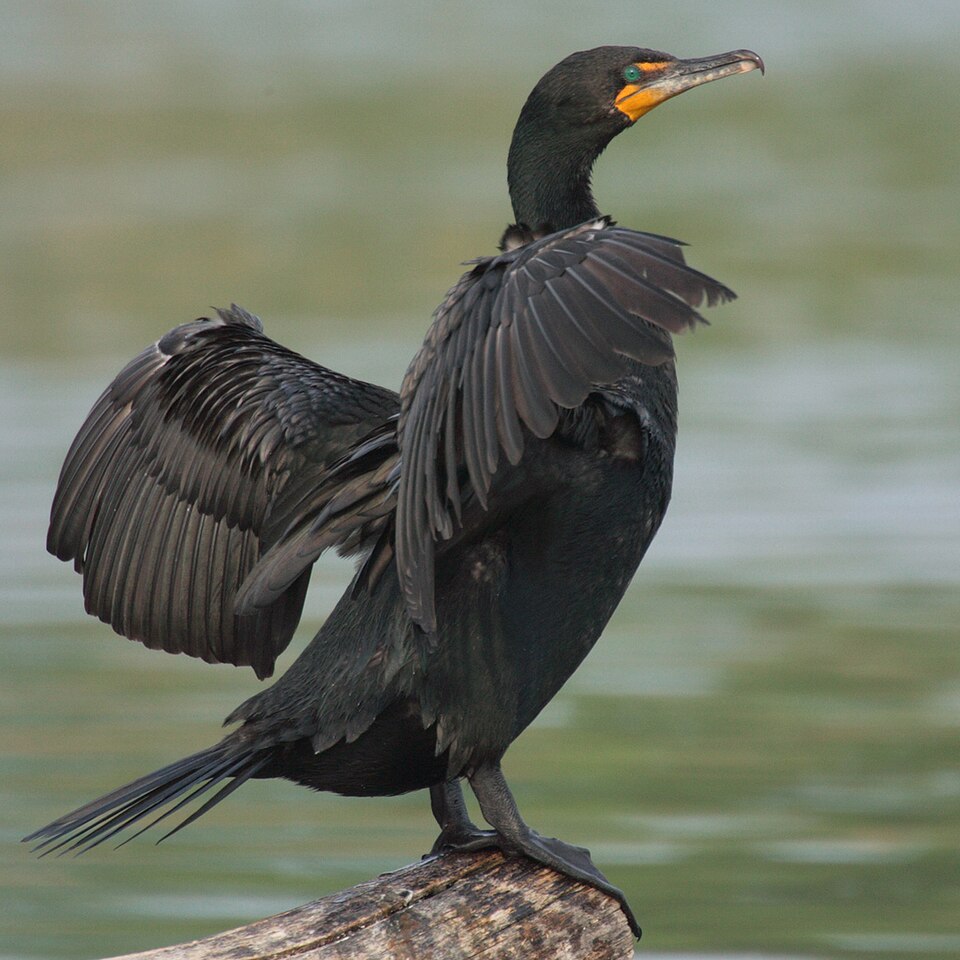
The Double-crested Cormorant is the waterbird most North Americans have seen without quite knowing what it was. It is the big, dark, goose-sized bird perched on a piling or a half-sunken log with its wings spread wide in the sun, or the low, snaky silhouette riding the surface of a lake with just its head and neck above the water. Equally at home on inland reservoirs, rivers, marshes, and saltwater bays, it is the only cormorant most inland birders will ever encounter, and the most widespread of the six cormorant species in North America.
For decades this bird was a conservation comeback story and then, in some places, a flashpoint. Numbers crashed in the mid-1900s from DDT and persecution, then rebounded dramatically after the pesticide was banned, to the point that anglers and aquaculture operators in some regions now consider it a nuisance. Whatever your opinion of its appetite for fish, it is a superb swimmer and diver, an excellent indicator of healthy fisheries, and an easy, satisfying bird to add to a list. Its scientific name was recently moved from Phalacrocorax to Nannopterum auritum.
Think of a cormorant as a long-bodied, long-necked, all-dark waterbird that sits low in the water and flies with a distinctive kinked neck. The Double-crested is heavy-bodied with a fairly long, thin, hook-tipped bill held tilted slightly upward when swimming. The single best clincher in good light is the patch of bare, orange-yellow skin on the face and throat in front of the eye.
| Overall color | Adults look black at a distance; up close, glossy bronze-green back feathers show dark scaling and edges. |
| Facial skin | Bare orange to yellow skin on the throat pouch and lores, the most reliable field mark. |
| Bill | Long, slender, hooked at the tip; grayish, set off by the orange face. |
| Eyes | Striking turquoise to emerald green, visible at close range. |
| Crests | Two tufts of feathers (black in eastern birds, often white in western birds) on the head, only in breeding season and easily missed. |
| In flight | Crooked, slightly upward kink in the neck; flies in loose lines or V-shapes, flapping steadily. |
Male vs. female
Males and females look essentially identical in the field. Both sexes share the dark body, orange facial skin, and green eyes, and both can grow the paired head crests in the breeding season. Males average slightly larger and heavier, but the difference is not reliable for identifying a lone bird. The crests that give the species its name are present on both sexes in spring and are shed afterward, so for most of the year you will not see them at all.
Juveniles
Juveniles and immatures look quite different from the glossy black adults and confuse many birders. They are browner and much paler, especially on the neck, breast, and belly, which can range from dingy gray-brown to nearly whitish on the foreneck and upper chest, fading to darker below. The contrast of a pale throat and breast against darker underparts is typical. Young birds still show the hooked bill and a duller version of the orange facial skin, and they gradually darken over their first two to three years before reaching full adult plumage.
The Double-crested Cormorant is nearly silent away from its colonies, which is part of why it seems so reptilian and brooding when you watch one fishing. At the breeding colony, though, it becomes surprisingly vocal. The main sound is a deep, low, guttural grunting, often rendered as a froglike or piglike oh-oh-oh or a rolling urrk, repeated and rather hoglike in tone.
These grunts and croaks are given mostly during courtship, nest-relief, and squabbles over space. Away from the colony, on a lake or jetty, you can watch a cormorant for an hour and hear nothing at all.
This is the most widespread cormorant in North America, breeding from Alaska and across much of Canada south through the United States to Mexico, the Bahamas, and Cuba. It nests both along the coasts and far inland on lakes, rivers, and reservoirs, which sets it apart from the more strictly coastal cormorant species.
Birds breeding in the northern interior and Canada are migratory, moving south in fall to spend winter along the southern coasts, the Gulf of Mexico, the Pacific Coast, and ice-free inland waters. Populations in the milder coastal and southern parts of the range are largely resident year-round. During migration, look for loose, ragged lines and V-formations of cormorants crossing the sky, easily mistaken for geese until you notice the kinked neck and silent flight.
The Double-crested Cormorant is almost entirely a fish-eater, and a formidable one. It hunts by diving from the surface and pursuing fish underwater with powerful kicks of its webbed feet, often staying down for half a minute or more and reaching considerable depths. It takes a wide variety of small to medium fish, choosing whatever is most abundant locally, and will also eat crayfish, amphibians, and aquatic invertebrates. Prey is usually brought to the surface, juggled, and swallowed head-first.
Because cormorants lack the heavily waterproofed plumage of ducks, their feathers become waterlogged, which actually reduces buoyancy and helps them dive. This is why you so often see them in the classic spread-wing pose afterward, standing on a piling or branch holding their wings open to dry in the sun and breeze. It is one of the most recognizable behaviors of any North American waterbird.
Double-crested Cormorants are colonial nesters, often sharing islands, snags, or wooded shorelines with herons, egrets, and other waterbirds. Depending on the site, they build bulky stick nests in dead trees, on the ground on rocky or sandy islands, or on artificial structures like channel markers and power-line towers. Nests are made of sticks, seaweed, and other debris, and are frequently whitewashed with the colony's accumulated droppings, which over years can kill the very trees the birds nest in.
The female typically lays three to four pale bluish, chalky-coated eggs. Both parents share incubation, which lasts roughly four weeks, and both feed the young by regurgitation. Nestlings are naked and helpless at hatching, then grow a coat of dark down. Pairs generally raise a single brood per season. Because colonies concentrate so many birds in one place, they can be sensitive to disturbance, and human approach during nesting can cause adults to flush and expose eggs and chicks.
The Double-crested Cormorant is not a backyard or feeder bird, and there is no realistic way to draw one to a typical yard. It needs open water with a healthy fish supply. That said, if you live near a lake, river, reservoir, or coast, you can reliably find and enjoy them with a few simple habits.
- Scan perches over water such as pilings, buoys, dead snags, docks, and dam structures, where cormorants gather to rest and dry their wings.
- Visit lakes and reservoirs in early morning, when birds are actively fishing and easy to watch from shore.
- Look for the spread-wing drying pose, which is unmistakable and visible from a long distance.
- Check migration in spring and fall for ragged lines and V's of cormorants passing overhead, distinguished from geese by their silence and kinked necks.
- If you have a pond or backyard water feature, expect a cormorant only if it holds enough fish to be worth a dive, and know that aquaculture and stocked ponds sometimes attract them.
- Neotropic Cormorant: Smaller and slimmer with a longer tail; the bare facial skin comes to a point behind the bill and is often bordered with a white V in breeding birds, versus the broad rounded orange throat of the Double-crested.
- Anhinga: Swims with only its snaky neck above water like a cormorant, but has a long pointed (not hooked) bill, a long fan-shaped tail, and bold silvery-white patches on the wings; soars on flat wings far more than cormorants do.
- Great Cormorant: Larger and bulkier with yellow facial skin bordered by a white throat patch; in North America largely restricted to the northeastern Atlantic coast in winter.
- Brandts Cormorant: A Pacific Coast saltwater species with a pale buff throat band and blue (not orange) throat skin in breeding season; rarely found inland, unlike the Double-crested.
Why do cormorants hold their wings out to dry?
Unlike ducks, cormorants have less waterproof plumage, so their feathers soak up water during dives. This reduces buoyancy and helps them swim underwater, but afterward they must perch and spread their wings to dry out and warm up. The pose is a normal, healthy behavior, not a sign of injury.
What is the difference between a cormorant and an anhinga?
Both are dark, long-necked diving birds, but an Anhinga has a straight, dagger-like bill (a cormorant's is hooked at the tip), a much longer fan-shaped tail, and silvery-white slashes on its wings. Anhingas also soar high on flat wings, while cormorants usually fly low and direct with steady flapping.
Are Double-crested Cormorants bad for fishing?
They eat a lot of fish and concentrate at productive waters, so anglers and fish farmers sometimes view them as competition. Studies show their impact on most wild sport fisheries is usually modest, since they tend to take whatever is most abundant, but localized impacts at hatcheries and small ponds can be real, which has led to management programs in some areas.
Do the 'double crests' actually show on the bird?
Only briefly. The two head tufts appear in the breeding season and are shed afterward, so for most of the year the bird shows no crests at all. When present they are black in eastern birds and often white in western birds, and they are surprisingly easy to overlook even up close.
How can I tell a cormorant from a loon or a goose on the water?
A swimming cormorant sits low with its thin bill tilted slightly upward and a snaky, kinked neck, and it often perches with wings spread. Loons have thicker, dagger bills and a smoother profile, and geese sit higher with short bills and are usually vocal in flight, while cormorants fly silently in ragged lines.