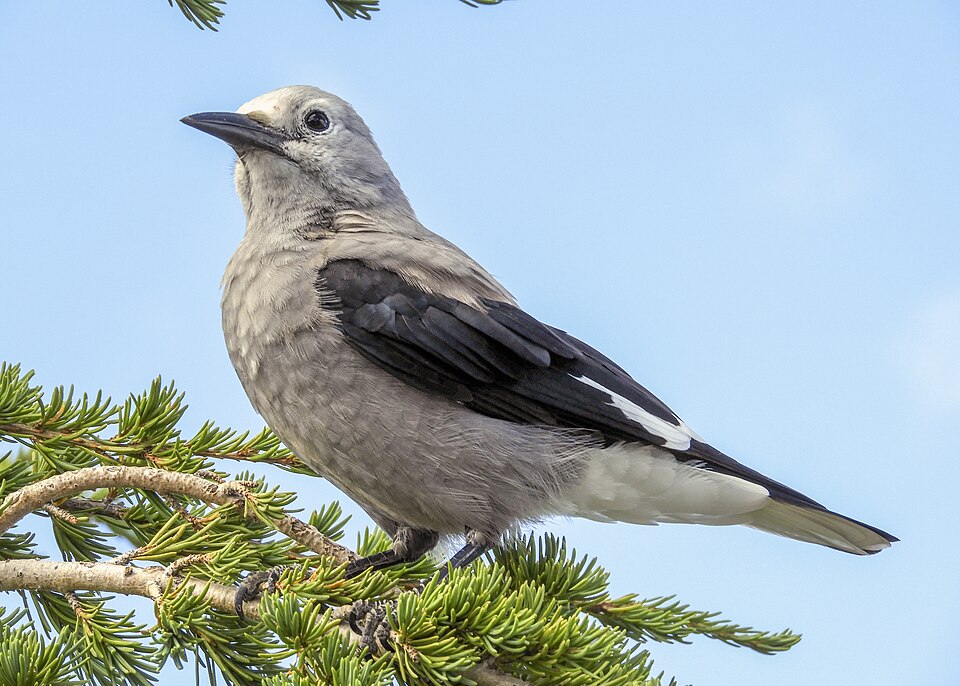
Clark's Nutcracker is one of the great characters of the western mountains, a stocky, pale-gray crow relative with a long, dagger-like bill and a voice that carries across timberline like a rusty hinge. Spend a day at a high-elevation parking lot or a subalpine campground in the Rockies, Sierra, or Cascades and you will likely meet one. They are bold, curious, and conspicuous, often perching on the very tips of dead conifers, sailing between ridges on flashy black-and-white wings, or working the cones of whitebark and limber pines with the focus of a craftsman.
What makes this bird truly remarkable is its relationship with pine seeds. A single nutcracker can harvest, carry, and bury tens of thousands of pine seeds in a single autumn, then relocate those scattered caches months later, even under snow, using an extraordinary spatial memory. The seeds it forgets grow into new trees, which means Clark's Nutcracker is one of the most important seed-planters of the high country. Whitebark pine, a struggling keystone species, depends almost entirely on this bird to spread its seeds. Named for William Clark of the Lewis and Clark Expedition, who first noted it in 1805, the nutcracker is woven into the ecology of nearly every high western range.
Clark's Nutcracker is a chunky, big-headed bird roughly the size of a small crow, with a stout body, a short squared tail, and a notably long, sharply pointed black bill it uses like a chisel and forceps. In flight it shows broad, rounded wings and an undulating, almost woodpecker-like flight on short glides. The overall impression is of a pale ash-gray bird with crisp black-and-white wings and tail that flash brightly as it flies.
| Body color | Smooth pale ash-gray over the head, chest, back, and belly, giving a clean, soft-toned look |
| Wings | Mostly black with a bold white patch on the inner trailing edge (secondaries), very obvious in flight |
| Tail | Black down the center with bright white outer tail feathers, flashing white as it flies and lands |
| Bill | Long, straight, sharply pointed, and entirely black, longer and more dagger-like than a jay's |
| Face | Pale gray face with a small dark eye; lacks any crest, mask, or bold facial pattern |
| Undertail | White undertail coverts contrasting with the black tail, noticeable as the bird perches and flicks its tail |
Male vs. female
Males and females look alike. The sexes share the same gray body, black-and-white wings and tail, and long black bill, and they cannot be reliably told apart in the field by plumage. Males average very slightly larger, but the difference is not useful for casual observation. During nesting, a brooding female may develop a brood patch, but you would have to have the bird in hand to notice.
Juveniles
Juvenile Clark's Nutcrackers look much like adults but are a touch duller and browner-gray, with a softer, less crisply defined plumage overall. Their bills are often a bit shorter and may show paler areas at the base before darkening fully to black. Because nutcrackers nest very early, often while snow still blankets the high country, well-grown young can be seen following and begging from parents by late spring and early summer, giving wheezy juvenile calls.
The signature sound of Clark's Nutcracker is a loud, harsh, drawn-out kraaa-aaa or chaaar, a grating, slightly rolling call that has been compared to a flicker's call slowed down or a rusty gate swinging open. It carries a long way across open subalpine slopes and is often the first sign a nutcracker is nearby. Birds frequently repeat the call in a slow, deliberate series as they perch on a treetop or fly between ridges.
Beyond that main call, nutcrackers have a varied vocabulary of softer notes, including conversational rattles, churrs, and mewing sounds given between mates and family groups. They are accomplished mimics on occasion and can be surprisingly quiet and stealthy when caching seeds, in contrast to their loud, attention-grabbing flight calls.
Clark's Nutcracker is a bird of the high mountains of western North America, found from the mountains of British Columbia and Alberta south through Washington, Oregon, Idaho, Montana, Wyoming, and the Sierra Nevada and other California ranges, into the southern Rockies and the high country of Arizona, New Mexico, and northern Mexico. It is strongly tied to coniferous forests near and above the level where whitebark, limber, pinyon, and ponderosa pines grow, often right up to timberline.
It is not a long-distance migrant, but its movements are tightly linked to pine-seed crops. In years when cone crops fail across the high country, nutcrackers stage dramatic downslope and lowland eruptions, sometimes turning up far from the mountains, in foothills, deserts, and occasionally well east or west of their usual haunts. In good seed years they may stay high all winter, relying on the seeds they cached the previous fall.
Pine seeds are the heart of this bird's diet, especially the large, nutritious seeds of whitebark, limber, pinyon, and other western pines. A nutcracker uses its long bill to pry seeds from cones, then tucks them into a special pouch under its tongue, the sublingual pouch, which can hold dozens of seeds at once. It carries these loads, sometimes the weight of many seeds at a time, to communal caching grounds where it buries them in small clusters in the soil, gravel, or under bark, often on south-facing slopes that clear of snow early.
Its real claim to fame is recovery: a single bird may cache tens of thousands of seeds across a season and relocate a large share of them months later using remarkable spatial memory, even probing through snow to the right spot. The seeds it never retrieves germinate, making the nutcracker a vital forester of the high mountains. Beyond pine seeds, it is an opportunist, eating insects, spiders, berries, and other seeds, raiding the occasional egg or nestling, scavenging carrion and roadkill, and readily taking handouts and scraps from people at scenic overlooks and campgrounds.
Clark's Nutcrackers nest remarkably early, often beginning in late winter while deep snow still covers the high forests. They can do this because they fuel breeding with the energy-rich pine seeds cached the previous autumn. Pairs build a bulky, well-insulated platform nest of twigs lined with grass, bark strips, and other soft material, usually placed on a horizontal branch of a conifer and often positioned to catch warming sun. The thick walls help the eggs and young survive frigid mountain nights.
The female typically lays a small clutch of pale greenish eggs marked with fine spotting. In an unusual arrangement among corvids, both the male and the female develop a brood patch and share incubation, taking turns keeping the eggs warm through cold weather. Both parents feed the young, largely on stored pine seeds, and the family stays together for a time after the young fledge, with juveniles following adults and learning where and how to find and cache seeds.
Clark's Nutcracker is generally not a backyard or feeder bird unless you live high in the western mountains. It is tied to subalpine conifer forests, so most people meet it at scenic overlooks, ski areas, trailheads, and campgrounds rather than at home. That said, if you live or stay in the right high-elevation habitat, you can absolutely draw one in.
- Live high to host them. Realistically you need to be in or very near subalpine conifer forest in the western mountains; at lower elevations, look for them during seed-failure eruption years instead.
- Offer big, fatty foods. If you are in their range, they readily take peanuts (in or out of the shell), shelled nuts, suet, and large seeds set out on a platform or open feeder.
- Use a sturdy platform feeder. These are crow-sized, bold birds; a solid tray or platform suits them far better than small tube feeders made for chickadees.
- Plant or protect native pines. Healthy whitebark, limber, and pinyon pines are the real magnet; conserving these trees does more for nutcrackers than any feeder.
- Be patient and let them get bold. At mountain campgrounds and overlooks they quickly learn where food appears and will return reliably, sometimes becoming almost tame.
- Skip the junk food. Avoid salty chips and bread; offer natural nuts and seeds so you are supporting, not harming, the birds you attract.
- Gray Jay (Canada Jay): Also gray and found in high conifer forests, but the Canada Jay is fluffier, round-headed, with a short stubby bill and no bold black-and-white in the wings and tail.
- Northern Mockingbird: Shows similar gray body with white wing and tail flashes in flight, but it is slimmer, smaller-billed, lives in open lowlands, and is unrelated to corvids.
- Pinyon Jay: Another pine-seed specialist of the West, but it is uniformly dull blue, not gray, lacks the black-and-white wing and tail pattern, and travels in large flocks.
- Townsend's Solitaire: A slim gray mountain bird with white outer tail feathers, but much smaller and slenderer with a tiny bill and a buffy wing patch rather than bold white secondaries.
Where can I see a Clark's Nutcracker?
Look in high western mountains near timberline, especially around whitebark, limber, and pinyon pines. Scenic overlooks, ski areas, campgrounds, and trailheads in the Rockies, Sierra Nevada, and Cascades are reliable spots, as the birds are bold and often approach people.
How is Clark's Nutcracker different from a Gray Jay?
Both are gray mountain birds, but the nutcracker has a long, dagger-like black bill and bold black-and-white wings and tail that flash in flight. The Canada Jay (Gray Jay) is fluffier and round-headed with a short stubby bill and plain wings and tail.
Why is Clark's Nutcracker important to pine forests?
It harvests and buries tens of thousands of pine seeds each fall, then relocates many of them later using exceptional memory. The seeds it never retrieves germinate into new trees, making it the main seed-planter for whitebark pine and other high-elevation pines.
How does Clark's Nutcracker remember where it buried seeds?
It has an outstanding spatial memory and uses landmarks like rocks, logs, and trees to relocate caches months later, even under snow. Studies show it can recover a large share of the thousands of caches it makes each season.
Will Clark's Nutcrackers come to bird feeders?
Only if you are in or near their high-elevation mountain habitat. There they readily take peanuts, nuts, suet, and large seeds from platform feeders and are famous for boldly grabbing food from people at campgrounds and overlooks. They are not typical lowland backyard birds.