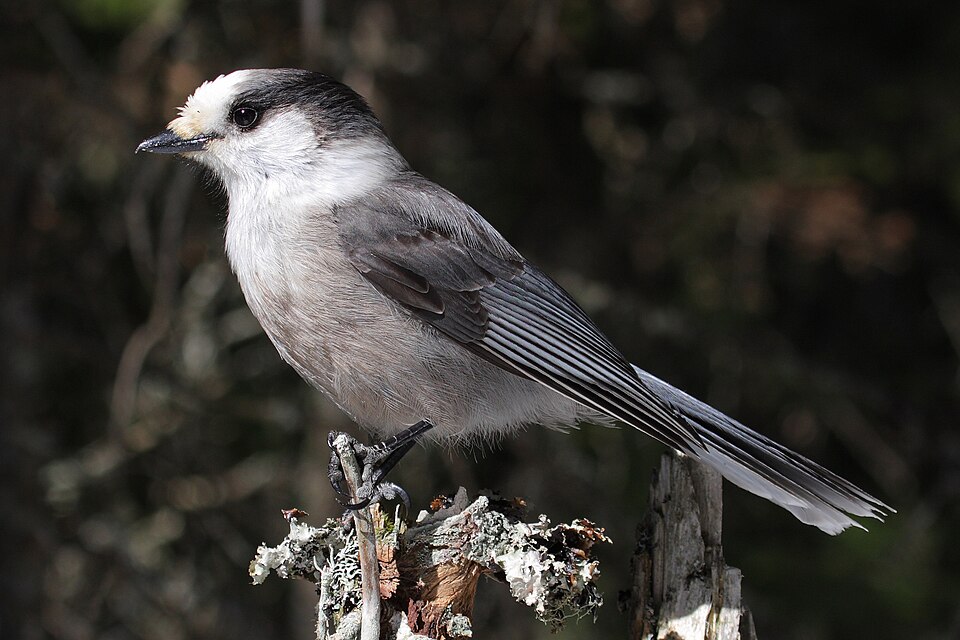
The Canada Jay is one of the most charming and approachable birds in North America's northern forests. Soft gray, fluffy, and surprisingly tame, it has earned a long list of nicknames over the years, including "Whiskey Jack," "camp robber," and its former official name, Gray Jay. Anyone who has eaten lunch in a spruce-fir forest of Canada, Alaska, or the high western mountains has probably had one glide silently down to a nearby branch, head cocked, hoping for a handout. They are bold to the point of landing on an outstretched hand, which makes them a favorite of hikers, campers, and skiers.
Beyond their friendly nature, Canada Jays are remarkable survivors. They are true birds of the cold, staying put in the boreal forest through brutal winters when most other songbirds have fled south. They manage this feat by hoarding tens of thousands of food items each summer and fall, gluing them into bark crevices with sticky saliva to retrieve during the lean months. They even nest in late winter, raising young while snow still blankets the ground. Few birds embody the spirit of the north woods so completely.
This is a medium-sized, round-headed jay with a short, stubby bill and a long tail. Its overall shape is soft and fluffy, almost like an oversized chickadee, and it lacks the crest you might expect from a jay. The plump silhouette and dense, loose plumage help it conserve heat in cold climates and give it a gentle, rounded look quite unlike the angular Blue Jay.
| Overall color | Soft gray above, paler whitish-gray below, with no bright colors anywhere |
| Head pattern | Whitish forehead and face with a dark gray to blackish patch on the back of the crown and nape |
| Bill | Short, stout, and black, much smaller than other jays' bills |
| Tail | Long and gray with paler tips, often flicked or fanned |
| Size and shape | Plump and round-headed with loose, fluffy plumage; no crest |
| Flight | Buoyant and gliding, often swooping silently between trees |
Male vs. female
Male and female Canada Jays look alike. There is no visible difference in plumage, size, or color between the sexes in the field, so you cannot reliably tell them apart by sight. During the breeding season behavior can offer hints, since the female does the incubating, but for general birding purposes you should consider the sexes identical.
Juveniles
Juvenile Canada Jays look strikingly different from adults and can puzzle birders who don't expect it. For their first summer they are a uniform sooty, dark slate-gray over the entire body, head, and underparts, often with a faint pale mustache mark near the bill. They lack the clean white-and-gray contrast of adults entirely. By late summer and fall they molt into the familiar gray adult plumage, so the dark juvenile look is something you will only catch in the warmer months.
Canada Jays are surprisingly quiet and varied vocalists, lacking a true song. Their most familiar sound is a soft, whistled wheeoo or a mellow quee-oo that carries gently through the forest. They also give a harsh, scolding chuck-chuck or a rough, churring chatter when agitated or mobbing a predator.
One of their most fascinating traits is mimicry. Canada Jays readily imitate other birds, and they are especially good at copying the calls of hawks, including the screams of the Northern Goshawk and Red-tailed Hawk. They can also produce an array of clicks, whistles, and soft conversational notes among family members. Because so much of their communication is quiet, you often hear them only at close range as they sneak toward your camp.
The Canada Jay is a year-round resident of the boreal and subalpine coniferous forests of North America. Its core range stretches across Canada and Alaska, following the great band of spruce and fir from coast to coast. In the western United States it dips south through the Rocky Mountains, Cascades, and Sierra Nevada at high elevations, and in the East it reaches into the northern New England states, the Adirondacks, and the upper Great Lakes region.
This is a non-migratory species. Canada Jays hold their territories all year, even through the deep cold of winter, relying on their cached food to get through. They do not move south in fall the way most songbirds do, so finding one almost always means you are in the right kind of cold, conifer-dominated habitat. Birders in the Lower 48 typically seek them at high mountain elevations or in the cool spruce bogs of the far north.
Canada Jays are true generalists and opportunists. Their diet includes insects, spiders, berries, fungi, carrion, small mammals, nestling birds, amphibians, and just about any human food they can snatch. This flexibility is exactly what allows them to thrive in harsh environments where pickier birds cannot.
Their signature behavior is food caching, or hoarding. Throughout the warmer months a single jay may store tens of thousands of food items, coating each morsel with sticky saliva and tucking it into bark crevices, under lichen, or among conifer needles high enough to stay above the snow. Their remarkable spatial memory lets them relocate these hidden stores all winter long, and these caches even fuel their unusually early breeding. Around people they are famously bold, swooping in to grab sandwich crusts, trail mix, and bacon, which is how they earned the nickname "camp robber."
Canada Jays are extraordinary early nesters. They build and lay eggs in late winter, often in February and March, while temperatures are still well below freezing and snow covers the ground. The nest is a thick, well-insulated cup of twigs, bark strips, and lichen, lined generously with feathers, fur, and cocoon silk to trap heat. It is usually placed on the south-facing side of a conifer, often a spruce, where it can catch any available sunlight.
The female lays a small clutch and does all the incubating, while the male brings her food at the nest. By breeding so early, the pair takes advantage of the food they cached the previous summer and gives their young a long head start before the next winter. Canada Jays are also known for complex family dynamics, where one juvenile may stay on the parents' territory and help out the following year while siblings disperse.
For most people, the Canada Jay is not a typical backyard or feeder bird, because it lives in cold conifer forests far from suburban neighborhoods. But if you live in or visit the right habitat, it is one of the easiest birds to attract up close, and meeting one is often more about going to them than bringing them to you.
- Go to their habitat. Visit boreal or high-elevation spruce-fir forests in Canada, Alaska, the Rockies, the Cascades, or northern New England, where they are year-round residents.
- Offer food on the trail. They will readily take unsalted nuts, seeds, or bits of bread from an open palm, often landing right on your hand at popular hiking and ski areas.
- Stop at picnic and camp sites. Canada Jays patrol these spots and frequently appear within minutes of someone opening a lunch.
- Keep human food simple and sparse. Avoid salty, greasy, or heavily processed snacks; a few unsalted nuts are a kinder treat than chips or jerky.
- Stay still and quiet. Their boldness rewards calm behavior; sudden movements may keep them at a wary distance.
- Clark's Nutcracker: Larger and paler gray with bold white-and-black wings and tail, a long pointed bill, and loud grating calls; another high-mountain cacher but far noisier and more contrasty.
- Blue Jay: Unmistakably blue with a crest and black necklace; brash and loud, and found in eastern woodlands and yards rather than boreal conifers.
- Northern Mockingbird: Also gray, but slimmer with a long tail, white wing patches in flight, and a long bill; lives in open and suburban habitats, not cold conifer forests.
- Gray Catbird: Slate-gray and slender with a black cap and rusty undertail; a skulking thicket bird of the warmer months, not a bold forest jay.
Is the Canada Jay the same as the Gray Jay?
Yes. Gray Jay was the official common name for years, but the species was renamed Canada Jay. It is the same bird, Perisoreus canadensis, and you will still see both names used.
Why is the Canada Jay called Whiskey Jack?
"Whiskey Jack" comes from Wisakedjak, a trickster figure in Cree and other Algonquian traditions. English speakers adapted the name over time, and it suits the jay's clever, mischievous, food-stealing personality.
Will a Canada Jay really land on my hand?
Often, yes. In areas where they encounter people regularly, such as popular trails, campgrounds, and ski areas, Canada Jays are famously tame and will glide down to take food from an outstretched palm.
Where can I see a Canada Jay?
Look in cold coniferous forests: across Canada and Alaska, and at high elevations in the Rocky Mountains, Cascades, and Sierra Nevada, plus northern New England, the Adirondacks, and the upper Great Lakes.
How do Canada Jays survive winter without migrating?
They hoard tens of thousands of food items during summer and fall, gluing each one in place with sticky saliva, then rely on an excellent memory to find these caches through the winter.