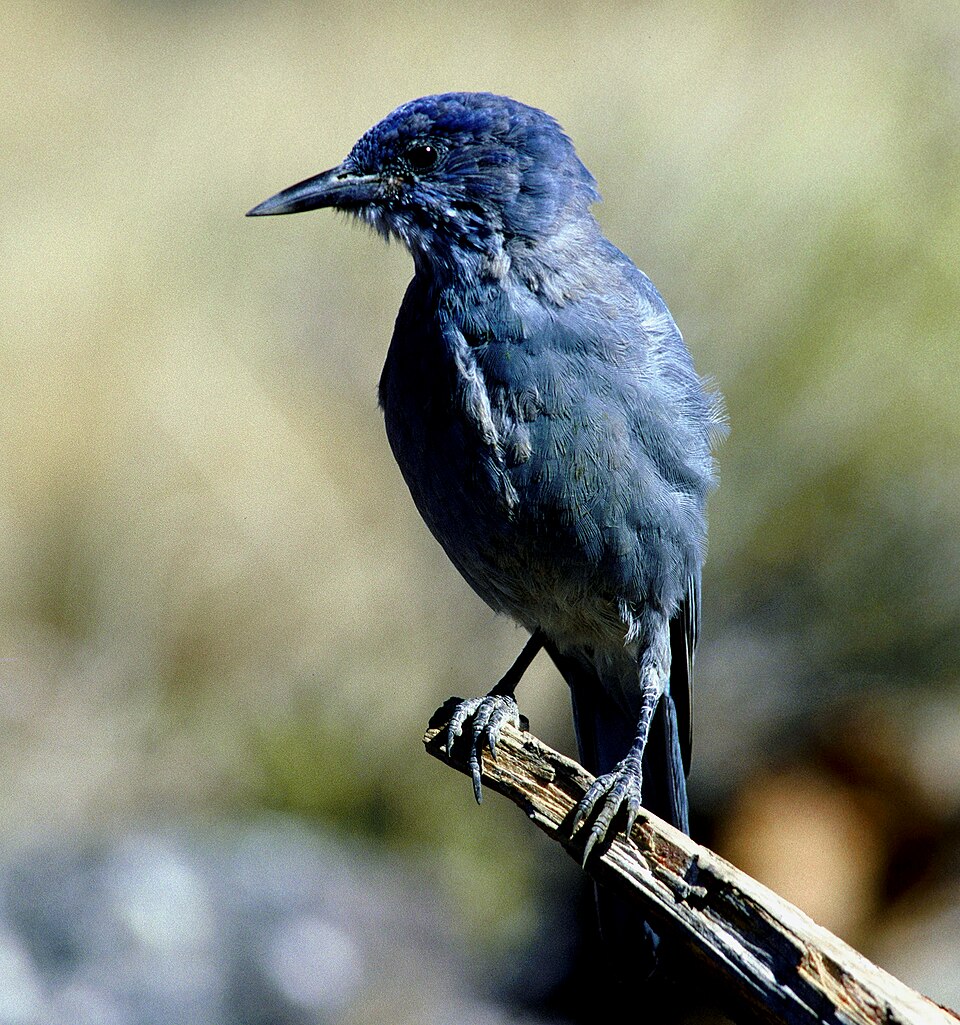
The Pinyon Jay is one of the most distinctive jays in North America, yet many people have never seen one. Uniformly dusty blue and lacking the crest most other jays sport, it lives almost its entire life tied to the pinyon-juniper woodlands of the interior West. More than a pretty bird, it is a true ecological partner of the pinyon pine: it harvests, caches, and forgets enough seeds each year to plant whole groves of trees, making it one of nature's most important pine planters.
What sets this species apart even more than its looks is its intensely social nature. Pinyon Jays live in permanent flocks that can number from a few dozen to several hundred birds, traveling, feeding, and nesting together year-round. They are constantly calling to one another, and a flock pouring across the sky in a long, rolling stream is one of the great sights of western birding. Sadly, the species has declined sharply over recent decades, and it is now a conservation priority across much of its range.
Think of a crow-shaped jay painted entirely in soft, chalky blue. The Pinyon Jay is stocky and short-tailed for a jay, with a long, sharply pointed bill and a smooth, crestless head. In flight its silhouette is more reminiscent of a small crow or a blackbird than a typical jay, with steady, direct wingbeats rather than the floppy, undulating flight of a Steller's or Blue Jay.
| Overall color | Uniformly dull, dusty blue over the whole body, deepest and brightest on the head |
| Crest | None - the smooth, rounded head readily separates it from Steller's and Blue Jays |
| Bill | Long, straight, sharply pointed and dark, used to probe deep into pine cones |
| Tail | Noticeably short for a jay, giving a front-heavy, crow-like flight profile |
| Throat | Often shows faint whitish streaking on the throat and chin |
| Size & shape | Stocky and compact, roughly robin-to-small-crow in size, flying in tight, noisy flocks |
Male vs. female
Males and females look essentially identical in the field - both are the same dusty blue all over with no reliable plumage differences a birder can use. Males average slightly larger and heavier, but this is not something you can judge on a single bird in the field. In the hand or in close comparison within a pair, the male may appear marginally bigger and brighter, but for practical purposes the sexes are best treated as alike.
Juveniles
Juvenile Pinyon Jays are noticeably duller and grayer than adults, lacking the cleaner blue tones, and they can look almost ashy or smoky overall. Young birds also show a paler, often pinkish or pale-based bill and gape early on, and they beg loudly from adults. As they molt into adult-like plumage through their first year they gradually acquire the more uniform dusty blue, but a flock in late summer will often contain a mix of crisp blue adults and washed-out gray youngsters.
The most familiar sound is the flight call, a nasal, far-carrying kaw or kraw-kraw that rises slightly at the end, often described as a mewing or laughing quality. A flock in motion produces a rolling chorus of these calls that birders learn to recognize before they ever see the birds. There is also a distinctive high, nasal queh? queh? with an almost questioning upward inflection.
Pinyon Jays are not known for a true musical song. Instead they have a rich vocabulary of caws, chuckles, and conversational notes used to keep the flock coordinated. Around the nest and within the colony, softer churrs and rattles are exchanged. The overall impression is of a constantly chattering, gregarious bird whose voice is more crow-like and nasal than the harsh screams of other western jays.
The Pinyon Jay is a year-round resident of the interior western United States, centered on the Great Basin and the southern Rocky Mountains. Its core range spans Nevada, Utah, western Colorado, Arizona, New Mexico, and adjacent parts of California, Oregon, Idaho, Wyoming, and Montana, closely matching the distribution of pinyon-juniper woodland.
It does not truly migrate, but it is highly nomadic. When the pinyon pine seed crop fails locally - which it does in irregular cycles - flocks may wander far beyond their usual haunts in search of food, sometimes turning up well outside the normal range in fall and winter. These irruptions are unpredictable, and a flock present one year may be absent the next. This wandering habit, combined with a strong decline in the species overall, makes it a sought-after and sometimes elusive bird to track down.
Pinyon pine seeds are the heart of this bird's diet and the engine of its whole way of life. With its long bill it pries seeds from green and ripe cones, assesses each one - often by weighing it in the bill or tapping it - and carries away the good ones in an expandable throat pouch. A single bird can transport dozens of seeds at a time to caching sites, burying them in the ground for later. Because flocks cache far more than they ever retrieve, the forgotten seeds germinate, and the jays effectively replant the very woodlands they depend on.
Beyond pine seeds, Pinyon Jays take juniper berries, other seeds, waste grain, and a substantial amount of insects, especially in spring and summer when growing young need protein. They readily eat grasshoppers, caterpillars, beetles, and other arthropods, and will occasionally take small fruits, eggs, or nestlings. Their remarkable spatial memory, used to relocate thousands of cached seeds, is among the most studied of any bird.
Pinyon Jays are colonial, social nesters, often building dozens of nests scattered through a traditional patch of woodland. Remarkably, breeding timing is tied to the pine seed crop: in years of abundant seeds, colonies may begin nesting unusually early, even in late winter, so that the previous fall's cached seeds can help fuel egg-laying and feeding. The bulky cup nest is built of twigs and lined with finer material, placed in a pinyon, juniper, or sometimes another conifer.
The female does most of the incubating while the male feeds her on the nest, and both parents - sometimes with help from other flock members - feed the young. After fledging, juveniles gather into a communal creche where adults continue to provision them, a striking example of the species' deeply social organization. Pairs typically raise a single brood per year, though replacement attempts can follow a failure.
The Pinyon Jay is not a typical backyard or feeder bird, and you should not expect a steady visitor unless you live within or right beside pinyon-juniper woodland in the interior West. That said, people who live in the right habitat sometimes do attract wandering flocks, especially in lean seed years. The best approach is to make your property friendly to the woodland these birds need.
- Location matters most. Only homes within or adjacent to pinyon-juniper country have a realistic chance; elsewhere the bird simply does not occur.
- Offer whole or shelled peanuts and black-oil sunflower seed on open platform feeders or the ground - flocks prefer to feed in the open where they can watch for danger.
- Protect native pinyon pines and junipers on your land; mature seed-bearing trees are the single biggest draw.
- Provide a large, ground-level or low water source, since thirsty flocks will come to drink and bathe together.
- Be patient and flexible - visits are irruptive and unpredictable, tied to the boom-and-bust pine seed cycle, so a flock may appear for a season and then vanish.
- Avoid pesticides so insect prey remains available for breeding birds and their young.
- Western Scrub-Jay: Scrub-jays are blue above with a contrasting gray-brown back patch and white underparts, plus a longer tail; Pinyon Jay is uniformly dusty blue with no back patch and a short tail.
- Steller's Jay: Steller's has a tall dark crest and a blackish head and chest; Pinyon Jay is crestless and uniformly blue.
- Blue Jay: Blue Jay is crested with bold white wing and tail markings and a black necklace; Pinyon Jay is plain dusty blue with no crest or white markings and is found farther west.
- Clark's Nutcracker: The nutcracker shares the pine-seed lifestyle and shape but is gray-bodied with bold black-and-white wings and tail, not blue.
What is the difference between a Pinyon Jay and a Blue Jay?
They are quite different. The Blue Jay has a crest, bold white spots in the wings and tail, and a black necklace, and it lives mainly in the East and Midwest. The Pinyon Jay has no crest, is a plain dusty blue all over with no white markings, and is restricted to pinyon-juniper woodlands of the interior West.
Why is the Pinyon Jay declining?
Populations have dropped sharply over recent decades, driven largely by loss and degradation of pinyon-juniper woodland from drought, large-scale die-offs of pinyon pine, wildfire, and habitat clearing. Because the bird depends so completely on pinyon seeds, anything that harms those forests hits the jay hard. It is now considered Vulnerable.
Do Pinyon Jays come to backyard feeders?
Only if you live within or beside pinyon-juniper habitat in the West. In the right area, flocks will sometimes visit open platform feeders or the ground for peanuts and sunflower seed, especially in poor pine-seed years. Outside that habitat, they simply do not occur, so most people will never see one at a feeder.
Why do Pinyon Jays travel in such large flocks?
They are among the most social of all North American birds, living in permanent flocks year-round. Group living helps them find and harvest the patchy, unpredictable pinyon seed crop, watch for predators, and coordinate breeding. Flocks can range from a few dozen to several hundred birds and even raise their young communally.
How do Pinyon Jays help pinyon pine forests?
They are key seed dispersers. Each bird caches large numbers of pine seeds in the ground for later use, and because flocks bury far more than they retrieve, the forgotten seeds sprout into new trees. Over time this plants and regenerates the very woodlands the jays depend on, making the two species ecological partners.