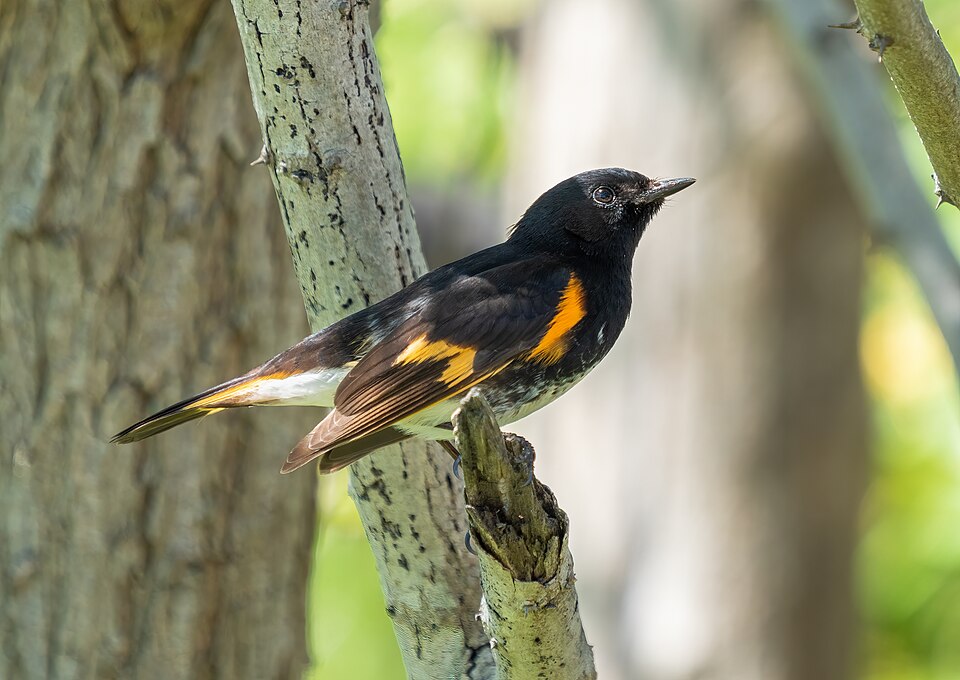
The American Redstart is one of the most animated warblers in North America, a small, restless bird that never seems to hold still. Adult males are unmistakable when they cooperate: glossy black above with brilliant orange patches blazing on the wings, tail, and sides, set off by a clean white belly. Watch one forage and you'll see why birders sometimes call it the "candelabra" or, in Latin America, candelita ("little torch"), it fans its tail and droops its wings to flash those colored patches, startling insects into flight so it can snap them out of the air.
Redstarts breed across a huge swath of the continent, from the boreal edge of Canada down through the eastern and northern United States, favoring second-growth woods, willow and alder thickets, and the leafy edges of forests near water. They are long-distance migrants, wintering from Mexico and the Caribbean south into northern South America. Because they hunt by movement rather than by quietly gleaning, they are often one of the first warblers a beginner learns to pick out, the flash of orange and the constant tail-fanning give them away.
This is a small, slim warbler with a relatively long, often-fanned tail and a flat-headed look. Its most reliable field mark isn't a color at all, it's behavior: the bird droops its wings, spreads its tail, and pivots constantly while sallying after insects. Once you learn that fidgety, fan-tailed style, redstarts become easy to name even when the light is poor.
| Adult male | Jet-black head, back, and chest with bright orange patches on the wings, tail base, and flanks; white belly. |
| Female | Gray head, olive-brown back, white underparts, with yellow (not orange) patches in the same wing, tail, and side spots. |
| Tail pattern | Dark tail with bright orange or yellow patches at the base on each side; frequently fanned open. |
| Wing patches | A bold patch of color across the wing, visible at rest and obvious in flight. |
| Bill and shape | Small, flat, slightly broad-based warbler bill with rictal bristles; slim body and longish tail. |
| Behavior | Active, drooping wings and flicking the fanned tail; sallies out to catch flying insects. |
Male vs. female
Adult males and females are easy to tell apart once a bird is in full plumage. The male is dramatic, black where the female is gray or olive, and orange where she is yellow. Females (and first-year males) share the same overall pattern but in muted tones: gray head, grayish-olive upperparts, clean white underparts, and lemon-yellow patches on the wings, tail sides, and breast. The shape, size, and tail-fanning behavior are identical, so the placement of the colored patches is the same in both sexes, only the colors differ.
Juveniles
Young redstarts and first-fall birds look much like adult females, gray and olive with yellow patches, which is a common source of confusion. The key wrinkle is that male American Redstarts take two years to reach full adult plumage. A first-spring male is "female-like" with yellow patches but may show a scattering of black flecks on the face and breast and a hint of orange in the patches. These second-year males will sing and even hold territories and breed, so a "yellowish redstart" singing on territory is very likely a young male, not a female.
The American Redstart sings a high, thin, somewhat variable series of notes that often ends with an emphatic down-slurred flourish, something like tsee tsee tsee tsee-o or see-see-see-see-SEW. Many males have more than one song type and switch between them: one version trails off evenly, while another drops sharply at the end. The pitch is high enough that the song can be easy to overlook or to confuse with other warblers.
The common call note is a sharp, sweet chip, clearer and softer than the harsh notes of some warblers. During migration and on the wintering grounds, this chip is often all you'll hear as the birds move actively through the foliage.
American Redstarts breed across much of southern and central Canada and the eastern United States, with the range extending west across the boreal zone and into parts of the Pacific Northwest and northern Rockies. They favor deciduous and mixed second-growth woodlands, riparian thickets, and forest edges, often near water.
They are true Neotropical migrants. In late summer and fall they head south to wintering grounds spanning Mexico, Central America, the Greater Antilles and other Caribbean islands, and northern South America. During spring and fall migration, redstarts pass through much of the continent and can show up in city parks, backyards with mature trees, and woodlots far from their breeding habitat, making migration the best time for many birders to see them.
American Redstarts are primarily insectivores, taking caterpillars, flies, leafhoppers, beetles, moths, wasps, and other small arthropods, plus spiders. Their signature hunting style is "flush-pursuit": by flashing the bright patches on the spread tail and drooped wings, they startle hidden insects into flying, then dart out to grab them in mid-air with an audible snap of the bill. They also glean prey from leaves and twigs and make short fly-catching sallies from a perch.
In late summer and on the wintering grounds, redstarts will supplement their insect diet with small fruits and berries, and they have been known to take seeds occasionally. But for most of the year, active, agile insect-hunting in the leafy mid-canopy is how this bird makes its living.
The female builds the nest, a tidy open cup of plant fibers, bark strips, grass, and rootlets, often bound with spider silk and lined with fine material and sometimes decorated on the outside with lichen. Nests are usually placed in the upright fork of a shrub or small deciduous tree, typically from a few feet to roughly 25 feet above the ground.
A typical clutch is about 3-4 (sometimes up to 5) creamy, speckled eggs. The female does the incubating, which lasts roughly 11-12 days, and the young leave the nest about 9 days after hatching. Both parents feed the nestlings and fledglings. Redstarts generally raise one brood per season across most of their range. Like many open-cup-nesting songbirds, they are sometimes parasitized by Brown-headed Cowbirds.
The American Redstart is not a feeder bird, it won't visit seed or suet, because it eats live insects caught on the wing or gleaned from foliage. You attract redstarts by offering the kind of habitat they hunt in rather than food in a tray. The good news is that yards near woods and water, especially during migration, have a real shot at hosting one.
- Plant and keep native trees and shrubs, redstarts forage in leafy deciduous growth and thrive on the insects native plants support.
- Skip or sharply reduce insecticides; a healthy population of caterpillars, flies, and leafhoppers is exactly what this warbler is after.
- Provide water. A clean birdbath or, better, a dripper or small moving-water feature is a strong draw, especially for migrants.
- Encourage second-growth and edge habitat, a brushy, layered yard near woodland or a stream is far more attractive than a manicured lawn.
- Watch during spring and fall migration, when redstarts move through parks and wooded backyards far outside their breeding range.
- Leave some thickets of willow, alder, or dense shrubs near water if you have the space; these mimic prime redstart breeding cover.
- Yellow Warbler: Female and immature redstarts can look yellowish, but Yellow Warblers are uniformly yellow with yellow (not dark) tails and lack the contrasting wing/tail patches and fan-tail behavior.
- American Robin: Shares orange-and-dark coloring in a glance, but the robin is far larger, ground-foraging, and shaped like a thrush, no confusion at close range.
- Blackburnian Warbler: Male shows fiery orange too, but it's concentrated on the throat and face with bold black-and-white wing and back stripes, not orange side and tail patches.
- Black-and-white Warbler: Similar black-and-white tones on a male redstart, but Black-and-white Warblers are streaky all over and creep along trunks and branches like a nuthatch.
Is the American Redstart a type of warbler?
Yes. Despite the name, it's a New World wood-warbler (family Parulidae), not related to the Old World redstarts. The name comes from the male's red-orange ('start' is an old word for tail) tail patches.
How do I tell a female redstart from a male?
Both sexes share the same pattern of patches on the wings, tail sides, and breast. Males are black-and-orange; females are gray-and-olive with yellow patches instead of orange. First-year males look female-like but may show black flecks and a hint of orange.
Will American Redstarts come to my feeder?
No. They eat live insects and spiders caught in flight or gleaned from leaves, so they ignore seed and suet. To draw them, offer native plantings, water, and pesticide-free habitat near woods, especially during migration.
Why do redstarts fan their tails and droop their wings?
It's a hunting tactic. Flashing the bright tail and wing patches startles hidden insects into flying, and the redstart then snaps them out of the air. The behavior is so habitual that they do it almost constantly while foraging.
When is the best time to see an American Redstart?
During spring and fall migration, when they pass through parks, woodlots, and wooded yards across much of North America. In summer, look in second-growth deciduous woods and willow or alder thickets near water within their breeding range.