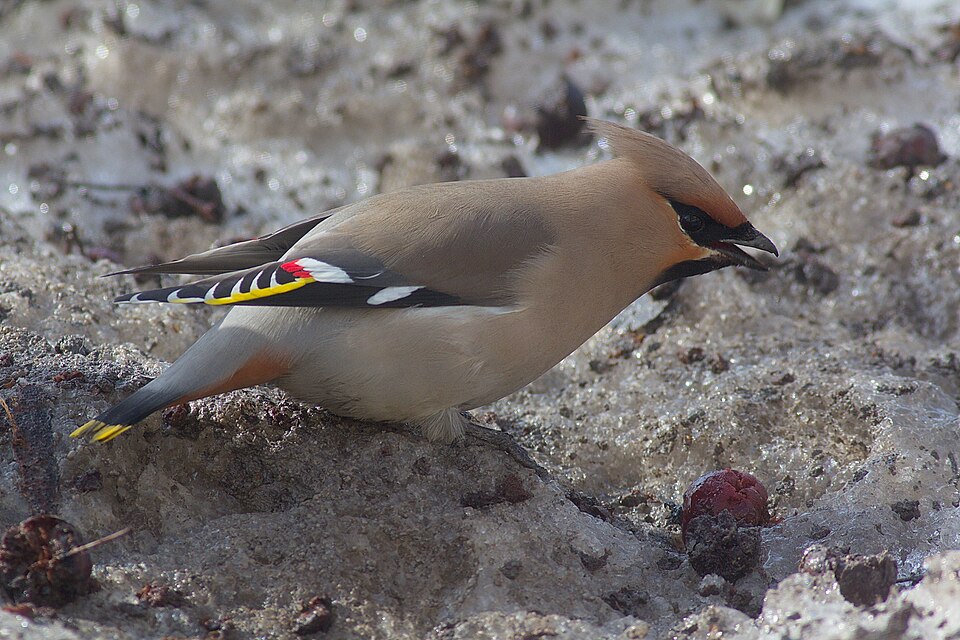
The Bohemian Waxwing is one of the great wanderers of the bird world, and its name fits it perfectly. Each winter it drifts unpredictably out of the boreal forests of the far north, following the fruit, and showing up in flocks that may number in the hundreds or even thousands. One year a town might be swarmed with them as they strip every rowan and crabapple bare; the next winter, not a single one appears. This boom-and-bust nomadism is the heart of what makes seeing them feel like such a windfall.
Up close, a Bohemian Waxwing is a genuinely beautiful bird: soft, smoky gray-brown plumage that looks almost airbrushed, a rakish crest, a black mask, and a tail tipped in bright yellow. The name "waxwing" comes from the little red, waxy droplets on the wing feathers that look exactly like sealing wax. Found right across the northern reaches of North America, Europe, and Asia, it is a true circumpolar bird and a much-anticipated guest wherever winter berries hang on.
This is a plump, starling-sized songbird with a distinctive shape: a peaked crest that it raises and lowers, a short neck, and a short, square-tipped tail. In flight, flocks look compact and fast, with pointed wings, often wheeling tightly together like starlings before descending onto a fruiting tree.
| Overall color | Soft pinkish gray-brown, palest on the belly, blending to gray on the rump and tail |
| Face | Black mask through the eye and a black throat patch, bordered by warm chestnut, with rusty undertail coverts |
| Crest | Prominent, swept-back crest, often held flat but raised when alert |
| Wings | Bold white and yellow markings plus the red waxy tips; a distinctive white-and-yellow striped pattern at rest |
| Tail | Gray with a broad bright-yellow band at the tip |
| Size | Noticeably larger and grayer than the similar Cedar Waxwing |
Male vs. female
Males and females look nearly identical and are very hard to separate in the field. On average, males show a slightly larger and crisper black throat patch with a more sharply defined lower edge, and may carry a few more red waxy tips on the wing, but these differences overlap and are unreliable for any single bird. For practical backyard purposes, treat the sexes as looking alike.
Juveniles
Juveniles are duller and more streaky than adults, with a grayer, less defined face pattern and a paler, smudgier throat rather than the clean black bib. They typically have fewer or no red waxy tips on the wings and a less colorful overall look. By their first winter they have largely molted into a plumage close to the adult, though young birds often show slightly less wax and a slightly smaller throat patch.
Bohemian Waxwings are not true songsters; instead they keep up a constant, sociable chatter that is one of the best ways to detect a flock overhead. The signature sound is a high, thin, buzzy trill, often written as sirrrr or zirrrr, slightly rougher and lower-pitched than the thinner, sweeter call of the Cedar Waxwing.
When a flock is feeding or flying, dozens of these trills run together into a soft, ringing, almost electric jingle that seems to come from everywhere at once. There is no real melodic song; the species communicates through these repeated buzzy notes, which carry surprisingly far on a still winter day.
Bohemian Waxwings breed in the open boreal forest and muskeg across northern North America, from Alaska through western and central Canada, and across northern Eurasia from Scandinavia to Siberia. In the breeding season they are scattered and secretive, nesting among spruce and other conifers near water.
In winter they become wanderers rather than true migrants. Flocks roam southward and eastward in search of fruit, reaching the northern United States, southern Canada, and across temperate Europe and Asia. The scale of this movement varies enormously year to year: in "irruption" winters, when northern berry crops fail, large numbers push much farther south than usual, sometimes turning up well beyond their typical range before vanishing again the next season.
For most of the year the Bohemian Waxwing is overwhelmingly a fruit specialist. In winter it depends almost entirely on small berries and fruits, especially mountain ash (rowan), juniper, crabapple, hawthorn, cotoneaster, mistletoe, and similar fleftover fruit that persists into the cold months. Flocks descend on a fruiting tree, gorge rapidly, and may strip it completely before moving on. They can eat astonishing quantities, and birds occasionally become tipsy on fermented berries.
In the breeding season their diet shifts toward insects, which they catch on the wing in flycatcher-like sallies from a perch, particularly mosquitoes, midges, and other flying insects abundant in the northern summer. They feed nestlings a mix of insects and fruit.
Bohemian Waxwings nest later than many songbirds, timing their breeding to the abundance of summer insects and ripening fruit. The female builds a bulky, loose cup of twigs, grass, moss, and lichen, lined with finer material and often placed on a horizontal conifer branch some distance out from the trunk. Pairs are not strongly territorial and may nest fairly close to one another.
The female lays a clutch of pale bluish-gray eggs spotted with dark markings and does most or all of the incubating, while the male brings her food. The young are fed by both parents and leave the nest after a couple of weeks. The species typically raises a single brood per season, fitting the short northern summer.
Bohemian Waxwings are not seed-feeder birds, so you will not lure them with a tube feeder or suet. They are fruit specialists, which means the way to attract them is to make your yard a winter berry station and then hope a roving flock passes through during an irruption year.
- Plant fruiting trees and shrubs that hold their berries into winter, such as mountain ash (rowan), crabapple, hawthorn, juniper, serviceberry, and cotoneaster.
- Choose native and ornamental varieties known for persistent fruit so there is still food available when waxwings wander through in December through March.
- Provide open water if you can keep it from freezing; waxwings readily drink and bathe, and water can pull a passing flock down.
- Be patient and a little lucky: they are irruptive and unpredictable, so some winters they will mob your trees and other winters they will skip your region entirely.
- Skip the seed feeders for this species and avoid pruning off berries in fall so the natural crop stays on the branch.
- If a flock arrives, enjoy them quickly; they can strip a tree in a day or two and then move on.
- Cedar Waxwing: Smaller, browner, and more delicate, with a pale lemon-yellow belly and plain whitish undertail coverts rather than the Bohemian's gray belly and rusty undertail. Cedar lacks the bold white and yellow wing markings.
- European Starling: Similar in size and forms comparable tight winter flocks, but starlings are dark and glossy with a longer pointed bill, no crest, and no yellow tail band.
- Northern Mockingbird: Grayish and roughly waxwing-sized, but slimmer with a long tail, white wing patches, and no crest, mask, or yellow tail tip; it is also a loud, varied singer.
What is the difference between a Bohemian Waxwing and a Cedar Waxwing?
Bohemian Waxwings are larger and grayer overall, with rusty undertail coverts and bold white and yellow markings in the wing. Cedar Waxwings are smaller, browner, have a yellowish belly and plain whitish undertail coverts, and lack the strong wing pattern. If you see white and yellow stripes in the folded wing, it is almost certainly a Bohemian.
Why do the wing feathers have red tips?
Those bright red tips are the pigmented, waxy ends of certain wing feathers, and they give the bird its name. They are thought to signal age and quality, with older, more experienced birds tending to carry more of them, which can play a role in mate choice.
When and where can I see Bohemian Waxwings?
Look for them in winter, roughly November through March, in the northern United States, Canada, and across northern Europe and Asia. They favor towns, parks, and roadsides wherever fruiting trees like mountain ash and crabapple still hold berries.
Why do Bohemian Waxwings show up some winters but not others?
They are irruptive, meaning their movements depend on northern berry crops. When fruit is abundant up north they may stay put, but when crops fail, large flocks push farther south in search of food, so a town can be flooded with them one year and see none the next.
Do Bohemian Waxwings really get drunk on berries?
They can. Late-winter berries sometimes ferment, and because waxwings eat huge quantities of fruit very quickly, they occasionally consume enough alcohol to become noticeably intoxicated, flying clumsily or appearing dazed until it wears off.