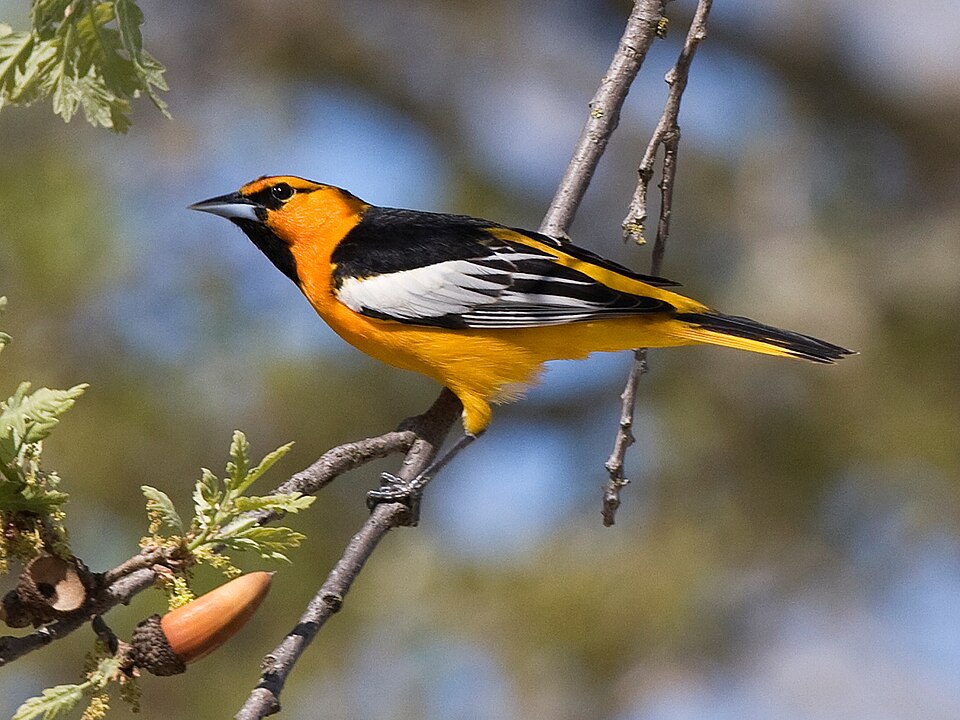
The Bullock's Oriole is the West's answer to the Baltimore Oriole, a slim, flame-orange songbird that arrives with the spring leaf-out and hangs its woven pouch nests high in cottonwoods, sycamores, and shade trees. Adult males are unmistakable when they catch the light: bright orange face and underparts, a neat black cap and throat, and a bold white wing patch that flashes in flight. For many people across the western states it is the most colorful bird that visits the yard all year, and a halved orange on the deck rail is often all it takes to bring one in.
Named for the 19th-century naturalist William Bullock, this oriole was for a time lumped together with the Baltimore Oriole under the single name "Northern Oriole" because the two interbreed where their ranges overlap on the Great Plains. Ornithologists later split them back into separate species based on differences in plumage, song, and behavior. Bullock's is a bird of open woodland and riparian corridors rather than deep forest, which is exactly why it adapts so well to suburbs, farmsteads, and city parks with mature trees.
This is a medium-sized, slender songbird, a touch larger and longer-tailed than a House Finch but smaller than a robin. Look for a sharply pointed bill, an athletic build, and the habit of feeding high in leafy canopy where the orange-and-black plumage stands out against green foliage and blue sky.
| Adult male face | Bright orange face with a black line through the eye and a black cap and throat, the orange wraps around the cheek, unlike the all-black hood of a Baltimore Oriole |
| Wing patch | Large bold white patch on the folded wing (much bigger than Baltimore's thin wingbar), conspicuous in flight |
| Underparts | Vivid flame-orange below in males; warm yellowish to dull orange in females and immatures |
| Bill | Long, straight, sharply pointed and blue-gray at the base, a classic oriole spike |
| Tail | Orange outer tail feathers with a black center and tip in males; pattern visible from below as the bird flits |
| Size & shape | Slim and long-tailed, about 7 inches, with a wingspan near a foot |
Male vs. female
Adult males and females look quite different. The male is the showstopper: brilliant orange below and on the face, with a black crown, black eye-line, black throat patch, black back, and a big white wing patch. The female is far subtler, grayish on the back and belly, with a yellow to dull-orange head, breast, and tail, and a paler gray belly that helps separate her from female Baltimore and Hooded Orioles. She also shows two thin whitish wingbars rather than the male's solid white block.
Juveniles
Juveniles and first-year birds resemble the female: yellowish on the head, throat, and breast, grayish on the back and belly, with pale wingbars. First-spring males are intermediate, they begin showing a black eye-line and a black throat smudge ("oriole goatee") against an otherwise female-like body, and they can sing and even breed before acquiring full adult plumage. Sorting out these in-between birds is one of the small puzzles of late-spring oriole watching.
The song is a short, lively series of whistled and chattery notes, drier and more abrupt than the rich flute of a Baltimore Oriole. A typical phrase runs about two to three seconds and mixes clear whistles with harsher rattling notes, something like kip, kit-tick, kit-tick, whew, kee-yew. Both sexes sing, which is unusual; the female's song is often shorter but serves to defend the nesting territory.
The most familiar everyday sound is the call: a harsh, dry chatter or rattle, cha-cha-cha-chaaat, given when birds are agitated or keeping in contact. You will also hear single sharp chuck or skip notes. Once you learn that scolding rattle, you will often locate the bird before you ever see the orange.
Bullock's Oriole is a bird of the western half of North America. It breeds from southern Canada (British Columbia, Alberta, Saskatchewan) south through the western United States to northern Mexico, and east onto the Great Plains, where it meets and occasionally hybridizes with the Baltimore Oriole. It favors open woodlands and riparian groves, rivers lined with cottonwoods and willows, oak savanna, mesquite, orchards, and tree-lined towns.
It is a long-distance migrant. Most birds winter in Mexico and parts of Central America, arriving on the breeding grounds in April and May and departing surprisingly early, many adults pull out in July and August, soon after the young fledge. A small number now linger through winter in the southwestern U.S., especially where feeders and flowering plants offer food.
Bullock's Orioles are versatile feeders. In the breeding season they are largely insectivorous, gleaning caterpillars, beetles, grasshoppers, ants, and spiders from foliage, and they are valuable controllers of tent caterpillars and other leaf-eating larvae. They forage acrobatically in the canopy, hanging upside down and probing clusters of leaves and bark crevices.
They also have a serious sweet tooth. Orioles drink nectar from flowers and feeders, sip the juice of ripe and overripe fruit, and will hammer into berries. A clever foraging trick called "gaping" lets them open soft fruit and flower bases: they jab the closed bill in, then force it open to pry the food apart and lap up the juice with a brush-tipped tongue.
The nest is a classic oriole marvel, a deep, gourd-shaped hanging pouch woven from plant fibers, grasses, hair, and increasingly bits of string and other found material. The female does most of the weaving, suspending the nest from the drooping outer twigs of a tall tree, often a cottonwood, sycamore, willow, or even an isolated yard tree, where it sways out of reach of most predators.
She lays a clutch of about four to five pale, grayish-white eggs marked with dark scrawls and blotches, and incubates them for roughly two weeks. The young leave the nest around two weeks after hatching. Bullock's Orioles typically raise a single brood per season, which fits their compressed schedule of arriving late and departing early.
Yes, Bullock's Oriole is one of the most rewarding feeder birds in the West, but you have to offer the right things and time it for migration and nesting season. Orioles are drawn to color (especially orange) and to sweets, and they often need a few weeks to discover a new feeder, so set yours out in early spring before the birds arrive.
- Put out halved oranges impaled on a deck rail, branch, or oriole feeder spike, the single most reliable oriole magnet.
- Offer grape jelly in a small dish or jelly feeder; a dollop is irresistible, though use it in moderation and keep it clean.
- Hang an oriole nectar feeder (a 4:1 water-to-sugar ratio, no red dye), the larger ports and orange color are designed for their bills.
- Time it right: have feeders out by early-to-mid spring before birds arrive, and expect activity to taper off by midsummer as they migrate south.
- Plant native nectar and fruit sources like trumpet vine, salvias, and berry shrubs, and keep a moving water feature, orioles love to bathe in shallow drips and misters.
- Leave some natural nest material available (short lengths of natural fiber or pet hair) and keep mature shade trees, which they need for nesting.
- Baltimore Oriole: The eastern counterpart. Male has a fully black hood (no orange on the face) and a thin orange-and-black wing pattern rather than a big white patch. The two hybridize on the Great Plains.
- Hooded Oriole: Slimmer with a longer, slightly down-curved bill. Male is more yellow-orange with a black throat that extends up onto the face, and lacks the bold white wing block. Favors palms in the Southwest.
- Scott's Oriole: A yucca-and-desert bird. Male is lemon-yellow and black (not orange) with a full black hood reaching the chest, very different color tone once you see it.
- Orchard Oriole: Smaller and chunkier; adult male is deep brick or chestnut rather than orange, and females are uniformly greenish-yellow with no gray belly.
What is the difference between a Bullock's Oriole and a Baltimore Oriole?
The quickest tell is the face: a male Bullock's has an orange face with a black eye-line and a black cap and throat, while a male Baltimore has a completely black hood with no orange on the face. Bullock's also shows a large solid white wing patch versus Baltimore's thinner orange-and-white wing markings. Range helps too, Bullock's is the western species and Baltimore the eastern one, though they overlap and interbreed on the Great Plains.
How do I attract Bullock's Orioles to my yard?
Offer halved oranges, grape jelly, and a nectar feeder (4 parts water to 1 part sugar, no dye), and put feeders out in early spring before the birds arrive. Orange-colored feeders, a shallow moving water source, and mature trees for nesting all increase your odds. It can take a couple of weeks for orioles to find a new feeder, so be patient.
When do Bullock's Orioles arrive and leave?
Most arrive on the breeding grounds in April and May and, unlike many songbirds, leave early, many adults head south in July and August soon after the young fledge. If you want to host them, your feeders should be ready by mid-spring and you may see activity wind down by midsummer.
What does a female Bullock's Oriole look like?
She is much plainer than the male: grayish on the back and belly with a yellow to dull-orange head, throat, breast, and tail, plus two thin whitish wingbars. The gray belly helps separate her from female Baltimore and Hooded Orioles. Young birds and first-year males look similar, with first-spring males starting to show a black eye-line and throat smudge.
Where do Bullock's Orioles build their nests?
They weave a deep, hanging, gourd-shaped pouch from plant fibers and grasses, suspended from the drooping outer branches of a tall tree, cottonwoods, sycamores, and willows are favorites, but they will use isolated yard and street trees. The female does most of the building, and the swaying, hard-to-reach placement helps protect the eggs and young from predators.