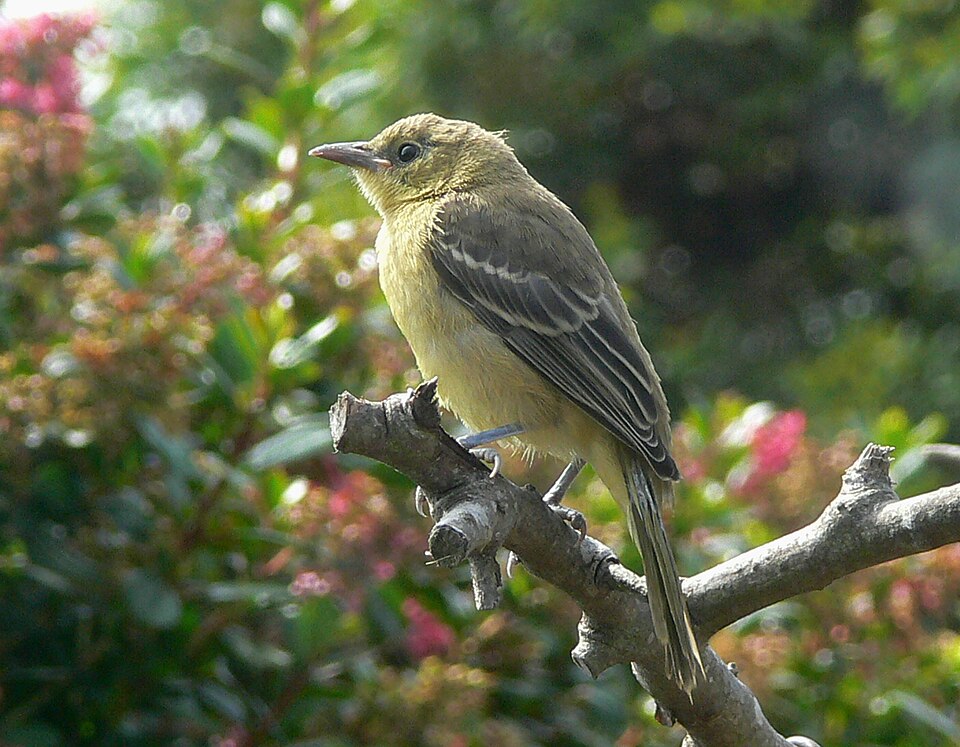
The Hooded Oriole is one of the most graceful members of the blackbird family, a slim, long-tailed songbird that brings a flash of warm orange to the palm trees, suburbs, and desert washes of the American Southwest. Unlike the bulky orioles of the East, it has a delicate build, a slender slightly down-curved bill, and a habit of slipping quietly through the fronds of fan palms, where it often hides its hanging nest. Birders who live within its range frequently come to know it as the oriole that nests in the neighborhood palm and visits the hummingbird feeder.
Its fortunes have closely followed human landscaping. As ornamental palms and flowering plants have spread through California, Arizona, Texas, and beyond, the Hooded Oriole has pushed steadily northward and become a familiar backyard bird in places where it was once scarce. It is a long-distance migrant for most of its U.S. range, arriving in spring with a burst of color and song and departing again by late summer, though a small but growing number now linger through winter where feeders are reliable.
Look for a small, slender oriole with a noticeably long tail and a thin, gently curved bill that sets it apart from other orioles at a glance. The overall impression is elegant and attenuated rather than chunky, and it often perches lengthwise along a palm frond or hangs acrobatically to feed.
| Adult male | Bright orange to orange-yellow head, underparts, and rump with a solid black throat, black face mask, and black back; black wings show two white wing bars |
| Bill | Thin and slightly decurved (down-curved) - a key feature separating it from the straighter-billed Bullock's Oriole |
| Tail | Long and graduated, giving the bird a slim, drawn-out silhouette |
| Female / immature | Olive-yellow above, dull yellow below, with grayish wings and two whitish wing bars; lacks any black bib |
| Wing bars | Two pale wing bars on both sexes, the upper one often broader |
| Size | Smaller and more slender than an American Robin; about sparrow-and-a-half in bulk |
Male vs. female
Adult males and females look distinctly different. The male is the showy one: rich orange or orange-yellow over the head, breast, belly, and rump, offset by a crisp black throat patch, black mask through the eye, and a black back and tail. Females and first-year birds are far more subdued, dressed in olive-yellow upperparts and soft yellow underparts with no black bib at all, looking somewhat like a faded, slender version of the male. Where the male is unmistakable, the female is easy to confuse with other female orioles, and the thin curved bill plus the warm yellow (rather than grayish-white) belly are the marks to lean on.
Juveniles
Juveniles resemble the adult female - olive-yellow above and yellowish below - but look softer and plainer overall. Young males take time to acquire full adult plumage: through their first spring and summer they often show a partial black throat patch coming in against an otherwise female-like body, sometimes with scattered orange feathers. These "in-between" young males are a common source of identification puzzles, and birds breeding in their first year may still wear this immature-looking dress.
The Hooded Oriole's song is a hurried, somewhat scratchy warble - a jumble of whistled and chattering notes that lacks the rich, flutey clarity of some other orioles and can sound almost improvised. It frequently mixes in harsh notes and imitations, giving the song a disjointed, conversational quality rather than a clean melody.
Its calls are more distinctive and easier to learn. A sharp, rising wheet or weet is given commonly, and an agitated, nasal chatter - a rapid chh-chh-chh or scolding rattle - is used in alarm and around the nest. These call notes are often the first clue that a Hooded Oriole is nearby, even when the bird is hidden among palm fronds.
The Hooded Oriole breeds across the southwestern United States and well down into Mexico, including the Baja peninsula. In the U.S. it occupies much of California (especially the southern half and the Central Valley, with a steady spread up the coast), southern Nevada, Arizona, southern New Mexico, and southern and central Texas, favoring lowland habitats with palms, cottonwoods, sycamores, mesquite, and suburban plantings.
Most U.S. breeders are migratory, arriving roughly in March and departing by late summer to winter in Mexico. A notable and increasing exception occurs where ornamental flowers and well-stocked feeders persist year-round - particularly in coastal and urban Southern California and parts of the Gulf Coast - where some birds now overwinter rather than migrating. The species' overall range has expanded northward over recent decades, tracking the planting of palms and other suburban vegetation.
Hooded Orioles are versatile feeders that take a mix of insects, nectar, and fruit. During the breeding season they glean caterpillars, beetles, ants, wasps, and other arthropods from foliage and bark, often probing into curled leaves and blossoms. They are notably fond of nectar and will work flowering plants - aloes, agaves, hibiscus, ocotillo, and tubular blooms of many kinds - sometimes piercing the base of a flower to "rob" nectar without pollinating it.
This sweet tooth makes them frequent and conspicuous visitors to hummingbird feeders, where they cling awkwardly and reach in for the sugar water, occasionally bending the ports in the process. They also relish ripe and halved fruit, especially oranges, and will take grape jelly. Their slender, slightly curved bill is well suited to probing flowers and reaching into tight spaces that stouter-billed birds cannot.
The nest is a beautifully woven, hanging pouch, but it is typically shallower and sewn more tightly against its support than the deep dangling baskets of some other orioles. Hooded Orioles are strongly associated with palms, and where fan palms are available the female often stitches the nest directly to the underside of a frond using plant fibers, threading material through the leaf so the cup hangs beneath it. In areas without palms they use cottonwoods, sycamores, mesquites, and other broad-leaved trees.
The female builds the nest and does the incubating, typically laying 3 to 5 eggs that are pale with darker spotting and scrawls. Pairs frequently raise two broods in a season across much of the range. The species is a regular host to cowbird parasitism, and its strong tie to palms means its breeding distribution has spread along with ornamental palm plantings.
Yes - within its southwestern range, the Hooded Oriole is one of the more reliable orioles to draw into a yard, partly because of its appetite for sugar water and fruit. A few simple offerings during spring and summer can turn a visit into a regular habit.
- Offer halved oranges and grape jelly on a platform or dedicated oriole feeder - skewer orange halves on a nail or branch where they are easy to reach.
- Put out sugar water (nectar) at about a 4:1 water-to-sugar ratio; Hooded Orioles readily use hummingbird feeders and dedicated oriole feeders with larger ports.
- Plant nectar-rich flowers like aloes, hibiscus, ocotillo, and other tubular blooms to provide a natural food source.
- If you have or can plant fan palms, you greatly improve your odds of attracting nesting birds, since they favor palm fronds for nests.
- Time your feeders to spring arrival (around March in much of the U.S. range) so food is waiting when migrants return.
- Skip pesticides - leaving caterpillars and other insects in the garden provides essential protein for nestlings.
- Bullock's Oriole: Overlaps in the West; male has an orange face with a black eyeline and crown (not a full black hood/mask), a large white wing patch, and a straighter bill. Bullock's is chunkier with a shorter tail.
- Baltimore Oriole: Mainly an eastern bird with little range overlap; male is deeper flame-orange with a solid black hood over the whole head and a single white wing bar, and is stockier with a straighter bill.
- Orchard Oriole: Males are brick-red rather than orange; females are greener-yellow and stubbier. Orchard is smaller and shorter-tailed, and ranges mostly farther east.
- Scott's Oriole: Shares desert and Southwest habitats; male is bright lemon-yellow and black (not orange) with a black hood extending onto the back and breast - a very different color scheme.
How can I tell a Hooded Oriole from a Bullock's Oriole?
Look at the head and bill. A male Hooded Oriole has a black throat and a black mask with an orange crown and nape, plus a thin, slightly down-curved bill and a long tail. A male Bullock's has an orange face with a neat black eyeline and black cap, a big white wing patch, a straighter bill, and a chunkier, shorter-tailed shape.
Will Hooded Orioles use a hummingbird feeder?
Yes. Hooded Orioles love sugar water and regularly visit hummingbird feeders, clinging to the side and reaching in for the nectar. If they're frequent visitors, consider adding a dedicated oriole feeder with larger ports so they can feed more comfortably.
What do Hooded Orioles eat?
They eat a mix of insects (caterpillars, beetles, ants, and wasps), flower nectar, and fruit. In yards they're especially drawn to halved oranges, grape jelly, and sugar-water feeders, and in the wild they work nectar-rich blooms like aloes, hibiscus, and ocotillo.
When do Hooded Orioles arrive and leave?
In most of their U.S. range they're spring and summer breeders, arriving around March and heading to Mexico for winter by late summer. A growing number now stay through winter in milder areas like coastal Southern California, especially where feeders and flowers are available year-round.
Why do Hooded Orioles like palm trees?
They use palm fronds as nesting sites, weaving their hanging pouch nest onto the underside of a frond with plant fibers. The spread of ornamental fan palms has helped the species expand its range northward into suburban areas.