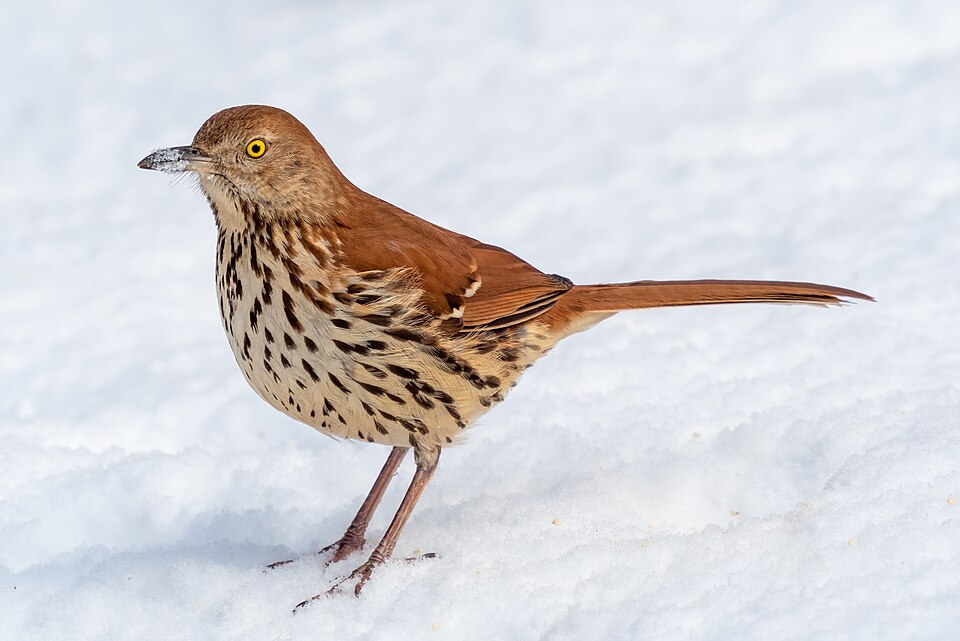
The Brown Thrasher is one of those birds that birders hear far more often than they see. A large, long-tailed songbird dressed in warm reddish-brown above and heavily streaked below, it spends most of its day low and out of sight, thrashing through leaf litter and tangled shrubs with a vigor that earned it its name. Slip too close and it slinks deeper into the bramble; but in spring a male will climb to an exposed perch and unleash one of the most remarkable performances in the bird world.
It belongs to the mimid family, the same group as the Northern Mockingbird and the Gray Catbird, and like its relatives it is a gifted mimic and improviser. Brown Thrashers are the official state bird of Georgia and a familiar presence across much of the eastern and central United States. Though still common, populations have declined steadily over recent decades as hedgerows, thickets, and shrubby field edges have been cleared, making the dense brushy cover this species depends on increasingly scarce.
Brown Thrashers are noticeably larger and longer than an American Robin, with a slim build, a long tail often held cocked upward, and a slightly down-curved bill. The overall impression is of a rusty, streaky, low-slung bird that moves with deliberate, ground-hugging confidence rather than flitting.
| Upperparts | Bright reddish-brown (foxy rufous) from crown to tail, unmarked above |
| Underparts | Creamy to whitish, boldly marked with heavy dark teardrop streaks down the breast and flanks |
| Eye | Staring pale yellow to yellow-orange eye that stands out against the warm face |
| Wings | Two thin whitish wing bars on otherwise rufous wings |
| Bill | Long and slightly decurved, dark above and paler at the base below |
| Tail | Long and rounded, often raised; frequently the longest-looking part of the bird |
Male vs. female
Males and females look essentially identical, and there is no reliable way to tell them apart in the field by plumage, size, or eye color. Both sexes wear the same rusty upperparts, streaked breast, and yellow eye. Behavior offers the best clue during the breeding season: only the male sings the loud, far-carrying paired-phrase song from a high perch, so a thrasher belting out an endless medley from a treetop in spring is almost certainly a male.
Juveniles
Recently fledged Brown Thrashers resemble adults but look softer and less crisply marked, with more diffuse, blurry breast streaking and a slightly buffier wash overall. The most telling difference is the eye: juveniles start out with a grayish or dull olive-yellow iris that brightens to the adult's pale yellow as they mature through their first summer and fall. Their tails are also shorter at first, giving them a stubbier look than the long-tailed adults.
The Brown Thrasher is famous for sheer vocal variety. Males are credited with the largest song repertoire of any North American bird, with estimates running into the thousands of distinct phrases. The signature pattern is a string of rich, musical phrases delivered in couplets, where each phrase is typically repeated twice before the bird moves on to the next: "dig-it, dig-it, plant-it, plant-it, pull-it-up, pull-it-up." This doubling is the key to separating it by ear from its mimid cousins.
The Northern Mockingbird usually repeats phrases three or more times, while the Gray Catbird tends to give each phrase only once. Brown Thrashers incorporate imitations of other birds, but less compulsively than mockingbirds, and the result has a more leisurely, conversational cadence. Away from the song, listen for a sharp, smacking "chack" or "tcheck" call note and a low, drawn-out whistle, often given from cover when the bird is agitated.
The Brown Thrasher breeds across the eastern and central United States and into south-central Canada, roughly from the Rocky Mountain foothills eastward to the Atlantic coast. It favors brushy habitats: hedgerows, woodland edges, overgrown fields, shrubby thickets, and shelterbelts on the Great Plains.
Birds in the northern and western parts of the range are migratory, withdrawing in fall to spend winter in the southeastern United States, where many thrashers are present year-round. Across the South, the species is a permanent resident. Spring migrants typically push north in March and April, and fall movement runs through September and October. It is a rare but regular vagrant farther west.
Brown Thrashers are omnivores with a strong taste for animal prey, especially during the breeding season. They eat beetles, caterpillars, grasshoppers, true bugs, spiders, and other invertebrates, and will take small lizards, frogs, and snakes on occasion. In late summer, fall, and winter the diet shifts toward fruits, berries, and nuts, including acorns that they hammer open with that sturdy bill.
Their feeding style is distinctive and gives the bird its name: a thrasher sweeps its bill sideways through leaf litter, flinging leaves and debris aside with vigorous strokes to expose hidden insects and seeds beneath. You will often hear one rummaging in the underbrush before you see it. They feed mostly on or near the ground and rarely venture far into the open.
Brown Thrashers build a bulky cup nest of twigs, lined with finer materials such as grasses, leaves, and rootlets. Nests are usually placed low, within a few feet of the ground in a dense shrub, thorny tangle, vine, or small tree, where heavy cover hides and protects the eggs. Both members of the pair help build it.
The female lays a clutch of typically 3 to 5 pale bluish or greenish eggs finely speckled with reddish-brown. Both parents share incubation, which lasts about two weeks, and both feed the nestlings, which leave the nest roughly 9 to 13 days after hatching. Pairs often raise two broods in a season. Brown Thrashers are notably aggressive defenders of their nests and will dive at intruders, including humans and snakes, sometimes drawing blood.
Brown Thrashers will visit yards, but they are not classic tube-feeder birds. The single most effective thing you can do is provide the dense, brushy cover they crave; structure matters more than any particular food.
- Plant and keep thickets: dense shrubs, hedgerows, brush piles, and native berry-producing plants give thrashers the cover and natural food they need.
- Offer ground-level food: scatter cracked corn, sunflower seed, peanuts, or mealworms on the ground or a low platform rather than in hanging feeders.
- Grow fruiting natives: dogwood, blackberry, elderberry, sumac, and holly draw thrashers in late summer and fall.
- Provide a ground-level birdbath: a low, shallow water source near cover is more appealing than an elevated bath.
- Leave the leaf litter: an un-raked layer of leaves under shrubs lets thrashers do what they do best, sweeping for insects.
- Skip the pesticides: insecticides remove the beetles, caterpillars, and grubs that make up so much of their diet.
- Northern Mockingbird: Gray, not rusty, with bold white wing patches and white tail edges flashed in flight; repeats song phrases three or more times instead of twice.
- Gray Catbird: Slate-gray with a black cap and rusty undertail; smaller and unstreaked, and sings phrases once with a distinctive catlike mew.
- Wood Thrush: Plumper, short-tailed forest thrush with rounder black spots (not streaks) on a white breast, a dark eye, and a flutelike song rather than mimicry.
- Long-billed Thrasher: A south Texas specialty that is grayer-faced with a longer, more strongly curved bill and an orange eye; ranges barely overlap.
What is the difference between a Brown Thrasher and a thrush?
They are unrelated families. The Brown Thrasher is a mimid (like mockingbirds and catbirds), with a long tail, long curved bill, yellow eye, and dark streaks on its breast. Thrushes such as the Wood Thrush are rounder, shorter-tailed, dark-eyed birds with round spots, not streaks, and they sing pure flutelike songs rather than mimicking other birds.
Why is the Brown Thrasher so loud and varied in its song?
Male Brown Thrashers improvise and string together an enormous number of phrases, with repertoires estimated in the thousands, more than any other North American songbird. They sing to defend territory and attract mates in spring. The trademark is repeating each phrase about twice before switching to a new one.
Are Brown Thrashers aggressive?
Toward their nests, yes. They are fierce defenders and will dive-bomb and strike intruders, including cats, snakes, and even people who get too close, sometimes drawing blood. Away from the nest they are shy and secretive, preferring to slip into cover rather than confront.
Will Brown Thrashers come to a bird feeder?
Sometimes, but they are not typical hanging-feeder birds. They prefer to feed on the ground, so they are far more likely to visit if you scatter sunflower seed, cracked corn, peanuts, or mealworms on the ground or a low platform near dense shrubs and brush piles.
Where do Brown Thrashers go in winter?
Northern and western breeders migrate south to the southeastern United States for winter, where they join populations that are already year-round residents. Across the South the species can be seen all year, while in the far north it largely disappears from late fall until spring.