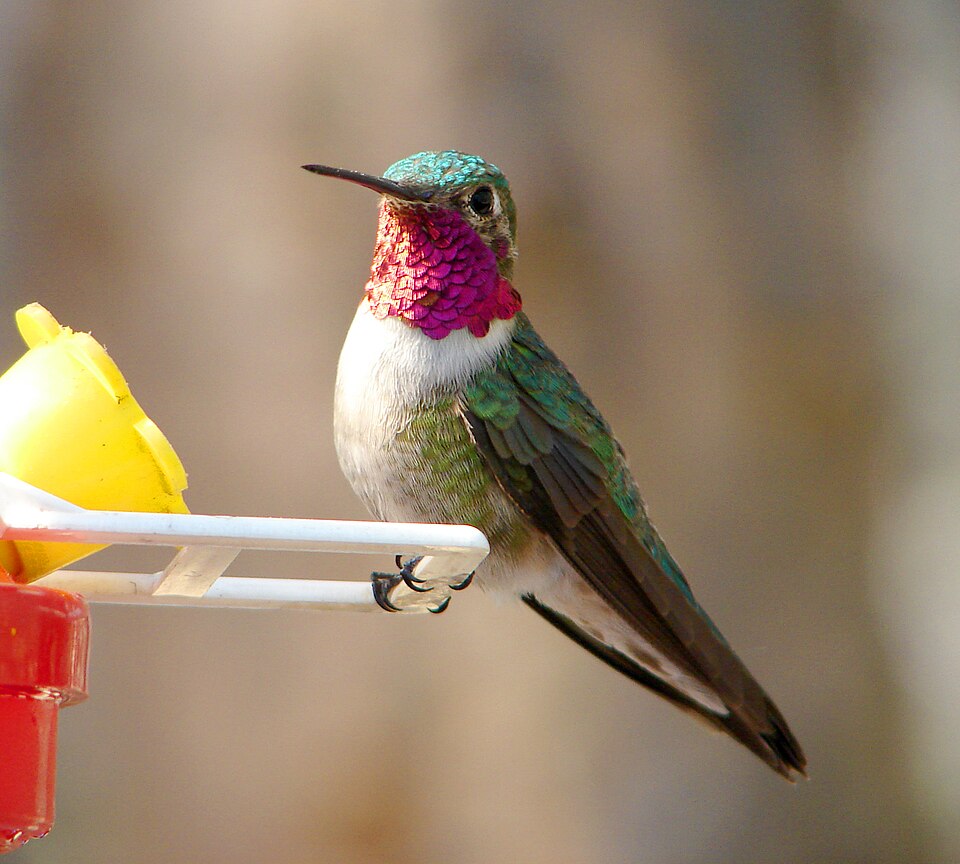
If you spend a summer morning near a high-country meadow in Colorado, Wyoming, or northern New Mexico, you'll likely hear the Broad-tailed Hummingbird before you see it. The adult male's wings produce a loud, metallic, cricket-like trill on every wingbeat, a sound so distinctive that experienced birders can identify the species with their eyes closed. It is one of the classic hummingbirds of the southern Rocky Mountains, a tough little bird that breeds higher and later than most of its relatives and toughs out chilly mountain nights by dropping into torpor.
The Broad-tailed is a medium-sized hummingbird with a rose-magenta throat on the male and a clean, green-backed look overall. It shares much of its summer range with the smaller, feistier Rufous and Calliope hummingbirds, and telling the females and youngsters apart is one of the great puzzles of western backyard birding. Common and widespread across mountain habitats, it readily visits feeders and flower gardens, making it a familiar and welcome presence at high-elevation homes throughout the West.
This is a fairly chunky, big-headed hummingbird with a relatively long, broad tail that gives the species its name. At rest the wingtips fall short of the tail tip. The two sexes look quite different, and as with most hummingbirds the surest mark on the male, the glowing throat, depends entirely on the angle of the light.
| Male gorget | Brilliant rose-pink to magenta throat that can look dark or blackish in poor light |
| Upperparts | Bright metallic green crown and back in both sexes |
| Underparts | Whitish below; male has a clean white chest, females and young show buffy or cinnamon wash on the sides |
| Tail | Broad and rounded; male's outer tail feathers are dark, females show rufous bases and white tail-corner spots |
| Wing trill | Adult males produce a loud, shrill, cricket-like trill in flight (a mechanical sound, not a vocal call) |
| Bill | Straight, medium-length, black |
Male vs. female
Males and females are easy to separate when seen well. The adult male has a vivid rose-magenta gorget (throat patch), a clean white breast, glittering green back and crown, and dark, slightly rufous-edged tail. His signature feature is the loud wing trill produced by specially shaped outer primary feathers. The female lacks any throat color, instead showing a pale throat finely speckled with dusky or bronze-green dots, buffy-cinnamon wash along the flanks, and white spots at the corners of the tail. Females also have rufous at the bases of the outer tail feathers, a useful mark when the tail is fanned. Female wings do not trill.
Juveniles
Juveniles closely resemble adult females, with green upperparts, buffy-washed sides, and a speckled throat. Immature males begin to show scattered rose-pink or magenta feathers flecking the throat as summer progresses, a giveaway to their sex before the full gorget grows in. Young birds often look fresh and neatly fringed with buff on the back feathers, and the wings of young males do not yet produce the adult trill.
Broad-tailed Hummingbirds are not true songsters. Their most famous sound is mechanical, not vocal: the adult male's wings throw off a loud, high, metallic zinging or cricket-like trill with every wingbeat, often the first clue to the species in mountain meadows. Birders frequently describe it as a shrill, ringing buzz that rises and falls as the bird approaches and passes.
Vocally, both sexes give sharp, dry chip notes, often run together into rapid chittering chase-calls during disputes at feeders and flowers (chit-chit-chit-chit). Males in display dives may add thin, squeaky chip series, but the wing trill remains the defining acoustic signature of the species.
The Broad-tailed Hummingbird is a bird of the interior West. It breeds at middle to high elevations through the southern Rocky Mountains and associated ranges, from southern Montana, Idaho, and Wyoming south through Colorado, Utah, Nevada, Arizona, and New Mexico, into the highlands of Mexico. It favors mountain meadows, pine-oak and pinyon-juniper woodlands, aspen groves, and brushy streamside areas, often well above 5,000 feet and ranging up toward treeline in summer.
It is a long-distance migrant. Most birds winter in the highlands of Mexico and Central America, with a few lingering along the U.S.-Mexico border. Spring migrants arrive in the southern Rockies as early as March and April, with males typically preceding females to set up territories. Southbound movement runs from late summer into fall. Resident populations occur in parts of Mexico and Guatemala.
Like all hummingbirds, the Broad-tailed feeds primarily on nectar, hovering at tubular flowers and probing with its long, extensible tongue. In its mountain range it favors red and pink blooms such as scarlet gilia (skyrocket), Indian paintbrush, larkspur, penstemons, currants, and red columbine, and it plays an important role pollinating these plants. Birds defend rich flower patches aggressively, chasing rivals with sharp chip notes and headlong dives.
Nectar is the energy source, but protein comes from small insects and spiders, which the birds catch in midair, glean from foliage, or pluck from spider webs. Insects are especially important for breeding females feeding nestlings. To survive cold mountain nights, Broad-tailed Hummingbirds can enter torpor, dropping their body temperature and metabolism dramatically to conserve energy until morning.
The female alone builds the nest, a tiny, deep cup of plant down and fine fibers bound together and camouflaged on the outside with bits of lichen, bark, and moss, all held with spider silk. The stretchy silk lets the cup expand as the chicks grow. Nests are typically saddled on a horizontal branch or fork, often low and frequently over or near water, and sometimes sheltered beneath an overhanging limb that helps trap heat on cold nights.
She lays two white, pea-sized eggs and incubates them on her own for roughly two and a half weeks. The male takes no part in nesting; after mating he plays no role in raising young. Chicks fledge a few weeks after hatching, and in the warmer, lower parts of the range a female may raise more than one brood in a season.
Yes, the Broad-tailed Hummingbird is a reliable and rewarding feeder and garden visitor across its western mountain range. If you live in the Rockies or Intermountain West at mid to high elevation, you have an excellent chance of hosting them all summer.
- Hang a hummingbird feeder filled with a simple 4:1 ratio of water to white table sugar (1 part sugar to 4 parts water). Never use honey, brown sugar, or red dye.
- Change the nectar every 2-3 days in warm weather to prevent fermentation and mold; clean feeders thoroughly at each refill.
- Plant native, nectar-rich tubular flowers like scarlet gilia, penstemon, paintbrush, columbine, and currants to draw birds and support pollination.
- Put feeders out early in spring (March-April in the southern Rockies) to catch arriving males, and leave them up into early fall for late migrants.
- Provide multiple feeders spaced out of sight of one another, since males are territorial and will try to monopolize a single feeder.
- Avoid pesticides so small insects and spiders, a key protein source, remain available, especially for nesting females.
- Rufous Hummingbird: Males are extensively rufous-orange on the back and sides with an orange-red gorget, unlike the green-backed Broad-tailed. Females overlap and are tricky, but Rufous shows more extensive rufous in the tail and a more compact, aggressive look; Rufous males lack the loud cricket-like wing trill.
- Calliope Hummingbird: Much smaller and shorter-tailed, with wingtips reaching or exceeding the tail tip at rest. Male shows distinctive magenta gorget streaks rather than a solid throat. Females are noticeably tinier than Broad-tailed.
- Black-chinned Hummingbird: Slimmer with a dull blackish throat showing only a thin violet band at the bottom edge on males. Lacks the rose-magenta gorget and the ringing wing trill of the Broad-tailed; often found at lower elevations.
- Anna's Hummingbird: Male has a rose-red crown as well as gorget and gives a buzzy scratchy song; a more coastal and lowland West Coast bird that overlaps little with the Broad-tailed's mountain range.
What makes the buzzing or trilling sound when a Broad-tailed Hummingbird flies?
It's the adult male's wings, not his voice. Specially shaped outer primary feathers produce a loud, metallic, cricket-like trill on every wingbeat. Females and young males don't make it, so a clear trilling flyby almost always means an adult male is present.
How can I tell a female Broad-tailed from a female Rufous Hummingbird?
It's genuinely hard, and even experts study the tail. Both have green backs and buffy sides, but female Rufous typically show more extensive rufous in the tail and flanks and look smaller and more aggressive. Broad-tailed females are a bit larger with cleaner underparts. When possible, note range, behavior, and tail pattern, and don't be afraid to leave some birds unidentified.
Where and when can I see Broad-tailed Hummingbirds?
Look in the southern and central Rocky Mountains and Intermountain West, from Montana and Wyoming south through Colorado, Utah, Arizona, and New Mexico, at mid to high elevations in meadows, aspen, and pine-oak woodlands. They arrive in spring (March-April) and depart by fall, wintering mainly in the mountains of Mexico and Central America.
What should I feed Broad-tailed Hummingbirds?
Use a homemade nectar of one part plain white sugar to four parts water, with no dye, honey, or artificial sweeteners. Keep feeders clean and refresh the nectar every couple of days in warm weather. Native tubular flowers like penstemon, scarlet gilia, and paintbrush are excellent natural food sources.
How do Broad-tailed Hummingbirds survive cold mountain nights?
They enter a state called torpor, lowering their body temperature and slowing their heart rate and metabolism dramatically to save energy through the cold night. By morning they warm back up and resume feeding. Nesting females often place nests under sheltering branches that help retain heat.