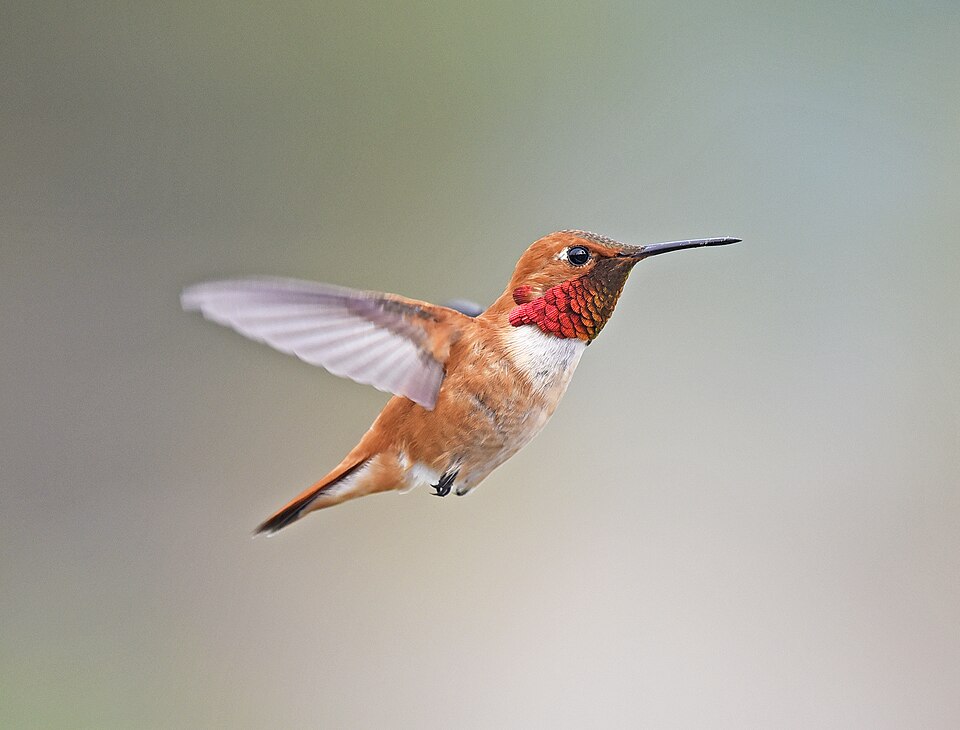
The Rufous Hummingbird is one of the most pugnacious birds you'll ever meet, and it weighs about as much as a nickel. Adult males glow a bright copper-orange that flashes like a struck match in good light, while their fiery red-orange throat patch can blaze almost like flame. Despite the tiny package, this is a hummingbird with attitude to spare. A single male will commandeer a feeder or a patch of flowers and dive-bomb anything that comes near, including larger hummingbirds, chipmunks, and the occasional startled gardener.
What makes the Rufous truly remarkable is its endurance. For its size, it undertakes one of the longest migrations of any bird in the world, a clockwise loop that carries it from wintering grounds in Mexico up the Pacific coast in spring and back down through the Rocky Mountain meadows in late summer. Along the way it breeds farther north than any other hummingbird, reaching into Alaska. Birders across the East have learned to keep a feeder up into late fall, because wandering Rufous Hummingbirds are by far the most likely "western stray" to turn up at a winter feeder thousands of miles out of range.
This is a very small, compact hummingbird with a short, straight bill and a tail that tapers to a point when perched. Size and shape alone rarely clinch the ID, so focus on color and the warm rufous tones that give the bird its name. Note that telling Rufous from the closely related Allen's Hummingbird often requires a clear view of the spread tail feathers.
| Adult male back | Bright coppery orange, usually solid rufous (some show green flecking on the crown or back) |
| Male gorget | Brilliant red-orange to flame-colored throat that can look dark when not catching light |
| Female & immature | Green above, rusty wash on the flanks and tail base, often a small spot of orange on the throat |
| Tail | Rufous at the base with dark tips; key feather (R2) often shows a notch in Rufous |
| Size & bill | Tiny and compact, about 3 inches, with a short, straight, needle-like black bill |
| Overall impression | A warm orange glow rather than the green-and-gray look of most other hummingbirds |
Male vs. female
Adult males are unmistakable when seen well, with their solid bright-orange backs and flanks and a glowing red-orange gorget. Females and immatures look entirely different: they are green above with a clean rusty wash along the sides, rusty coloring at the base of the tail, and usually just a small patch of bronzy or orange-red spotting on the throat rather than a full gorget. Because females and young birds are so much plainer, they are easy to overlook and are also where most identification headaches with Allen's Hummingbird arise.
Juveniles
Juveniles closely resemble adult females, with green upperparts, rusty flanks, and a pale, lightly spotted throat. Young males begin showing scattered iridescent orange-red feathers on the throat as they mature, and by their first fall some already have a few flame-colored gorget feathers coming in. In late summer and fall, the majority of Rufous Hummingbirds you see at feeders are these green-backed females and immatures rather than the brilliant adult males.
Rufous Hummingbirds are not songbirds, and they don't have a true musical song. Instead they communicate with a variety of sharp, buzzy, and ticking calls. The most common is a hard, chip-like chup or tchup, often run together into an excited, stuttering chase note when one bird is driving off another, something like tchup-tchup-ti-ti-ti.
The most distinctive sound is mechanical rather than vocal. The male's wings produce a high, trilling whine in flight, and during his courtship and threat display he climbs and then plunges in a steep dive, the air rushing through his wing and tail feathers to create a buzzy, popping brrr-DZEE at the bottom of the arc. Once you learn that wing trill, you can often detect a Rufous before you ever see it.
The Rufous Hummingbird breeds farther north than any other hummingbird, from the Pacific Northwest and the northern Rockies up through British Columbia and into southern Alaska. In spring it migrates north along the Pacific coast and lowlands, timed to the bloom of currants, salmonberry, and other early flowers.
The fall return is different and famous: birds drift south through the high mountain meadows of the Rockies and Cascades, following the late-summer wildflower bloom, before continuing on to wintering grounds in Mexico. This clockwise migratory loop is one of the longest journeys relative to body size of any bird. Rufous Hummingbirds are also the classic "vagrant" hummingbird in the East and Southeast, where individuals regularly turn up at feeders in fall and early winter, sometimes lingering for weeks if food and shelter hold out.
Like all hummingbirds, the Rufous runs on sugar. It feeds heavily on nectar from tubular and brightly colored flowers, favoring reds and oranges such as red columbine, paintbrush, penstemon, currant, and fireweed, and it readily visits sugar-water feeders. A hovering Rufous laps nectar with a fringed, extensible tongue rather than sipping through the bill.
Protein comes from small insects and spiders, which the bird catches in midair, plucks from foliage, or even snatches from spiderwebs. Insects are especially important for breeding females and growing nestlings. Rufous Hummingbirds are also notoriously territorial around food, and a single male will aggressively defend a rich nectar source or feeder against all comers, including much larger birds.
The female does all the nesting work alone. She builds a tiny, cup-shaped nest of soft plant down and moss, binding it together and anchoring it to a branch with spider silk, then camouflaging the outside with bits of lichen and bark. The nest is often placed low in a conifer or shrub, sometimes in loose groupings where good habitat concentrates several females.
She typically lays two minute white eggs and incubates them on her own for about two and a half weeks. The female alone feeds the young a diet of regurgitated nectar and insects, and the chicks fledge roughly three weeks after hatching. Males play no part in raising young; once mating is done, they often begin their southward migration well ahead of the females and juveniles.
Yes, the Rufous is very much a backyard and feeder bird across the West, and a prized surprise visitor in the East. A clean sugar-water feeder and the right plants will draw them in, especially during spring and fall migration.
- Fill feeders with a simple 1 part white sugar to 4 parts water mix, with no red dye and no honey or artificial sweeteners.
- Plant native tubular, nectar-rich flowers like penstemon, red columbine, currant, and fireweed; bright reds and oranges are especially attractive.
- Hang multiple feeders out of sight of one another, since a single dominant Rufous will try to monopolize and defend any feeder it can see.
- Keep feeders clean and change the nectar every few days in warm weather to prevent dangerous fermentation and mold.
- In the East and South, leave a feeder up into late fall and early winter, since wandering Rufous are the most likely western hummingbird to appear far out of range.
- Avoid pesticides so small insects and spiders remain available, which hummingbirds need for protein.
- Allen's Hummingbird: Nearly identical females and immatures; adult male Allen's usually has a green back rather than solid orange, and certain tail feathers are narrower. Often needs a spread-tail view to separate.
- Anna's Hummingbird: Larger and greener overall with no rufous tones; males have a rose-pink throat and crown rather than orange.
- Broad-tailed Hummingbird: Green-backed with a rose-magenta gorget on males and only limited rufous on the flanks; males make a loud, distinctive metallic wing trill.
- Ruby-throated Hummingbird: The default Eastern hummingbird; green-backed with no rufous, so any orange-toned hummingbird at an Eastern feeder is worth a careful second look.
How can I tell a Rufous Hummingbird from an Allen's Hummingbird?
Adult male Rufous usually has a solid coppery-orange back, while male Allen's typically shows a green back. Females and immatures of the two species are nearly impossible to separate in the field; reliable identification often requires a clear look at the shape and width of the spread tail feathers, so many birders simply log ambiguous birds as 'Rufous/Allen's.'
Why is the Rufous Hummingbird so aggressive at feeders?
Rufous Hummingbirds are highly territorial and will defend a rich food source to monopolize the energy it provides. A single bird often guards a feeder and chases off other hummingbirds, and even larger birds. Hanging several feeders where they cannot all be seen at once helps more birds feed in peace.
When do Rufous Hummingbirds migrate?
They move north up the Pacific coast in spring, roughly February through May depending on latitude, and head south through the mountains in mid to late summer. Many have left the U.S. by early fall, though strays regularly show up at Eastern feeders into late fall and winter.
Should I take my feeder down so Rufous Hummingbirds will migrate?
No. Leaving a feeder up does not stop hummingbirds from migrating, which is triggered by day length and instinct, not food availability. In fact, keeping a clean feeder up late in the year can be a lifeline for a wandering Rufous, and it gives you a real chance of hosting a rare visitor.
Why is there a Rufous Hummingbird at my feeder in winter in the eastern U.S.?
Rufous are famous wanderers, and a small number stray far east of their normal range each year, sometimes lingering at feeders into winter. These birds are surprisingly hardy and can survive cold snaps as long as they have food. If one appears, keep the feeder thawed and consider reporting it to a local birding group.
What do Rufous Hummingbirds eat besides nectar?
They catch and eat small insects and spiders, taking them in midair, gleaning them from leaves, or pulling them from spiderwebs. This protein is essential for breeding females and for feeding nestlings, so a pesticide-free, insect-friendly yard helps support them.