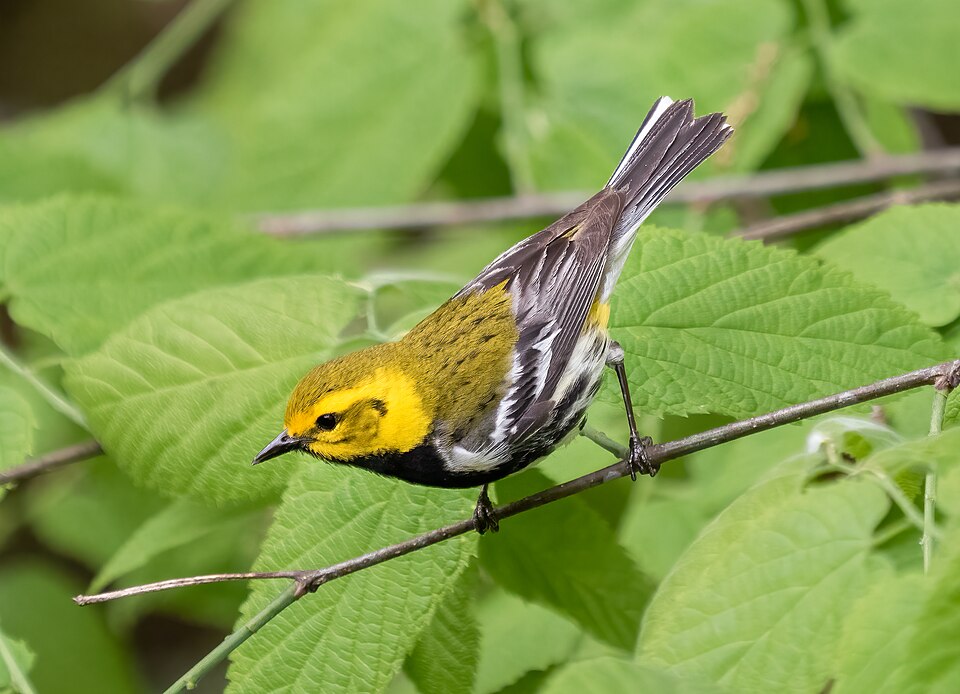
The Black-throated Green Warbler is one of the most recognizable wood-warblers of eastern North America, and for many birders its lazy, buzzy song is the unmistakable soundtrack of a summer walk through conifers. With a glowing yellow face framing dark eyes, an inky black throat, and crisp olive-green upperparts, the male is hard to confuse with much else once you get a good look. It is small, active, and endlessly busy, flitting through spruce, hemlock, and pine as it gleans insects from needles and twigs.
This is a bird of the boreal and Appalachian forests, breeding from the spruce-fir woods of Canada and New England down the spine of the Appalachians, and wintering in Central America and the Caribbean. Although it nests high in the canopy and isn't a feeder visitor, it is one of the easier warblers to learn because it sings persistently, often perches in the open at the tops of trees, and migrates through much of the eastern half of the continent. Learn its song and you'll find it turns up far more often than you expected.
This is a classic small, compact Setophaga warbler with a short tail, thin pointed bill, and the restless, needle-probing habits of a canopy gleaner. The combination of a bright yellow face and a black-and-white body is diagnostic and visible even at a distance against the sky.
| Face | Bright lemon-yellow cheeks and forehead surrounding a dark eye, with a faint olive line through the eye and across the ear patch |
| Throat | Solid black throat and upper breast on males; the black streaks down the flanks |
| Upperparts | Unstreaked olive-green back and crown, giving the bird its name |
| Wings | Blue-gray wings with two bold white wing bars |
| Underparts | White belly and undertail; black streaking along the sides |
| Size & shape | Tiny and compact, about chickadee-sized, with a thin warbler bill and short tail |
Male vs. female
Males and females look broadly similar, but the throat is the key. Breeding males show a full, solid black throat and chest with bold black flank streaking. Females are duller: the throat is mostly whitish or pale yellow with only scattered black mottling, often forming a partial black necklace rather than a solid bib. Females also tend to have slightly less vivid yellow on the face. In fall, males molt to a more subdued plumage and their black throat becomes partly veiled with pale feather edges, so the difference between the sexes narrows considerably.
Juveniles
Juveniles and first-fall birds are the dullest of all. They show the same yellow-tinged face and white wing bars but lack the black throat almost entirely, sometimes showing only faint dusky smudging where the bib will eventually be. The face is washed yellow-olive rather than clean lemon, and the flank streaking is faint. Despite the muted plumage, the yellow face plus white wing bars and olive upperparts still point reliably to this species, and young birds usually keep just enough dark on the sides of the throat to hint at the adult pattern.
The song is the easiest way to find this bird and one of the first warbler songs many birders learn. It is a slow, buzzy, slightly wheezy series often written as "zee-zee-zee-zoo-zee" or "zoo-zee-zoo-zoo-zee," with the buzzy quality earning it the old mnemonic "trees, trees, murmuring trees." There are two common song types: an accented-ending version used to attract mates and an unaccented version used more in territorial and male-to-male contexts.
The most frequent call note is a sharp, high, slightly metallic "tsip" or "chip," given year-round including on migration and wintering grounds. In flight and at night during migration, it gives a high, thin "see" flight call.
The breeding range spans two main zones: a broad northern band across the boreal forest of central and eastern Canada and the northeastern United States, and a separate southern arm running down the Appalachian Mountains as far as northern Georgia. A genetically distinct coastal population (sometimes called Wayne's Warbler) breeds in cypress swamps of the mid-Atlantic coastal plain. The bird favors mature coniferous and mixed forests, especially spruce, fir, hemlock, and pine.
It is a long-distance migrant, leaving its breeding grounds in late summer and fall to winter in Mexico, Central America (notably southern Mexico through Panama), and parts of the Caribbean and northern South America. During spring and fall migration it passes through much of the eastern and central United States, where it can show up in almost any wooded park or backyard with tall trees.
Black-throated Green Warblers are primarily insectivorous, feeding heavily on caterpillars, especially during the breeding season when they take advantage of larval outbreaks in conifers. They also eat beetles, true bugs, flies, gnats, spiders, and other small arthropods gleaned from foliage and twigs.
Their typical foraging style is active gleaning in the outer branches and tips of conifers, where they hop and hover to pick prey from needles and bark. They will occasionally sally out to snatch a flying insect in mid-air. On the wintering grounds and in migration they broaden their diet to include some berries and will join mixed-species foraging flocks moving through the canopy.
The female builds a compact, cup-shaped nest of bark strips, grasses, twigs, and spider silk, lined with finer materials such as hair, moss, and feathers. Nests are usually placed against the trunk or in a fork of a conifer, often well up in the tree, though heights vary considerably.
A typical clutch is 3 to 5 eggs, which are creamy or grayish-white with brown and lavender spotting concentrated at the larger end. The female does the incubating for roughly 12 days, and both parents feed the nestlings, which fledge in another 8 to 11 days. Pairs usually raise a single brood per season across most of their range, occasionally attempting a second where the season is long enough.
This is not a feeder bird and won't come for seed or suet, but you can still draw it to your yard during migration and, in the right habitat, in summer. The keys are tall trees, water, and a pesticide-free, insect-rich environment.
- Plant or keep conifers such as spruce, hemlock, and pine; these are the bird's preferred foraging and nesting habitat and the single biggest draw.
- Offer moving water. A dripper, mister, or fountain-style bird bath is far more attractive to migrating warblers than seed ever will be.
- Skip the pesticides. Caterpillars and other insects are this warbler's food, so an insect-friendly yard is essential.
- Provide a layered, native landscape with mature trees and understory; warblers move through canopy foliage searching for prey.
- Watch during migration windows in spring (roughly April-May) and fall (August-October), when this species filters through wooded yards and parks across the East.
- Learn the song, the buzzy zee-zee-zee-zoo-zee will tip you off to a bird in your trees long before you spot it.
- Townsend's Warbler: A western counterpart with a similar yellow-and-black face but a bold black ear patch surrounded by yellow and a yellow breast; ranges barely overlap.
- Hermit Warbler: Western bird with an all-yellow face and black throat but a plain gray back and no olive crown; very limited range overlap with this species.
- Golden-cheeked Warbler: A Texas Hill Country endemic with a yellow face and black throat but a solid black crown, back, and a black eye line; the back is black, not olive.
- Blackburnian Warbler: Shares conifer habitat and black-and-white patterning, but the male has a flaming orange throat and face rather than yellow with a black bib.
What does a Black-throated Green Warbler sound like?
Listen for a slow, buzzy, wheezy song often written as "zee-zee-zee-zoo-zee" or "zoo-zee-zoo-zoo-zee." It's one of the easiest warbler songs to learn and is sometimes remembered with the phrase "trees, trees, murmuring trees." The call note is a sharp, high "tsip."
Where do Black-throated Green Warblers live?
They breed in coniferous and mixed forests across the boreal regions of Canada and the northeastern U.S., and down the Appalachian Mountains to northern Georgia. They winter in Mexico, Central America, and the Caribbean, and pass through much of the eastern U.S. during migration.
Will a Black-throated Green Warbler come to my bird feeder?
No. This is an insect-eating canopy warbler that won't visit seed or suet feeders. Your best bet for attracting one is tall conifers, a pesticide-free yard full of insects, and especially a dripper or moving-water bird bath during spring and fall migration.
How do you tell a male from a female Black-throated Green Warbler?
The throat is the giveaway. Males have a solid black throat and chest with bold black flank streaks. Females have a mostly whitish or pale-yellow throat with only scattered black mottling, often just a partial necklace, and slightly duller plumage overall.
What's the difference between a Black-throated Green Warbler and a Blackburnian Warbler?
Both are small black-and-white conifer warblers, but the Blackburnian male has a brilliant flaming-orange throat and face, while the Black-throated Green has a lemon-yellow face and an all-black throat. Their habitats and ranges overlap heavily in northern and Appalachian forests.
Are Black-throated Green Warblers rare?
No, they are common and their population is considered stable, ranked Least Concern. They can be hard to spot because they forage high in the canopy, but they sing persistently, so birders who learn the song find them regularly throughout their range and on migration.