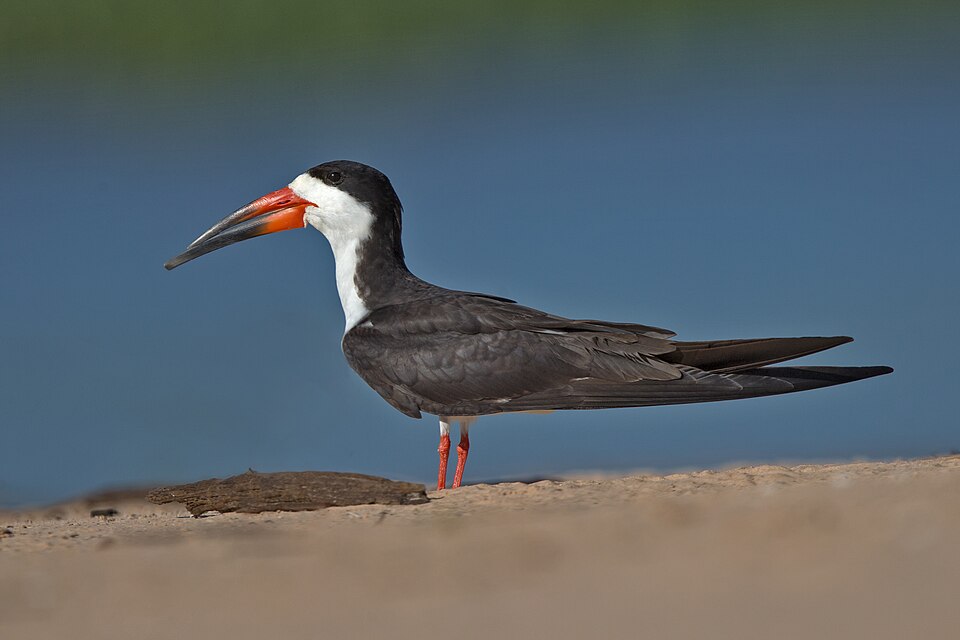
Few North American birds look as improbable as the Black Skimmer. It is a long-winged, tern-like seabird dressed in crisp black-above, white-below plumage, but the showstopper is its bill: a flattened, knife-thin red-and-black blade in which the lower half juts noticeably past the upper. That strange overbite-in-reverse is not a deformity but a precision tool. Skimmers are the only birds on the continent that feed by flying low and dragging the open lower mandible through the water, snapping the bill shut the instant it touches a fish.
Black Skimmers are creatures of warm coasts, sandy beaches, sheltered bays, and coastal lagoons. They nest in noisy colonies, often alongside terns, and spend much of the day loafing in tight flocks all facing the same direction into the wind. Most birders meet them at dusk or in the soft light of early morning, when long, buoyant lines of skimmers patrol the calm shallows and cut their telltale wakes across the surface. Watching one fish is one of the great spectacles of the American shoreline.
Think of a skimmer as a tern that got stretched out and handed a strange bill. It has very long, narrow wings, a slim body, short legs, and a buoyant, deliberate wingbeat that looks slower and more rowing than a tern's snappy flight. In any plumage the unique bill clinches the identification: long, laterally compressed (flattened side to side like a letter opener), bright red-orange at the base fading to black at the tip, with the lower mandible clearly longer than the upper.
| Bill | Unmistakable: long, knife-thin, red at base and black-tipped, with the lower mandible jutting well past the upper |
| Upperparts | Solid blackish on crown, back, and wings; a clean white trailing edge shows on the inner wing |
| Underparts | Bright white below, including the forehead and face below the cap |
| Wings & flight | Very long, slender wings; slow, buoyant, slightly floppy wingbeats lower than a tern's |
| Legs | Short and bright red-orange, set far back on the body |
| Size | Larger than most terns, roughly gull-sized but far slimmer and longer-winged |
Male vs. female
Males and females look alike in plumage, both showing the same black upperparts, white underparts, and red-and-black bill. The reliable difference is size: males are noticeably larger and heavier-billed than females. In a mixed flock or a courting pair you can often pick out the male as the bigger bird with the longer, deeper bill, though a lone skimmer is usually impossible to sex in the field.
Juveniles
Juveniles are easy to age. Instead of solid black above, they are mottled and scaled with buff, brown, and pale feather edges, giving a dappled, sandy look that camouflages chicks on open beaches. Their bills are shorter and duller, lacking the bold adult red, and the lower mandible has not yet grown to its full exaggerated length. Winter (nonbreeding) adults are intermediate, showing a whitish nape and hindcollar that breaks up the otherwise solid black hood.
Black Skimmers are not songbirds, but their colonies are unmistakably loud. The signature call is a nasal, barking kaup or aaup, often described as sounding oddly dog-like or like a yapping puppy. Birds give these notes in flight and on the ground, and a disturbed colony erupts into a chorus of grating, repeated barks.
Around the nest and in close encounters they add softer growls and a low, churring err-err-err. There is no melodic song to listen for; instead, the experience is the collective racket of dozens of nasal yelps rising off a sandbar as the flock wheels overhead.
In North America the Black Skimmer is mainly a bird of the Atlantic and Gulf coasts, breeding from the mid-Atlantic states south through Florida, around the Gulf of Mexico, and along the coast of California and northwest Mexico on the Pacific side. The species also ranges widely along the coasts and large rivers of Central and South America, where related subspecies occur.
It is largely coastal and shows seasonal shifts rather than dramatic long-distance migration. Northern breeders withdraw south for winter, concentrating along the Gulf and the southern Atlantic coast, while Florida and Gulf birds may be present year-round. Hurricanes and strong storms occasionally push skimmers well inland or north of their normal range, and small numbers turn up as vagrants away from the coast.
Black Skimmers eat small fish, supplemented by shrimp and other small aquatic creatures. Their feeding method is unlike any other North American bird: a skimmer flies low and straight, drops its long lower mandible into the water, and plows a thin furrow across the surface. The moment that sensitive lower bill brushes a fish, the head snaps down and the upper mandible clamps shut, often without the bird ever seeing its prey.
Because they fish largely by touch, skimmers favor calm, shallow water, channels, lagoons, tidal creeks, and sheltered bays, and they often feed most actively at dawn, dusk, and even into the night when small fish move into the shallows and the surface is glassy. You will frequently see them work an area in tight, synchronized lines, peeling off and circling back to skim the same productive stretch again and again.
Skimmers nest in colonies on open sand, shell beaches, dredge-spoil islands, and sandbars, very often mixed in with nesting terns. The nest itself is minimal, just a shallow scrape in the bare sand with little or no lining. Both the eggs and the downy, sandy-colored chicks are superbly camouflaged against the substrate, which is also their greatest vulnerability: nests are easily crushed by foot traffic, vehicles, and pets, and exposed to flooding by high tides and storms.
A typical clutch is three to five buff, dark-blotched eggs, and pairs usually raise a single brood per season, with the potential to renest if a clutch is lost. Both parents share incubation, which lasts roughly three weeks, and both feed the chicks, ferrying small fish back to the colony. Newly hatched chicks have equal-length mandibles; the lower bill only begins to outgrow the upper after they are feeding on their own.
The Black Skimmer is not a backyard or feeder bird, so there is no seed, suet, or nest box that will bring one to your yard. It is a specialized coastal fish-eater best enjoyed where it lives. The most meaningful thing you can do is help protect the beaches it depends on, and learn where and when to find it.
- Look on sheltered coasts: scan sandy beaches, tidal flats, sandbars, and the edges of bays and lagoons, especially where terns gather.
- Time it right: visit at dawn, dusk, or under calm conditions, when skimmers feed most actively on glassy shallow water.
- Respect posted colonies: keep well back from roped-off beach-nesting areas, since skimmer eggs and chicks are nearly invisible in the sand and easily crushed.
- Keep dogs leashed on the beach and never drive vehicles through loafing or nesting flocks.
- Support beach and barrier-island conservation; protecting dredge-spoil islands and undisturbed sandbars directly benefits skimmer colonies.
- Bring a scope or binoculars and watch a feeding flock skim, it is one of the best free shows on the coast.
- Caspian Tern: Large tern with a heavy red bill, but the bill is a normal pointed shape with both mandibles equal; lacks the skimmer's blade-like lower bill and black-above pattern.
- Royal Tern: Pale gray above with an orange bill and shaggy black cap; flies with quicker tern wingbeats and never skims the water with its bill.
- Sandwich Tern: Smaller and paler, with a slim black, yellow-tipped bill; lacks the skimmer's bold black upperparts and oversized lower mandible.
- Laughing Gull: Often shares the same beaches, but is a stockier gull with a hooded look in summer, broader wings, and an ordinary gull bill.
Why is the Black Skimmer's lower bill longer than the upper?
The longer, blade-thin lower mandible is a feeding adaptation. The skimmer flies low and slices the lower bill through the water; when it touches a fish, the bill snaps shut. Chicks actually hatch with equal-length mandibles, and the lower bill only grows longer once they begin feeding themselves.
How does a Black Skimmer catch fish?
It feeds by touch, not sight. The bird flies just above calm, shallow water with its mouth open and the sensitive lower mandible plowing the surface. The instant the bill contacts a fish, the head drops and the upper mandible clamps down to grab the prey, which is why skimmers often feed at dusk and after dark.
Where can I see a Black Skimmer?
Look along warm coasts, the U.S. Atlantic and Gulf coasts and parts of coastal California, on sandy beaches, tidal flats, sandbars, and sheltered bays and lagoons. They often loaf in tight flocks alongside terns and feed most actively at dawn and dusk.
Are Black Skimmers endangered?
Globally the species is listed as Least Concern, but it is sensitive to disturbance and several states list it as threatened or of special concern. Because it nests on open beaches, it is highly vulnerable to human foot and vehicle traffic, pets, predators, and storm flooding of its colonies.
How do you tell a skimmer from a tern?
The bill is the giveaway: a skimmer has a long, flattened, red-and-black bill with the lower half jutting past the upper, while terns have evenly pointed bills. Skimmers are also blacker above, longer-winged, and fly with slower, more buoyant wingbeats, and only skimmers drag the bill through the water to feed.