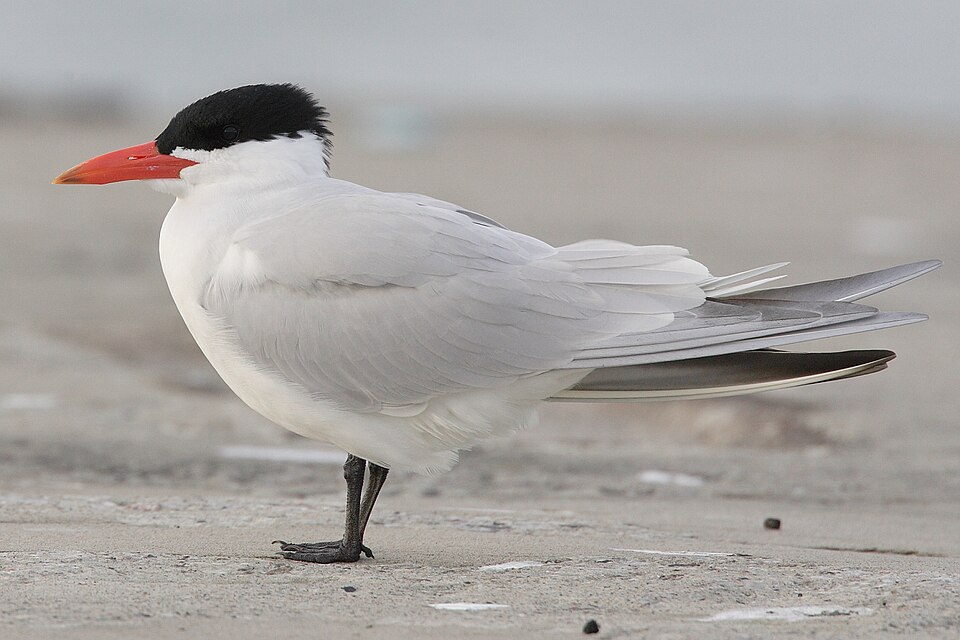
The Caspian Tern is the heavyweight of the tern world, and once you see one there is no mistaking it for anything else. Roughly the size of a large gull, it carries a thick, blood-red bill that looks almost too big for its head. Where most terns are slim and buoyant, the Caspian is broad-shouldered and powerful, flying with deep, deliberate wingbeats and a slightly hunched, businesslike air. It cruises high over open water, head angled down, scanning for fish before folding into a heavy plunge-dive.
Despite its name and its near-global distribution, this is a bird many backyard birders meet by accident, at a lake edge, a coastal estuary, or a big reservoir rather than at a feeder. It nests in scattered, often shifting colonies on bare sandy or gravelly islands, and it has a famously bad temper at the nest, diving at intruders with a rasping scream. Knowing its size, that fire-engine bill, and its raucous voice will let you pick it out of a crowd of smaller terns at a glance.
Size and bill do most of the identification work here. The Caspian Tern is bull-necked and gull-sized, with broad wings and a relatively short, only shallowly forked tail compared with the deeply streamered tails of many terns. In flight it looks heavy and direct rather than light and dancing.
| Bill | Massive, thick, carrot- to blood-red, often with a dusky smudge near the dark tip; the single best field mark |
| Size | The largest tern in the world, close to a Ring-billed Gull in bulk with a wingspan near four feet |
| Cap | Black crown in breeding season; in winter and on younger birds the cap is streaked grayish, never a clean black |
| Wings | Pale gray above; from below the outer primaries show a distinctive dark, dusky patch near the wingtips |
| Tail | Short and only shallowly forked, unlike the long, deep streamers of Common, Forster's, or Royal Terns |
| Legs | Black, fairly short for the body size |
Male vs. female
Male and female Caspian Terns look alike. There is no reliable plumage or bare-part difference you can pick out in the field. Males average very slightly larger, but the overlap is so complete that size is no help with a lone bird. In a courting pair you may see one bird (usually the male) carrying a fish to present to its mate, which can hint at sex through behavior rather than appearance.
Juveniles
Juveniles are easy to age. They show a heavily mottled and scaly back, washed with brown and buff rather than clean pale gray, and a streaky, smudged cap instead of a crisp black one. The bill is duller, more orange than fire-engine red, and often paler at the base. Young birds frequently stay with their parents well after fledging, begging loudly and following the adults on migration, so a streaky-backed Caspian flying behind a clean-backed one is almost certainly a bird of the year.
The voice is unmistakable and carries a long way. The classic call is a harsh, low, grating kaaarh or raah, deeper and rougher than any other tern, often likened to the croak of a heron or even a distant raven. Birders frequently hear a Caspian before they spot it overhead.
Around colonies the racket intensifies, with rasping screams and a distinctive begging call from juveniles, a wheezy, whistled whee-you or kee-uree that they repeat endlessly while chasing a parent for food. There is nothing musical about this tern; its sound is all gravel and complaint.
Few birds are as widespread. The Caspian Tern breeds on every continent except Antarctica, in scattered colonies across North America, Europe, Africa, Asia, and Australia. In North America it nests around the Great Lakes, along both coasts, on interior lakes and reservoirs of the West and northern Plains, and in patches of the Gulf and Atlantic coasts.
Northern populations are migratory. Birds from inland and northern colonies move south in fall, wintering along the southern U.S. coasts, through Mexico and Central America, and into northern South America. You are most likely to encounter migrants at large lakes, river mouths, and coastal bays from late summer through fall, often loafing on sandbars among gulls and smaller terns.
The Caspian Tern is a fish specialist. It feeds mainly on small to medium surface fish, taking whatever is locally abundant, including shad, herring, smelt, anchovies, minnows, and young of many other species. It hunts by flying steadily 20 to 50 feet above the water with its bill pointed down, then plunging headfirst to seize prey at or just below the surface.
Unlike a gull, it rarely scavenges and almost never feeds on land. It will occasionally take crayfish or large insects, and it is an opportunistic pirate, sometimes stealing fish from other terns or robbing nests of eggs and chicks at mixed colonies. Single dives, rather than the prolonged hovering of smaller terns, are typical of this powerful, direct hunter.
Caspian Terns nest in colonies, sometimes just a few pairs and sometimes hundreds, almost always on open, bare ground with little vegetation, such as sandy or gravelly islands, dredge-spoil sites, and rocky islets. The nest itself is minimal: a shallow scrape in sand or gravel, sometimes ringed with a few bits of debris, shells, or grass.
The female typically lays two to three pale, dark-blotched eggs, and both parents share incubation for about three to four weeks. The single brood is fiercely defended; adults dive and scream at gulls, foxes, and people who venture too close. Chicks can wander from the nest within days but depend on their parents for food for a long stretch, with family groups staying together into and even through fall migration, an unusually extended period of parental care for a tern.
This is not a backyard or feeder bird, and no amount of seed or suet will bring one in. The Caspian Tern is a wide-ranging fish-eater of open water, so the way to enjoy it is to go where it hunts rather than wait for it to come to you.
- Visit big water. Scan large lakes, reservoirs, coastal estuaries, river mouths, and the Great Lakes shoreline, especially during late-summer and fall migration when numbers peak.
- Check gull and tern roosts. Look on exposed sandbars, spits, and mudflats where mixed flocks loaf; the Caspian will be the giant with the red bill.
- Listen first. Learn its harsh, croaking kaaarh and you will often locate a high-flying bird by ear before you see it.
- Bring a scope. Birds frequently rest far out on islands or distant bars, where a spotting scope makes the bill color and streaked winter cap easy to confirm.
- Respect colonies. If you find a nesting island, stay well back; disturbed adults abandon eggs and chicks to gulls, so observe from a distance and never land.
- Royal Tern: Slimmer with a slenderer orange (not deep red) bill, a shaggy black crest, and a deeper-forked tail; coastal in the Americas and lacks the Caspian's heavy build and dusky underwing tips.
- Elegant Tern: Much smaller and daintier with a thin, drooping yellow-orange bill and a long shaggy crest; a Pacific-coast bird without the Caspian's bulk or croaking call.
- Forster's Tern: A small, pale tern with an orange-and-black bill, long forked tail streamers, and buoyant flight; roughly half the Caspian's size.
- Common Tern: Small and graceful with a slender red-and-black bill, deeply forked tail, and dancing flight; tiny next to the gull-sized Caspian.
How big is a Caspian Tern compared to a seagull?
It is genuinely gull-sized, roughly as large as a Ring-billed Gull, with a wingspan close to four feet. It is the largest tern in the world, which is why it stands out so dramatically among the smaller, slimmer terns it often loafs with.
What is that bird with a huge bright red bill at the lake?
If it is gull-sized, pale gray above with a black cap, and carrying a thick carrot- to blood-red bill, you are almost certainly looking at a Caspian Tern. That massive red bill is its single most reliable field mark.
Where does the Caspian Tern get its name if it lives all over the world?
It was first formally described from specimens collected near the Caspian Sea, so the name stuck even though the species actually breeds on every continent except Antarctica and is one of the most widespread terns on Earth.
What sound does a Caspian Tern make?
A harsh, low, grating croak, often written as kaaarh or raah, that sounds more like a heron or raven than a typical tern. You can frequently identify one by ear as it passes overhead before you even raise your binoculars.
Will a Caspian Tern ever come to a backyard or bird feeder?
No. It is a fish-eating bird of open water and does not visit feeders. To see one, head to a large lake, reservoir, or coast, especially during fall migration, and scan sandbars and tern roosts for the big bird with the red bill.