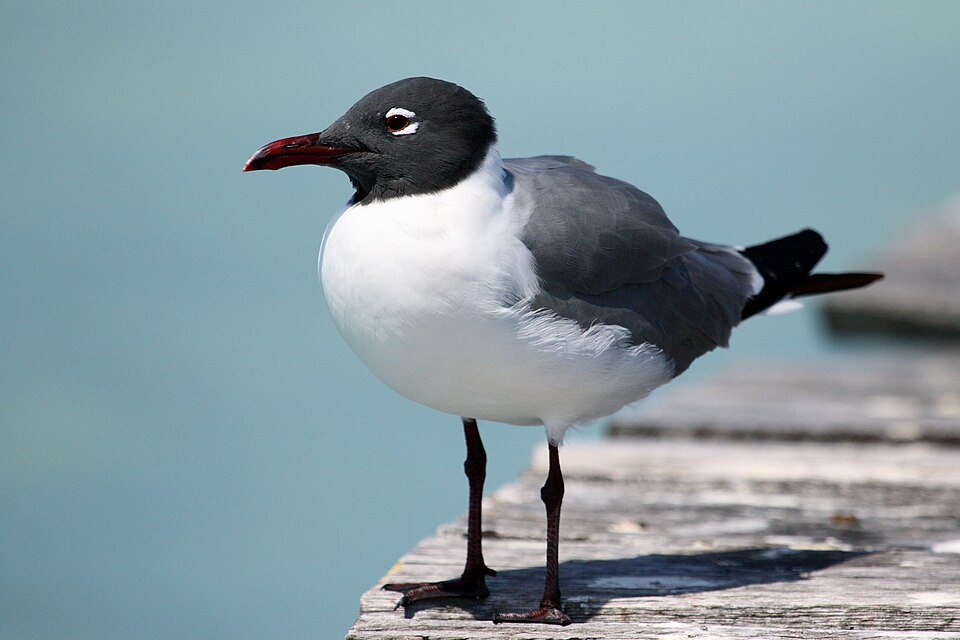
The Laughing Gull is the loud, sociable beachcomber of warm American coastlines, named for its rollicking, descending call that really does sound like a fit of laughter. In breeding plumage it is one of the most handsome gulls on the continent: a crisp jet-black hood, white eye-crescents, a long drooping red bill, and a clean gray back set off by black wingtips. It is a medium-sized gull, smaller and slimmer than the familiar Ring-billed or Herring gulls, with a buoyant, graceful flight that makes flocks look almost tern-like as they wheel over the surf.
This is the default gull of the southeastern and Gulf states, abundant on beaches, salt marshes, piers, and harbor towns from spring through fall. Few coastal birds are more comfortable around people. Laughing Gulls patrol parking lots, follow shrimp boats for discards, and famously snatch fries from boardwalks and ferries. Their numbers crashed during the plume-hunting era of the late 1800s but rebounded strongly under protection, and today they are a fixture of any warm-weather trip to the Atlantic or Gulf shore.
Look for a medium-small, elegant gull with a long, slightly drooping bill and long wings that project well past the tail at rest. The combination of a slender build, dark gray upperparts, and extensively black wingtips that blend into the gray back (with no white "mirrors") is distinctive, and in summer the full black hood is unmistakable among North American gulls.
| Breeding head | Full black hood (actually very dark slate) with bold white crescents above and below the eye |
| Bill | Long, slender, and slightly drooping; deep red in breeding adults, blackish in winter and immatures |
| Back & wings | Dark slate-gray upperparts blending into black wingtips with no white spots ('mirrors') |
| Legs | Dark reddish-black to black; reddish in peak breeding condition |
| Nonbreeding head | White with a smudgy gray 'shadow' wash across the rear crown and behind the eye |
| Size & shape | Slim, medium-small gull with long wings extending well past the tail when standing |
Male vs. female
Male and female Laughing Gulls look alike in plumage, so you cannot reliably sex them in the field by color or pattern. Males average slightly larger and longer-billed, and in a bonded pair standing side by side the male often looks marginally bulkier and heavier-billed, but this is subtle and unreliable for a lone bird. Behavior offers better clues during courtship, when the male typically performs the head-tossing displays and feeds the female.
Juveniles
Juveniles are warm grayish-brown overall with neat pale feather edges that give a scaly look, a brown-washed breast, and a dark bill and legs. They take about three years to reach full adult plumage, passing through messy intermediate stages. First-winter birds show a gray back contrasting with brown wings, a partial dark hood-shadow, and a broad black tail band; by the second year they look much more adult-like but retain some dark marks in the wing and bill. The broad black tail tip on young birds is a useful flight mark.
The signature call is exactly what the name promises: a long, descending series of clear, strident notes, ha-ha-ha-ha-haah-haah-haah, that rises and then tumbles downward like raucous laughter. Birders often call it the "long call," and a single excited bird can set off an entire raucous colony.
Away from the full laugh, Laughing Gulls give a nasal, complaining kaaa or kee-agh, sharp single yelps, and soft conversational notes around the nest. The sound is so tied to the southern coast that, for many people, hearing that wild cackle over the dunes is the very definition of summer at the beach.
Laughing Gulls breed along the Atlantic coast from the Canadian Maritimes (locally) and New England south through Florida, around the entire Gulf of Mexico, and into the Caribbean and along the coast of Mexico. The bulk of the population nests in dense colonies on barrier islands and salt marshes from the mid-Atlantic to Texas. They are overwhelmingly coastal, though small numbers wander inland, especially after storms or to large lakes and reservoirs.
They are strongly migratory in the north: birds from New England and the mid-Atlantic largely vacate in winter, shifting south to the southeastern states, the Gulf coast, the Caribbean, and the Pacific and Atlantic coasts of Central and northern South America. In the Deep South and along the Gulf they are present year-round. Spring brings adults back to colonies in striking full breeding dress from April into early summer.
The Laughing Gull is a true opportunist. Its natural diet centers on small fish, marine invertebrates, crabs, shrimp, insects, earthworms, and the eggs of crabs and other birds. Along Atlantic beaches in late spring, large flocks famously gather to gorge on horseshoe crab eggs, and they readily follow plows for grubs and snatch flying insects on the wing.
Like most gulls, they have learned to exploit people. Laughing Gulls scavenge fishery discards behind shrimp and trawl boats, comb beaches and parking lots for scraps, and boldly steal food from inattentive picnickers and other birds. They are notorious kleptoparasites, harassing Brown Pelicans and even perching on a pelican's head to grab fish slipping from its pouch. Feeding methods are varied: surface-dipping in flight, shallow plunging, walking and pecking on mudflats, and aerial hawking of insects.
Laughing Gulls nest in large, noisy colonies on the ground, choosing barrier-island dunes, salt-marsh islands, and dredge-spoil islands that are relatively safe from mammalian predators. The nest is a scrape or a bulky cup of grasses, marsh vegetation, and debris, often built up to stay above high tides in marsh sites. Pairs are monogamous within a season and defend a small territory around the nest amid the crowd.
The female typically lays three eggs (sometimes two or four), olive to buff and blotched with brown for camouflage among the vegetation. Both parents incubate for roughly three weeks, and both feed the chicks, which are mobile soon after hatching but stay near the nest. There is normally a single brood per year, though pairs may re-lay if an early clutch is lost. Colonies on low marsh are vulnerable to flooding from storm tides.
The Laughing Gull is not a backyard or feeder bird in any meaningful sense, and intentionally feeding gulls is discouraged because it makes them aggressive and unhealthy. That said, if you live or visit near the coast, you can reliably enjoy them with a few simple habits.
- Visit warm Atlantic and Gulf beaches, piers, jetties, and harbors from spring through fall, where Laughing Gulls are abundant and easy to watch up close.
- Time a late-spring trip to Delaware Bay or other mid-Atlantic beaches to see big flocks feeding on horseshoe crab eggs.
- Do not hand-feed them fries or bread; it harms the birds, encourages aggressive food-snatching, and is discouraged or prohibited at many beaches.
- Scan around Brown Pelicans and fishing boats, where Laughing Gulls gather to steal fish and grab discards.
- Bring binoculars to a roosting flock on a sandbar at low tide to study the range of plumages from crisp breeding adults to scaly juveniles.
- Franklin's Gull: Very similar black-hooded gull but smaller, with bolder white eye-crescents, large white spots ('mirrors') separating the gray from the black wingtip, and broad white tips to the wing. A bird of the interior prairies, rare on the coasts where Laughing Gulls dominate.
- Ring-billed Gull: Similar size but never has a black hood; shows a pale gray back, yellow legs, pale eyes, and a yellow bill with a black ring. Far more likely inland and in winter parking lots.
- Bonaparte's Gull: Much smaller and daintier with a small black bill, a black hood (not extending down the nape), pink legs, and flashy white wedges in the outer wing in flight.
- Herring Gull: Much larger and bulkier with a pale gray back, pink legs, pale eyes, and black wingtips with white mirrors; no black hood at any age.
Why is it called a Laughing Gull?
For its call: a loud, descending series of cackling notes that sounds remarkably like raucous human laughter. A single excited bird can trigger a whole colony into the chorus, which is unmistakable on warm-weather beaches.
What does a Laughing Gull look like in winter versus summer?
In summer (breeding) adults have a full black hood, white eye-crescents, and a deep red bill. In winter the hood is lost, leaving a white head with a smudgy gray wash on the rear crown and behind the eye, and the bill turns blackish. The dark gray back and black wingtips stay the same year-round.
Where do Laughing Gulls live?
They are coastal birds of the warm Atlantic and Gulf shores, breeding from New England south through Florida, around the Gulf of Mexico, and into the Caribbean and Mexico. Northern birds migrate south for winter, while Gulf and southeastern populations are present year-round.
Are Laughing Gulls aggressive or dangerous?
They are bold and opportunistic around people and will snatch unattended food, but they are not dangerous. The boldness is largely a learned response to being fed; not hand-feeding them keeps both birds and beachgoers better off.
How do I tell a Laughing Gull from a Franklin's Gull?
Both have black hoods, but the Laughing Gull is larger with a longer drooping bill and black wingtips that lack big white spots. Franklin's is smaller and rounder-headed with bold white eye-crescents and large white 'mirrors' splitting the black wingtip. Location helps: Laughing Gulls own the coasts, Franklin's the interior prairies.