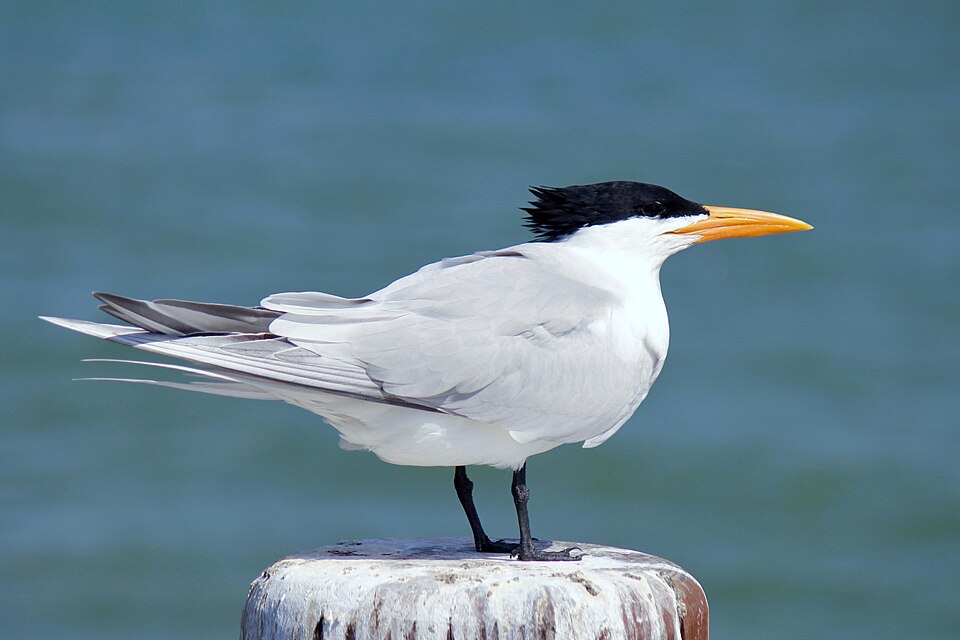
The Royal Tern is one of the largest and most elegant terns you'll meet along a warm-water coastline. Long-winged and built for soaring, it patrols beaches, inlets, and estuaries from the southern United States down through the Caribbean and along the coasts of West Africa, plus a separate population in South America. With its heavy carrot-orange bill, shaggy black crest, and crisp pale-gray-and-white plumage, it reads as a seabird that means business, yet it spends a surprising amount of time loafing shoulder-to-shoulder with gulls and skimmers on open sandbars.
For most of the year, the "full black cap" you might expect on a tern is actually missing on a Royal Tern. Outside the brief breeding window, the crown turns white from the forehead back, leaving a ragged black band around the back of the head like a receding hairline. That look, combined with its size and the unmistakable orange dagger of a bill, makes the Royal Tern one of the easier large terns to learn once you know what to watch for.
This is a large tern with a powerful build: long, narrow, swept-back wings, a moderately forked tail, and a thick, slightly drooping bill. In flight it looks rangy and graceful, flying with deep, unhurried wingbeats and frequently hovering before a plunge. On the ground its short black legs and chunky body give it a top-heavy, almost regal posture.
| Bill | Heavy, dagger-like, bright orange to orange-red; thicker and more drooping than most terns but slightly slimmer and more orange than the Caspian's blood-red bill |
| Crown | Full glossy black cap with a shaggy crest only briefly in early breeding; most of the year the forehead is white with a black band wrapping the rear crown |
| Upperparts | Pale silvery gray back and upperwings; outer primaries show a darker gray wedge in flight |
| Underparts | Clean white below; underwing mostly white with limited dark on the primary tips |
| Tail | White and deeply forked, longer and more swallow-like than the Caspian Tern's |
| Legs | Short and black, occasionally with some orange on the feet |
Male vs. female
Male and female Royal Terns look alike. The sexes share the same size, bill color, and plumage, so you cannot reliably tell them apart in the field. During courtship you may see paired birds where one (usually the male) presents a small fish to the other, but that behavior, not appearance, is the only practical clue to who is who.
Juveniles
Juvenile Royal Terns are duller and more patterned than adults. They show a paler yellowish or dull-orange bill, dusky-gray smudging and faint dark bars across the back and wing coverts, and dark markings on the tertials and tail. The crown is mottled rather than cleanly capped, and the legs often look yellowish rather than black. Young birds beg loudly from their parents with a thin whistling call and may stay dependent for months, even following adults far from the natal colony.
The Royal Tern is a vocal bird, especially around colonies and roosts. Its most familiar call is a loud, ringing, slightly rolling keer or kree-er, higher and less harsh than the deep, grating bark of a Caspian Tern. The tone has a clear, almost bleating quality that carries well over surf and wind.
Around nesting birds and family groups you'll also hear a sharper, repeated kak or kik and various softer chatters. Begging juveniles give a thin, whistled tseee that adults clearly recognize, picking their own chick out of a crowded, noisy colony by voice.
In North America, Royal Terns breed along the Atlantic and Gulf coasts, from roughly Maryland and Virginia south through Florida, Texas, and into Mexico, with scattered colonies on the Pacific coast of Mexico and southern California. They are essentially coastal and rarely venture far inland. Additional populations breed in the Caribbean, along the coast of South America, and across the Atlantic on the coasts of West Africa.
After breeding, many North American birds disperse north along the Atlantic coast in late summer before shifting south for winter. Wintering birds spread along the southern U.S. coasts and down to South America. They are strongly tied to salt water year-round, so even on migration you'll find them at beaches, jetties, inlets, and large estuaries rather than freshwater lakes.
Royal Terns are fish specialists. They feed mainly on small schooling fish such as anchovies, herring, silversides, and menhaden, and they readily take shrimp, small crabs, and squid when available. They hunt by flying over the water, often 20 to 40 feet up, scanning the surface, then folding their wings and plunge-diving headfirst to seize prey just below the surface.
Most foraging happens in shallow coastal waters, surf zones, tidal channels, and inlets, where currents concentrate baitfish. They will follow feeding frenzies created by predatory fish or dolphins pushing bait to the surface, and they sometimes patrol close behind shrimp boats and other vessels to grab disturbed or discarded fish.
Royal Terns are intensely colonial, nesting in dense, crowded groups on low sandy islands, shell beaches, and dredge-spoil islands, often packed in with other terns and Black Skimmers. The nest is little more than a shallow scrape in open sand, sometimes ringed with droppings. Nests are placed so close together that incubating adults nearly touch their neighbors, and this tight packing helps the colony mob predators.
The female typically lays a single egg (occasionally two), buff-colored and blotched with brown, and both parents share incubation for about three to four weeks. Soon after hatching, the chicks leave their scrapes and gather into a large mobile group called a creche, sometimes hundreds of young together. Remarkably, parents still find and feed only their own chick within this crowd, recognizing it by call. Royal Terns raise one brood per year.
The Royal Tern is not a backyard or feeder bird, so there's no seed, suet, or nest box that will bring one to your yard unless you happen to live right on a warm coastline. It's a wild seabird of beaches and estuaries, and the best way to "attract" one is to go where it lives and give it space.
- Visit sandy beaches, inlets, jetties, and estuaries along warm coasts, especially around high-tide roosts where terns and gulls loaf together on open sand.
- Scan mixed flocks of resting birds with binoculars or a scope; the big orange bill and white forehead make Royal Terns stand out among smaller terns.
- Look for active feeding frenzies near the surf or behind shrimp boats, where plunge-diving terns gather over baitfish.
- Give nesting colonies a wide berth from spring through summer; flushing adults exposes eggs and chicks to heat and predators, so observe from a distance.
- Support beach-nesting bird programs and respect posted closures and symbolic fencing that protect tern and skimmer colonies.
- Caspian Tern: Even larger and bulkier with a massive blood-red bill (Royal's is slimmer and more orange), a shallower tail fork, dusky underwing primaries, and a harsher, lower croaking call.
- Elegant Tern: Smaller and slimmer with a longer, thinner, slightly downcurved orange-yellow bill, a shaggier crest, and a Pacific-coast range; a tricky lookalike where ranges overlap.
- Sandwich Tern: Noticeably smaller with a slim black bill tipped yellow and shaggy black crest; often forages alongside Royal Terns in the same flocks.
- Forster's Tern: Much smaller and paler with an orange bill tipped black and a black eye-mask in winter rather than a wraparound black rear crown.
How do you tell a Royal Tern from a Caspian Tern?
Both are large crested terns, but the Caspian is bulkier with a thick, dark blood-red bill, while the Royal is slimmer with a more carrot-orange bill. In flight, the Caspian shows obvious dark on the underside of the wingtips and has a shallow tail fork; the Royal has cleaner pale underwings and a deeper fork. Their voices differ too: the Caspian gives a deep, harsh croak, the Royal a higher ringing keer.
Why does a Royal Tern often have a white forehead instead of a full black cap?
The full black cap appears only briefly during the early breeding season. For most of the year, including late summer and fall when many people see them, the forehead and crown turn white, leaving a ragged black band wrapping the back of the head. This is normal non-breeding plumage, not a sign of a young or sick bird.
What does a Royal Tern eat?
Mainly small schooling fish like anchovies, silversides, herring, and menhaden, plus shrimp, small crabs, and squid. It catches prey by plunge-diving headfirst into shallow coastal water, often after hovering to line up the shot.
Where can I see a Royal Tern?
Look along warm coastlines: the U.S. Atlantic and Gulf coasts, the Caribbean, parts of the Pacific coast of Mexico and southern California, plus West Africa and coastal South America. They favor beaches, inlets, jetties, and estuaries and rarely appear inland or on freshwater.
How many eggs does a Royal Tern lay?
Usually just one egg per nest, occasionally two. Both parents incubate for about three to four weeks, after which the chick joins a large group of young called a creche while still being fed by its own parents.