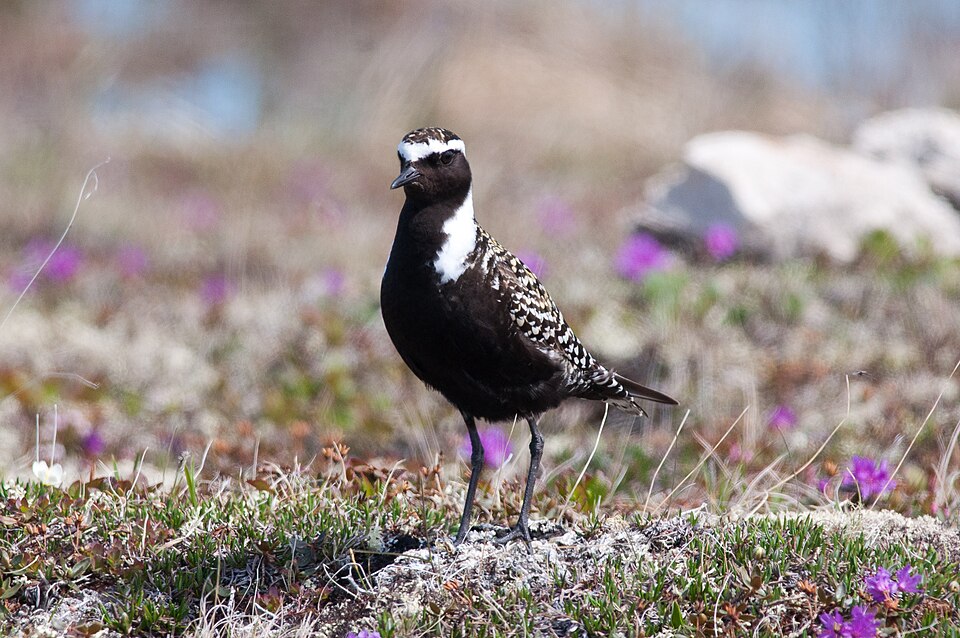
The American Golden-Plover is one of the great endurance athletes of the bird world, a trim, long-winged shorebird that breeds on the high Arctic tundra and winters all the way down in the grasslands of southern South America. Twice a year it threads a remarkable loop across the hemisphere: a spring push up through the heart of the continent and a fall route that, for many birds, swings far out over the open Atlantic. In peak breeding dress it is unmistakable and gorgeous, the upperparts flecked with bright gold and black like a scattering of sequins, the face and underparts a deep velvety black bordered by a bold white stripe.
For most North American birders, this is a bird of plowed fields, short-grass prairies, sod farms, mudflats, and airport edges rather than backyards. It travels in loose flocks, often mixed with other plovers and shorebirds, running in quick bursts and then freezing to pluck insects from the ground. Its understated elegance, its long-distance feats, and the thrill of picking one out of a field full of other shorebirds make it a favorite target during migration.
This is a medium-sized, slender plover with a notably small head, large dark eye, short black bill, and long wings that project well past the tail at rest, giving it an elegant, attenuated, almost athletic build. On the ground it stands fairly upright and runs in the classic stop-start plover style; in flight the wings are long and pointed and the underwing is plain grayish, lacking the black "wingpit" of its larger cousin.
| Breeding plumage | Upperparts spangled gold and black; face, throat, breast and belly solid black, framed by a bold white stripe running from the forehead down the side of the neck. |
| Nonbreeding plumage | Plain and gray-brown above with faint gold flecks, a dingy grayish breast, and a distinct pale eyebrow (supercilium) and dark cap. |
| Wing projection | Long primaries extend well past the tail tip at rest, a key structural clue separating it from Black-bellied Plover. |
| Underwing | Plain grayish underwing with NO black axillaries (wingpits), unlike Black-bellied Plover. |
| Rump and tail | Uniform brown rump and tail with no white rump patch or contrasting tail pattern in flight. |
| Bill and legs | Short, stubby black bill and dark gray legs; overall trimmer and longer-winged than similar plovers. |
Male vs. female
In breeding plumage the sexes look broadly similar, but males tend to be the more crisply marked of the two: their black face and underparts are blacker and more solid, and the white border stripe down the neck is cleaner and bolder. Females often show a duller, more mottled black on the face and breast, sometimes with whitish or gray flecking mixed into the black, especially on the cheeks and lower belly. These differences are subtle and overlap, so in the field a lone bird usually can't be sexed with confidence. Outside the breeding season the two sexes are effectively identical.
Juveniles
Juveniles, which make up many of the birds seen during fall migration, are neatly patterned but understated. They are gray-brown overall, finely spangled with yellowish-gold spots above, and show a grayish, faintly barred or smudged breast rather than any black belly. A clean pale eyebrow contrasts with a darker crown and cheek, giving the face a capped look. They lack the warm buffy tones of some other young shorebirds and appear cool gray-brown, which, combined with the long wings and small bill, is often the first clue that picks them out from the crowd.
The most familiar sound is the flight call, a clear, slightly mournful, two-note whistle often written as queedle or kee-dik, with the second note dropping in pitch. It carries well across open fields and is frequently the thing that alerts a birder to a flyover before the bird is even seen. Migrating flocks give a thinner, more urgent tu-ee or chu-wit.
On the breeding grounds males perform a butterfly-like display flight on slow, deep wingbeats while delivering a repeated, ringing, somewhat plaintive song to defend territory and attract a mate. Away from the tundra, in fields and on mudflats during migration, these birds are usually fairly quiet apart from the occasional contact whistle.
American Golden-Plovers breed across the high Arctic tundra of northern and western Alaska and much of Arctic Canada. After nesting, they undertake one of the longest migrations of any North American bird, wintering on the pampas and grasslands of southern South America, from Argentina and Uruguay north into Bolivia and Paraguay.
The two legs of the journey follow strikingly different paths. In spring, the bulk of the population funnels north through the interior of the continent, especially the Great Plains and Midwest, where they gather in plowed fields and prairies. In fall, many adults strike out eastward to the Atlantic coast and then fly south over the open ocean toward South America, an over-water route that means fall migrants are scarcer and more scattered in the interior. This is why most inland birders see far more golden-plovers in spring than in autumn, and why the species turns up as a sought-after rarity along parts of the West Coast and elsewhere.
On migration and in winter, American Golden-Plovers are visual hunters of open ground. They feed using the classic plover technique: run a few steps, stop and stand alert, then dart forward to snatch prey from the surface or just below it. Their diet is dominated by insects and other invertebrates, beetles, grasshoppers, crickets, fly larvae, caterpillars, and earthworms, gleaned from short grass, plowed soil, sod farms, and the drier margins of wetlands. They will also take spiders, small crustaceans, and snails, and on the breeding grounds they eat berries and seeds when invertebrates are scarce.
Because they favor firm, open ground rather than deep mud, they are often found in agricultural fields and pastures alongside other grassland-loving shorebirds, frequently mixing with Black-bellied Plovers, Buff-breasted Sandpipers, and Pectoral Sandpipers during migration.
Nesting takes place on dry, open Arctic tundra, often on slightly elevated or well-drained ridges with lichen, moss, and low vegetation. The nest itself is a simple shallow scrape on the ground, lined sparsely with lichens, dry grasses, and bits of moss, minimalist by necessity in a landscape with few materials and a very short summer.
The female typically lays four eggs, buff to olive and heavily blotched with dark brown, arranged points-inward in the scrape. Both parents share incubation over roughly three to four weeks, and the well-camouflaged adults sit tight, relying on their cryptic upperparts to disappear against the tundra. The chicks are precocial, down-covered and able to walk and feed themselves soon after hatching, and are tended by both parents until they fledge. The species raises a single brood per short Arctic summer before the long journey south begins.
This is not a backyard or feeder bird, so there's no seed or suet that will bring one in. It's a long-distance migrant of open country, and the way to see one is to go where they stop to refuel rather than to wait for one to come to you.
- Focus your search on spring migration (roughly April into May in the central U.S.), when most birds move north through the interior and are far more numerous inland than in fall.
- Scan plowed fields, short-grass prairies, sod farms, pastures, and flooded field edges, not deep marsh. They like firm, open ground.
- Check large flocks of other shorebirds carefully; golden-plovers often travel mixed in with Black-bellied Plovers and Pectoral or Buff-breasted Sandpipers.
- Use a spotting scope and watch for the stop-start running gait and the upright, long-winged silhouette to pick them out at a distance.
- Learn the flight call, a clear, falling queedle, so you can detect flyovers you'd otherwise miss.
- Birds in worn full breeding plumage (gold-spangled with a black belly) are easiest to identify, so target the peak of spring passage.
- Black-bellied Plover: Bigger, bulkier, and grayer (not golden) above; shows diagnostic black axillaries (wingpits) and a white rump and wing stripe in flight. Wings do not project as far past the tail.
- Pacific Golden-Plover: Very similar but slightly smaller-bodied with longer legs and a shorter primary projection; in breeding plumage the white neck stripe continues down the flanks, and it has more obvious golden tones. A tough West Coast and Pacific separation.
- European Golden-Plover: A rare vagrant; bulkier with a white underwing (vs. grayish), and breeding birds show a broad white border and white belly center rather than an all-black underside.
How is an American Golden-Plover different from a Black-bellied Plover?
The golden-plover is smaller and slimmer, with gold-spangled (not gray) upperparts, longer wing projection past the tail, and a plain grayish underwing. The Black-bellied Plover is chunkier and grayer, shows black 'wingpits' (axillaries) and a white rump in flight, and is generally a coastal-leaning, larger bird.
Where and when can I see an American Golden-Plover?
Look during migration in open habitats like plowed fields, short-grass prairies, sod farms, and pasture edges. In the central U.S., spring (April-May) is the prime window, when most birds move north through the interior. Fall migration is more concentrated on the Atlantic coast and over the ocean, so inland fall sightings are fewer.
Why is the American Golden-Plover famous for its migration?
It makes one of the longest migrations of any North American bird, breeding on the high Arctic tundra and wintering on the grasslands of southern South America. Many birds take a looping route, flying north through the continent's interior in spring and then far out over the Atlantic in fall.
What does an American Golden-Plover eat?
Mostly insects and other invertebrates, beetles, grasshoppers, crickets, fly larvae, caterpillars, earthworms, and spiders, picked from the surface of open ground. On the breeding tundra it also eats berries and seeds. It hunts by sight, running and pausing in classic plover fashion.
Is the American Golden-Plover a backyard bird?
No. It is a migratory shorebird of open fields, prairies, and shorelines, not a feeder visitor. You won't attract one with seed or suet; instead, scan suitable open habitat during migration, especially in spring.