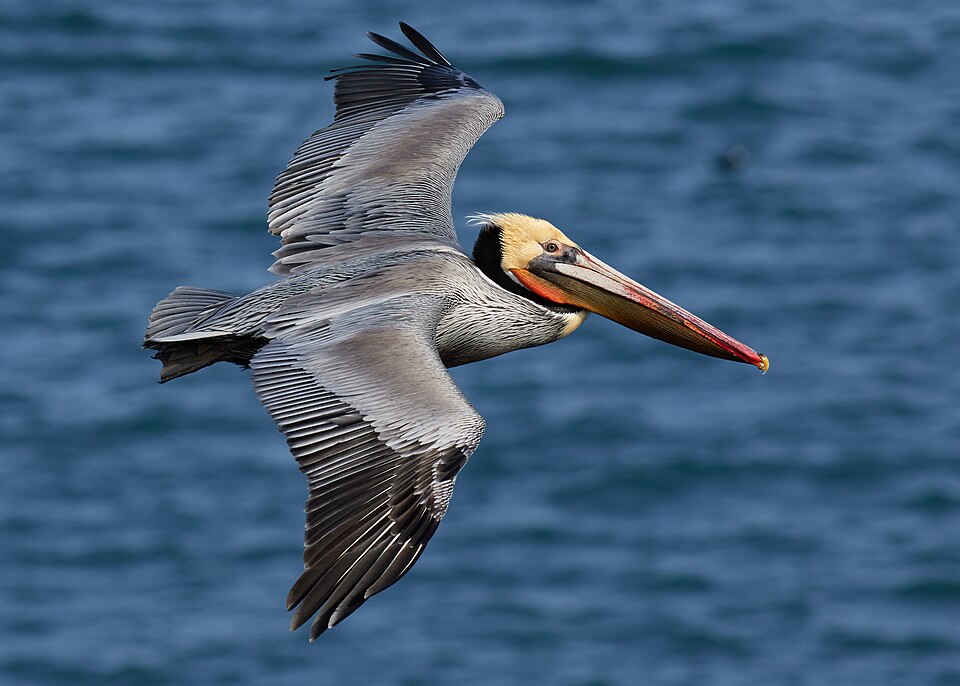
Few birds say "the coast" quite like the Brown Pelican. Big-bodied, long-billed, and unmistakable in flight, it glides in tidy single-file lines just above the surf, then folds its wings and crashes headfirst into the water after fish. It is the smallest of the world's eight pelican species, yet at nearly four feet long with a wingspan that can top seven feet, there is nothing small about the impression it makes. Brown Pelicans are birds of saltwater almost exclusively, patrolling beaches, jetties, piers, estuaries, and harbors along the warmer coasts of the Americas.
This is also one of conservation's great success stories. By the early 1970s the species had vanished from much of its U.S. range, poisoned by DDT that thinned eggshells until they shattered under nesting adults. After the pesticide was banned, populations rebounded so strongly that the Brown Pelican was removed from the federal Endangered Species list in 2009. Today, watching a squadron of pelicans skim a wave at dawn is an everyday coastal pleasure again, and a living reminder of what habitat protection can do.
The Brown Pelican is one of the easiest large birds to identify by shape alone. Look for an oversized, top-heavy front end: a long, flat bill with an expandable throat pouch slung beneath it, a thick neck usually folded back onto the shoulders, and broad, deeply bowed wings. In flight it alternates a few slow, deep wingbeats with long glides, often in lines or V-formations cruising low over the water.
| Size & shape | Huge, heavy-bodied seabird with a very long bill and a stretchy throat pouch; broad wings and a short tail |
| Body color | Grayish-brown overall; silvery-brown wings; darker belly in adults |
| Head (breeding) | Pale yellow to whitish crown and forehead, with a rich chestnut-brown stripe down the back of the neck |
| Head (nonbreeding) | Whole neck turns white or pale, losing the dark chestnut hindneck |
| Bill & pouch | Long gray bill; pouch is dull on most birds but flushes bright reddish in Pacific breeders |
| Flight style | Low gliding over waves in single-file lines, neck tucked, with deep deliberate wingbeats |
Male vs. female
Males and females look alike in plumage and color, so you cannot reliably sex a Brown Pelican in the field. The main difference is size: males average noticeably larger and heavier-billed than females, but this only shows when a mated pair stands side by side. Behavior at the nest is a better clue than appearance during the breeding season.
Juveniles
Young Brown Pelicans are easy to separate from adults. Juveniles and first-year birds are plain grayish-brown above with a brown head and neck and a pale, whitish belly, lacking the bold dark-and-pale head pattern of breeding adults. It takes roughly three years for a pelican to acquire full adult plumage, so you will often see in-between birds with a partly white belly and a muddled head pattern, especially in late summer and fall.
Adult Brown Pelicans are remarkably silent for such a conspicuous bird. Away from the colony they rarely make a sound, so you will almost never hear one passing overhead. At breeding colonies they may give low, hoarse grunts and raspy croaks during displays and disputes.
The noisiest pelicans are the young ones. Nestlings and recently fledged birds beg loudly with squealing, grunting, and high-pitched raaa sounds at the nest. If you hear a chorus of grunts and squawks on a pelican island, it is almost always the chicks doing the talking.
Brown Pelicans live along the warm coasts of the Americas. In the United States they are found on both seaboards: along the Pacific from central California south through Mexico, and along the Atlantic and Gulf coasts from roughly the mid-Atlantic states south through Florida and around the Gulf of Mexico. They also range through the Caribbean and down both coasts of Central and northern South America.
They are not true long-distance migrants, but they do disperse. After breeding, many birds wander well north of their nesting range, so pelicans turn up in summer and fall along the California coast far north of where they breed, and along the Atlantic coast up toward the Northeast. With colder weather they retreat back toward the warmer southern coasts. They almost never stray far inland; a Brown Pelican on a freshwater lake well away from the sea is a notable rarity.
Brown Pelicans are fish specialists, and they catch their prey with one of the most dramatic feeding techniques of any North American bird: the plunge dive. Spotting a fish from up to 60 feet above the water, the pelican angles into a steep dive, partly folds its wings, and hits the surface bill-first, the impact stunning small schooling fish like menhaden, anchovies, mullet, and sardines. As it plunges, the huge throat pouch balloons open and scoops up a mouthful of water and fish at once.
Back at the surface, the bird tilts its bill down to drain the water out of the pouch before tipping its head up to swallow the catch. This is the moment gulls love: gulls and even smaller birds frequently hover at a pelican's head, trying to snatch fish out of the pouch. Brown Pelicans also scavenge readily around fishing piers, docks, and cleaning stations, where they have learned that people mean an easy meal.
Brown Pelicans nest in colonies, almost always on isolated islands free of mammal predators, on mangrove islets, or in low shrubs and trees near the water. The nest itself varies with the site: birds nesting on the ground scrape out a shallow depression and rim it with sticks, grass, and debris, while those nesting in trees or shrubs build a bulkier stick platform. The male typically gathers nesting material and the female does most of the building.
The female usually lays two or three chalky-white eggs, and both parents share incubation, which lasts about a month. In a touching adaptation, pelicans warm their eggs partly with their large webbed feet. Chicks hatch naked and helpless and are fed regurgitated fish; they grow quickly, and after several weeks young from neighboring nests often gather into loose creches before fledging. Pairs raise a single brood per year.
The Brown Pelican is not a backyard or feeder bird in any normal sense, so there is no seed mix or feeder that will bring one to your yard. It is a strictly coastal saltwater species, and you find it by going to it rather than the other way around.
- Go coastal. Visit ocean beaches, fishing piers, jetties, marinas, and estuaries along the Pacific, Atlantic, or Gulf coasts within the species' range.
- Time it right. Early morning and late afternoon often bring the best feeding activity, when squadrons glide low over the surf to fish.
- Watch the piers. Working fishing piers and boat-cleaning stations reliably attract loafing pelicans hoping for scraps.
- Never hand-feed them. Tossing fish or scraps teaches pelicans to beg and entangles them in lines and hooks; enjoy them at a respectful distance instead.
- Discard fishing line properly. Monofilament line is a leading cause of pelican injury and death, so cut and bin loose line and use designated recycling bins.
- American White Pelican: Much larger and bright white with black wingtips; feeds by dipping while swimming rather than plunge-diving, and favors inland lakes and rivers.
- Brown Booby: Also plunge-dives but is far smaller and more streamlined, with a sharply two-toned brown-and-white body and a pointed bill, lacking the pelican's throat pouch.
- Double-crested Cormorant: Dark and goose-sized with a hooked bill; swims low and dives from the surface rather than from the air, and often perches with wings spread to dry.
How do Brown Pelicans catch fish?
They plunge-dive. A pelican spots a fish from the air, folds its wings, and plunges bill-first into the water, scooping fish and water into its expandable throat pouch. It then drains the water out before tipping its head back to swallow the catch.
What is the difference between a Brown Pelican and an American White Pelican?
Color, size, and feeding style. The Brown Pelican is grayish-brown, coastal, and plunge-dives from the air. The American White Pelican is much larger, bright white with black wingtips, lives mostly on inland lakes, and feeds by dipping its bill while swimming, often cooperatively.
Were Brown Pelicans ever endangered?
Yes. The pesticide DDT thinned their eggshells so badly that nests failed across much of their range, and the species was listed as endangered. After DDT was banned, populations recovered strongly, and the Brown Pelican was removed from the U.S. endangered list in 2009.
How big is a Brown Pelican?
Big. Adults are roughly 3.5 to 4.5 feet long and weigh around 6 to 12 pounds, with a wingspan that can reach about 7.5 feet. Despite the size, they are the smallest of the world's pelican species.
Why do gulls follow Brown Pelicans?
When a pelican surfaces after a dive and tips its bill down to drain water from its pouch, fish are briefly exposed. Gulls hover at the pelican's head and try to steal fish out of the pouch before the pelican can swallow them.