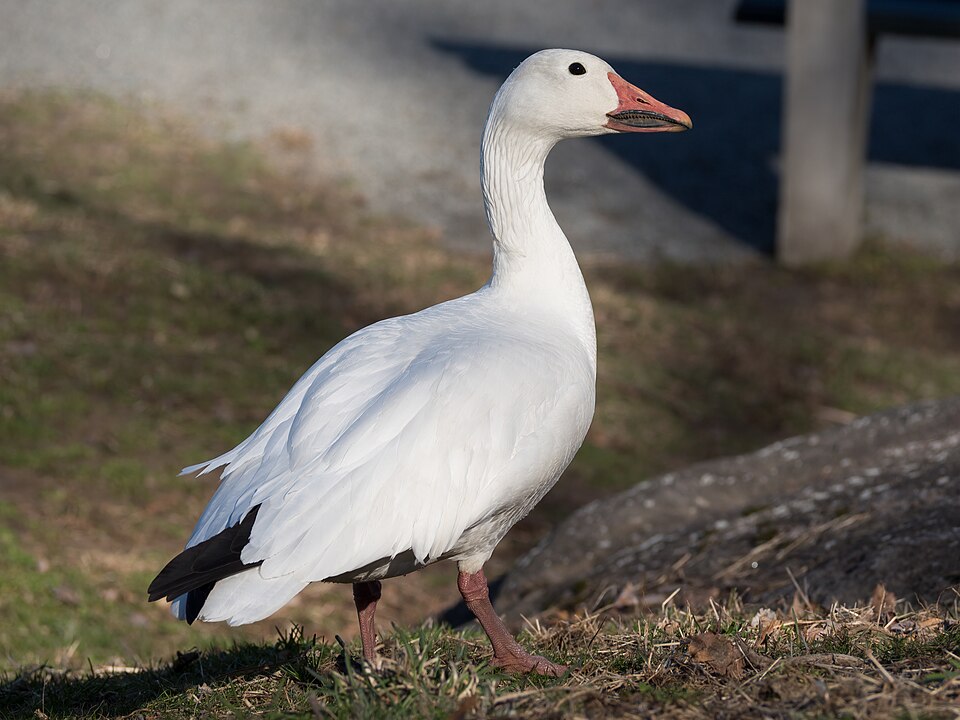
The Snow Goose is one of North America's most numerous and most spectacular waterfowl. It nests in dense colonies across the high Arctic of Canada, Alaska, and northeastern Siberia, then funnels south each autumn into vast wintering flocks that can number in the tens of thousands. When a flock lifts off a flooded field all at once, the air fills with a swirling, snow-like blizzard of white wings and a deafening chorus of high yelping calls. It is the kind of wildlife spectacle that draws people to refuges like Bosque del Apache, Sacramento Valley, and the marshes of the Gulf Coast and mid-Atlantic.
Two color forms, or morphs, occur in the same population: the familiar white-bodied bird and the darker "Blue Goose," which was once thought to be a separate species. They interbreed freely, so a single flock often holds both, plus intermediates. Snow Goose numbers have grown so large in recent decades that the birds have begun degrading their own fragile Arctic breeding grounds, making this abundant goose an unusual conservation story of too much success rather than too little.
The Snow Goose is a medium-large goose, smaller and more compact than a Canada Goose, with a fairly short neck, a stocky body, and a stout pink bill. The single best field mark up close is the so-called "grinning patch" or "grin", a black gap along the cutting edge of the bill that looks like the bird is smiling or showing its teeth.
| Plumage (white morph) | Clean white body with sharply contrasting jet-black wingtips (primaries), most visible in flight. |
| Plumage (blue morph) | White head with a dark slate-gray body; intermediates show varying amounts of white on the belly. |
| Bill | Thick and pink with a distinctive black 'grin patch' along the edge, diagnostic at close range. |
| Legs and feet | Pink. |
| Head staining | Face and head are often stained rusty-orange from feeding in iron-rich mud. |
| Size and shape | Compact, short-necked goose; chunkier than a swan, more rounded-headed than a Canada Goose. |
Male vs. female
Males and females look alike in plumage, both show the same white or blue morph coloration, the pink grinning bill, and pink legs. Males (called ganders) average slightly larger and heavier than females, but the difference is subtle and usually only obvious when a mated pair stands side by side. There is no seasonal change in appearance, so a bird looks the same on the wintering grounds as it does on the breeding tundra.
Juveniles
Juveniles are easy to separate from adults in their first fall and winter. White-morph immatures are dingy grayish overall rather than clean white, with a dull dark bill and grayish legs that lack the bright pink of adults. Blue-morph juveniles are sooty brownish-gray with a dark head, lacking the crisp white head of the adult Blue Goose. Young birds gradually molt into adult plumage over their first year, so by the following spring they look much more like their parents.
Snow Geese are noisy, and a flock is usually heard before it's seen. The typical call is a high, harsh, nasal yelp or honk, often rendered as whouk or la-luk, repeated rapidly and given both in flight and on the ground. It is higher-pitched and more shrill than the deep, resonant honk of a Canada Goose.
The cumulative sound of a large flock is a wild, rolling clamor, thousands of overlapping yelps that rise and fall like a distant pack of barking dogs or a baying crowd. Birders sometimes describe the roar of a takeoff as one of the loudest sounds in the bird world. Pairs and family groups also exchange softer conversational notes while feeding.
Snow Geese breed in colonies on the Arctic tundra of northern Canada, Alaska, Greenland, and the Wrangel Island region of Siberia. They are strongly migratory, departing the breeding grounds in fall and traveling in large flocks along well-defined corridors. Major wintering concentrations form in California's Central Valley, the Texas and Louisiana Gulf Coast, the Mississippi Valley, the mid-Atlantic coast, and parts of Mexico.
Migration is a high-energy, high-volume affair: birds move in long, wavering lines and shifting V-formations, often stopping at the same traditional staging areas year after year. Because populations have grown so large, flocks now overwinter farther north than they once did, and lingering birds turn up on agricultural land well outside the core range. The "Greater" Snow Goose of the Atlantic and the smaller "Lesser" Snow Goose of the interior and west are the two recognized subspecies.
Snow Geese are primarily vegetarian grazers and grubbers. On the breeding tundra they pull up grasses, sedges, rushes, and roots, often "grubbing" by yanking entire plants out by the roots, a feeding style that, in huge numbers, can strip and damage marsh vegetation. The rusty staining often seen on their heads comes from probing iron-rich Arctic mud.
On migration and in winter they have shifted heavily onto farmland, feeding on waste grain in harvested rice, corn, and wheat fields, as well as winter wheat shoots, marsh grasses, and tubers. They typically feed in dense, mobile flocks during the day and roost on open water at night, picking up and resettling repeatedly across a landscape.
Snow Geese nest in dense colonies on the open Arctic tundra, often near water and sometimes thousands of pairs strong. The female chooses the site and builds a shallow ground nest from grasses, moss, and other plant material, lining it generously with her own down. She typically lays around 3 to 5 creamy white eggs.
The female does almost all of the incubation, which lasts a little over three weeks, while the gander stands guard nearby and defends the nest aggressively. The downy goslings leave the nest within a day of hatching and feed themselves, but both parents escort and protect the brood. Families stay together through the first migration, which is how young birds learn the traditional routes and wintering sites.
The Snow Goose is not a backyard or feeder bird, it's a wild, flock-loving grazer of open marshes and farmland, so you won't lure one to a seed feeder or a suburban lawn. The way to enjoy this species is to go to it, and fortunately that's easy and rewarding because the birds concentrate in predictable, accessible places.
- Visit national wildlife refuges and waterfowl management areas in late fall and winter, places like Bosque del Apache (NM), the Sacramento Valley refuges (CA), and Gulf Coast and mid-Atlantic marshes host huge flocks.
- Time your visit for dawn or dusk, when flocks make their dramatic 'fly-out' to feed and 'fly-in' to roost, the most spectacular viewing of the day.
- Scan farm fields and flooded agricultural land near refuges; geese often feed on waste grain miles from their roost.
- Bring a spotting scope, flocks are often distant, and a scope lets you pick out blue morphs and the smaller Ross's Goose mixed in.
- Watch the edges of large white flocks for darker blue-morph birds and stained rusty heads, which add interest to a sea of white.
- Stay on roads and overlooks rather than approaching on foot, a flushed flock burns precious winter energy and quickly relocates.
- Ross's Goose: Much smaller and daintier, with a stubby triangular bill that lacks the black 'grin patch'; rounder head and a steeper forehead. Often hides within Snow Goose flocks.
- Canada Goose: Brown-bodied with a black neck and white chinstrap, not white with black wingtips; gives a deeper, more resonant honk.
- Greater White-fronted Goose: Grayish-brown overall with an orange bill, white forehead patch, and black belly barring, never the clean white of a Snow Goose.
- Tundra Swan: Much larger and all white with a long neck and a black bill (no black wingtips); flies with a slower, more deliberate wingbeat.
What is the difference between a Snow Goose and a Ross's Goose?
Ross's Goose is noticeably smaller and more delicate, with a short, triangular bill that lacks the black 'grin patch' found on a Snow Goose's bill. Ross's also has a rounder head and steeper forehead. The two often flock together, so look for the smaller, stubbier-billed birds within a Snow Goose flock.
Are blue geese and snow geese the same bird?
Yes. The 'Blue Goose' is simply a dark color morph of the Snow Goose. Blue morphs have a white head and a dark slate-gray body, while white morphs are clean white with black wingtips. They interbreed freely and occur together in the same flocks, with intermediate birds showing a mix.
Why do Snow Geese have orange or rusty-colored heads?
The rusty staining is not part of their plumage. It comes from feeding and grubbing in iron-rich Arctic mud, which discolors the feathers of the face and head. The amount of staining varies from bird to bird and fades over time.
When and where can I see Snow Geese?
They are winter visitors across much of the United States from roughly November through February, concentrating at wildlife refuges and agricultural areas in California's Central Valley, the Gulf Coast, the Mississippi Valley, and the mid-Atlantic. Visit at dawn or dusk to catch the dramatic mass fly-outs.
Why are there so many Snow Geese now?
Snow Goose populations have boomed, partly because the birds feed heavily on waste grain in farm fields, which provides abundant winter food. Their numbers have grown so large that they damage their own Arctic breeding habitat, leading wildlife agencies to expand hunting seasons to help control the population.