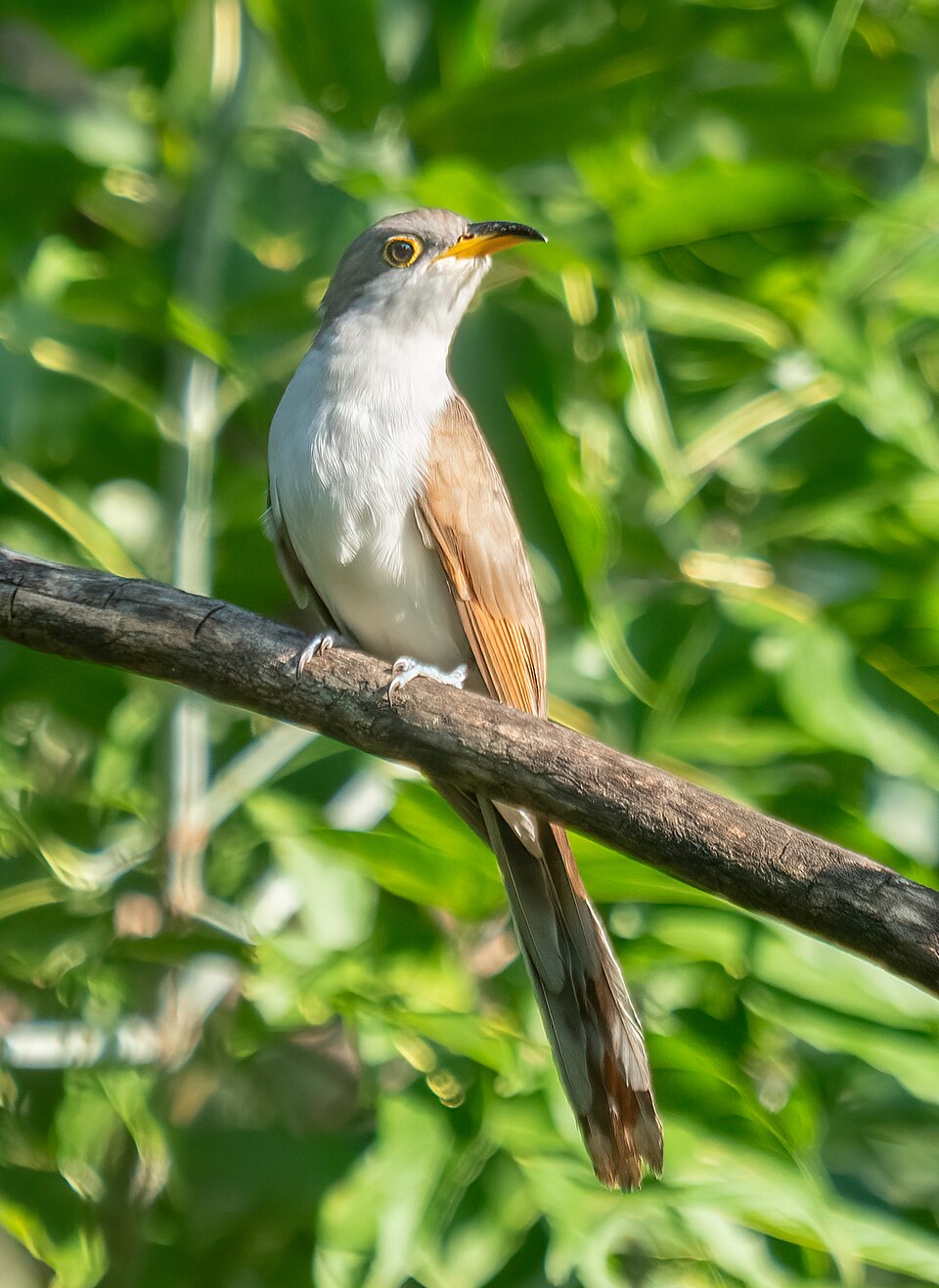
The Yellow-billed Cuckoo is one of those birds you hear far more often than you see. It is a long, lean songbird-relative that slips quietly through the leafy crowns of trees and dense thickets, where its rusty wings and white-spotted tail blend into the dappled shade. Many backyard birders spend years aware of its hollow, knocking call drifting from a woodlot in late summer without ever clapping eyes on the bird itself. When you do see one, it is unmistakable: a slender, almost reptilian shape with a long graduated tail, a gently curved bill, and a habit of sitting frozen on a branch before gliding off.
It matters to gardeners and woodland owners because it is one of North America's great caterpillar specialists. Few birds will tackle the hairy, spiny, distasteful caterpillars that most birds refuse, and the cuckoo eats them by the hundred, including outbreak insects like tent caterpillars and fall webworms. The species breeds across much of the eastern and central United States in summer and winters in South America. Sadly, its western population has collapsed with the loss of cottonwood-willow riverside forests, and that group is now federally protected as Threatened.
Think long and lean. A Yellow-billed Cuckoo is roughly robin-length but stretched out, with a slim body, a small head, and a very long tail that it often holds slightly drooped. The silhouette alone, slender with a slightly downcurved bill, separates it from most backyard birds before you even see color.
| Upperparts | Plain warm grayish-brown above with a faint olive or bronze sheen, no streaking or spots on the back. |
| Bill | Long and slightly downcurved; lower mandible (and base of upper) bright yellow, the rest dark. This is the key field mark. |
| Wings | Bright rufous (rusty) primary feathers that flash conspicuously in flight, a great clincher. |
| Tail | Long and graduated, blackish below with three pairs of large bold white spots or 'thumbprints' showing from beneath. |
| Underparts | Clean, unmarked white from throat to undertail; gives a very pale-bellied look. |
| Face | Plain face with a dark eye and, in adults, a narrow yellow ring of bare skin around the eye. |
Male vs. female
Males and females look essentially identical in the field. Both sexes have the yellow lower bill, rufous wing flash, and big white tail spots, and there is no difference in plumage color or pattern that a birder can reliably use. Females average slightly larger and heavier than males, but you will never judge that on a single bird. For all practical purposes, treat any Yellow-billed Cuckoo you see as unsexable in the field.
Juveniles
Juveniles look much like adults but a bit muted. The bold black-and-white pattern on the underside of the tail is softer and grayer, the white spots appearing more diffuse, and the bare eye-ring is dull or grayish rather than yellow. Young birds often show a faint buffy or peachy wash on the undertail coverts and may have slightly less vivid rufous in the wing. By their first fall migration these differences are subtle, and a fresh juvenile can be tricky, especially when trying to separate it from a young Black-billed Cuckoo.
The classic song is a strange, hollow, wooden sound that carries surprisingly far: a long series that starts as a fast guttural kuk-kuk-kuk-kuk and then slows and drops into a deliberate, knocking kowlp-kowlp-kowlp at the end, often written ka-ka-ka-ka-kow-kow-kowlp-kowlp-kowlp. The slowing-down, falling-off finish is diagnostic and gives the bird its folk name "rain crow," from the old belief that it called before storms.
It also gives a softer, even-pitched series of kuk or cooo notes, sometimes a mellow rolling coo, with none of the abrupt knocking quality. Compared with the Black-billed Cuckoo, whose song is a steady, evenly spaced cu-cu-cu / cu-cu-cu in measured groups, the Yellow-billed's song is faster, more rattling, and clearly slows and lowers at the end.
In summer, Yellow-billed Cuckoos breed across most of the eastern and central United States, from the Great Plains east to the Atlantic and south into Mexico, favoring deciduous woodlands, riverside forests, overgrown orchards, and shrubby second growth. They are long-distance migrants, arriving relatively late in spring (often not until May) and departing by early fall to winter in northern and central South America.
The story in the West is different and far more fragile. Western birds, often called the western Yellow-billed Cuckoo, depend on increasingly rare cottonwood and willow gallery forests along desert rivers in California, Arizona, and the Southwest. With most of that habitat drained, dammed, or cleared, the western population has dwindled dramatically and is listed as Threatened under the U.S. Endangered Species Act.
This is a caterpillar bird above all else. The Yellow-billed Cuckoo specializes in large, often hairy or spiny caterpillars that most songbirds avoid, including tent caterpillars, fall webworms, gypsy moth larvae, and tussock moths. It will gorge during caterpillar outbreaks, and its numbers in a given area can rise and fall with local insect booms. The bird's stomach lining periodically becomes matted with shed caterpillar hairs, which it eventually coughs up as a pellet.
It hunts slowly and deliberately, creeping along branches and through foliage, scanning for prey and snatching it with a quick lunge. Beyond caterpillars it takes cicadas, katydids, grasshoppers, beetles, and other large insects, along with some tree frogs, small lizards, bird eggs, and seasonal fruit and berries. It rarely feeds in the open, which is part of why it stays so easy to overlook.
Yellow-billed Cuckoos build a surprisingly flimsy nest, a loose, shallow platform of twigs lined with leaves, moss, or catkins, usually placed on a horizontal limb or in a fork of a tree or large shrub at moderate height. Both members of the pair share construction, incubation, and feeding of the young. Famously, the breeding cycle is very fast: from egg-laying to a chick leaving the nest can take only a couple of weeks, and the nestlings develop with startling speed, fledging while still looking only half-grown.
The species lays a small clutch of pale blue-green eggs and may raise one or two broods, sometimes timing nesting to coincide with caterpillar abundance. Although true cuckoos in the Old World are notorious nest parasites, the Yellow-billed Cuckoo mostly raises its own young, but it will occasionally lay eggs in the nests of other birds, including the Black-billed Cuckoo and other species, an interesting flexible habit.
The Yellow-billed Cuckoo is not a feeder bird and will not come to seed, suet, or nectar. You cannot bait it in, but you can make a wooded or shrubby property the kind of place it wants to hunt and nest. The key is habitat and a tolerance for the insects it eats.
- Keep or plant dense deciduous trees and shrubby thickets, especially native willows, cottonwoods, oaks, and hawthorns that host lots of caterpillars.
- Skip the insecticides. A yard sprayed for caterpillars and webworms has nothing for a cuckoo to eat; tolerating tent caterpillars is the single best thing you can do.
- Leave woodland edges, brushy fencerows, and overgrown corners intact rather than mowing or clearing them, since cuckoos favor that dense low cover.
- If you have a stream or wet swale, protect the streamside willows and brush, this riverside habitat is exactly what western cuckoos need.
- Learn the slowing kowlp-kowlp-kowlp call so you can detect birds by ear in mid- to late summer, when they are most vocal.
- Be patient and watch quietly, as cuckoos sit motionless for long stretches; scanning the inner branches of leafy trees beats waiting for one to fly.
- Black-billed Cuckoo: Very similar shape but has an all-dark bill, a red eye-ring (in adults), only small grayish tail spots rather than big bold white ones, and little to no rufous in the wing.
- Mangrove Cuckoo: A coastal Florida/Caribbean species with a black mask through the eye and buffy underparts; lacks the clean white belly and the rufous wing flash.
- Greater Roadrunner: A much larger ground-dwelling cuckoo of the Southwest; heavily streaked, crested, and terrestrial, so confusion is only at the family level, not in the field.
What does a Yellow-billed Cuckoo sound like?
Its signature song is a hollow, wooden series that starts fast and guttural, then slows and falls off into a knocking kowlp-kowlp-kowlp at the end. It also gives softer cooing notes. Old folklore calls it the 'rain crow' because people thought it called before storms.
How do I tell a Yellow-billed Cuckoo from a Black-billed Cuckoo?
Look at the bill, wings, and tail. The Yellow-billed has a yellow lower bill, bright rufous (rusty) wing patches that flash in flight, and three pairs of big bold white spots under the tail. The Black-billed has an all-dark bill, little rufous in the wing, only small gray tail spots, and (in adults) a red eye-ring instead of yellow.
Are Yellow-billed Cuckoos rare?
In the East and Midwest they are fairly common but secretive, so they are under-detected. The western population, dependent on cottonwood-willow riverside forests, has declined sharply and is listed as Threatened under the U.S. Endangered Species Act.
Will a Yellow-billed Cuckoo come to my bird feeder?
No. It is an insect specialist that eats caterpillars and large bugs and ignores seed, suet, and nectar. You can encourage it only by providing wooded, shrubby habitat and avoiding insecticides so its caterpillar prey survives.
Why is the Yellow-billed Cuckoo good for my yard?
It is one of the few birds that eats large hairy caterpillars other birds refuse, including tent caterpillars and fall webworms, often gorging during pest outbreaks. A resident cuckoo can put a real dent in caterpillar numbers without any spraying.