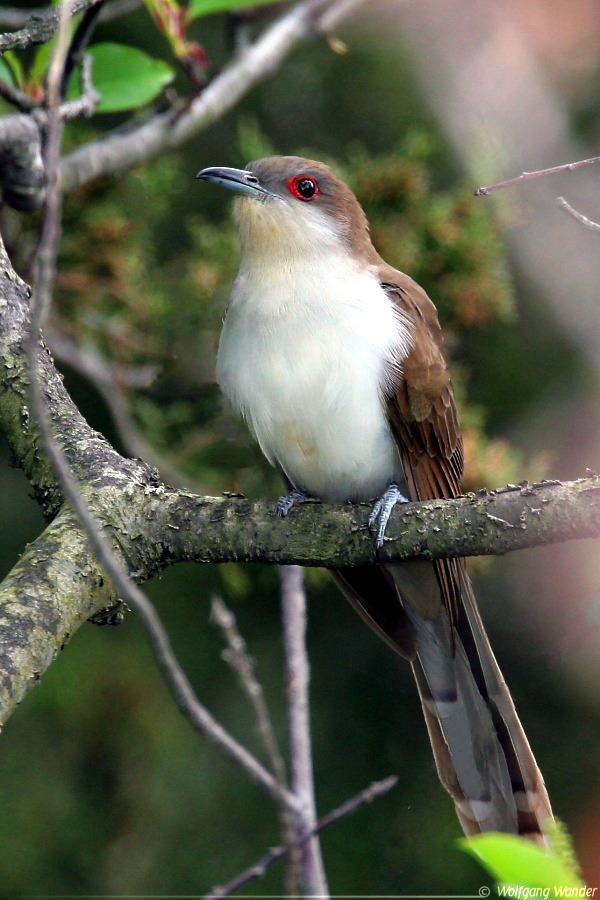
The Black-billed Cuckoo is one of North America's most elusive woodland birds, a slim, long-tailed shape that slips through dense thickets and leafy treetops far more often heard than seen. Despite being a fairly large bird, it has a remarkable talent for staying hidden, perching motionless among the leaves and gliding quietly from branch to branch. Many birders go years hearing its soft, rhythmic calls drifting from a brushy edge before ever laying eyes on one. It belongs to the cuckoo family, but unlike its famous Old World relatives, it usually raises its own young rather than dumping eggs in other birds' nests.
This is a bird with a job to do, and that job is eating caterpillars, especially the hairy, spiny ones most birds refuse to touch. Black-billed Cuckoos are tied closely to outbreaks of tent caterpillars and gypsy moth larvae, and their numbers and movements often track these food booms. Unfortunately, the species has been declining across much of its range, likely due to loss of shrubby habitat and pesticide use that knocks down its insect prey. For the patient birder, finding one feels like a genuine reward.
Look for a slender, pigeon-sized bird with a long, graduated tail, a slightly down-curved bill, and a sleek, almost reptilian way of moving. Cuckoos have a distinctive horizontal posture, often perching low and level along a branch with the long tail held straight behind them. The Black-billed is plain and subtle in color, so the details matter.
| Upperparts | Warm grayish-brown above, smooth and unmarked, often with a faint bronzy or olive sheen in good light |
| Underparts | Clean whitish below, sometimes with a faint grayish wash across the chest |
| Bill | All-dark (black) bill, slightly curved, the key field mark separating it from Yellow-billed Cuckoo |
| Eye ring | Narrow red eye ring on adults (can look reddish-orange); often hard to see at a distance |
| Tail | Long and graduated; underside shows small, indistinct grayish-white tail spots, not the bold black-and-white pattern of Yellow-billed |
| Wings | Lacks the rufous (rusty) flash in the primaries shown by Yellow-billed Cuckoo in flight |
Male vs. female
Males and females look essentially identical in the field. Both sexes share the brown upperparts, white underparts, dark bill, and red eye ring, and there is no reliable plumage difference a birder can use to separate them. They are also very close in size, so sexing a Black-billed Cuckoo by sight is not practical outside of the hand.
Juveniles
Juveniles resemble adults but are softer and more washed-out, with a buffy or yellowish tinge to the throat and undertail and an eye ring that is gray or yellowish rather than red. Their plumage often looks slightly fluffier and less crisp, and the tail spots are even more faint and poorly defined than on adults. Young birds can be confusing because the lack of a red eye ring removes one of the most useful adult marks, so focus on the all-dark bill and the absence of rufous in the wings.
The classic call is a soft, hollow, rhythmic series most often written as cu-cu-cu, cu-cu-cu, cu-cu-cu, delivered in evenly spaced groups of three or four notes that run together in a steady, almost mechanical cadence. The tone is mellow and somewhat muffled, lower and gentler than a woodpecker drum, and it can carry surprisingly far on a still day. Birds call most persistently at dawn and dusk, and notably they will also call at night, especially on warm nights in early summer.
Compared with the Yellow-billed Cuckoo's harsher, slowing kowlp-kowlp-kowlp that drops off at the end, the Black-billed's song stays even and runs in tidy triplets without the gulping, decelerating quality. Learning these two voices is often the fastest way to tell the species apart, since both birds stay so well hidden.
Black-billed Cuckoos breed across the northeastern and north-central United States and into southern Canada, from the Great Plains east to the Atlantic and north into the boreal edge. They favor a band roughly from the Dakotas and the Great Lakes through New England and the Appalachians, with patchy occurrence to the south. They are long-distance migrants, arriving on the breeding grounds relatively late in spring (often May) and departing by early fall.
The entire population winters in South America, primarily in the northwestern part of the continent, crossing the Gulf of Mexico and the Caribbean during migration. Because they migrate at night and stay hidden by day, they are easy to miss even in places where they pass through regularly. Spring and fall migrants can turn up well outside the core range, including occasional vagrants far to the west.
Caterpillars are the heart of this bird's diet, and it is one of the few North American birds that readily eats hairy and spiny caterpillars such as eastern tent caterpillars, forest tent caterpillars, fall webworms, and gypsy moth larvae. It gleans them methodically from leaves and twigs, often hidden inside the canopy, and will gorge during caterpillar outbreaks. The spines accumulate in the stomach lining, which the bird periodically sheds and regurgitates, a remarkable adaptation to such a prickly meal.
Beyond caterpillars, Black-billed Cuckoos take other large insects including cicadas, grasshoppers, beetles, and dragonflies, and they will eat some snails, small frogs, and seasonal berries and fruit. Their feeding style is patient and deliberate: they move slowly through foliage, reaching and plucking prey rather than chasing it, which adds to their reputation as a hard-to-spot bird.
Unlike the brood-parasitic cuckoos of Europe, the Black-billed Cuckoo typically builds its own nest and raises its own brood, though it will occasionally lay eggs in the nests of other birds (including Yellow-billed Cuckoos and a few songbirds). The nest is a flimsy, shallow platform of twigs lined with soft material such as leaves, grass, plant down, and catkins, usually placed low to mid-height in a dense shrub, tangle, or small tree.
The species is famous for its breakneck nesting timeline. Eggs hatch quickly, and the nestlings develop with astonishing speed, young can leave the nest and clamber about in the branches within roughly a week of hatching, long before they can truly fly. Both parents incubate and feed the young. Breeding effort often surges in years with abundant caterpillars, when birds may lay larger clutches or nest more readily.
The Black-billed Cuckoo is not a feeder bird and will not come to seed, suet, or nectar, so you cannot lure it the way you would a chickadee or finch. It is, however, a bird you can encourage by managing habitat and giving it the wild, brushy cover and insect prey it depends on. If you live within its range and have the right conditions, your best shot is making your property friendly to caterpillars and dense edges.
- Keep native shrubs and thickets: Dense, brushy edges, overgrown hedgerows, and willow or alder tangles provide the cover cuckoos prefer for foraging and nesting.
- Tolerate caterpillars: Avoid spraying insecticides and let native trees host tent caterpillars and other larvae, these outbreaks are exactly what draw cuckoos in.
- Plant native trees and shrubs: Oaks, willows, cherries, and other natives support the large caterpillar populations cuckoos need.
- Listen at dawn, dusk, and night: Learn the steady triplet call, since you will almost always hear this bird before you see it, sometimes after dark.
- Leave wild corners unmown: A messy, shrubby back corner does far more for cuckoos than a manicured lawn ever will.
- Yellow-billed Cuckoo: Very similar shape, but shows a yellow lower bill, bold black-and-white tail spots underneath, and a rufous flash in the wings; its call is a harsher, slowing kowlp series.
- Mangrove Cuckoo: A Florida and coastal specialty with a buffy belly, black mask, and yellow-based bill; limited range makes confusion unlikely away from southern coasts.
- Mourning Dove: Shares a slim, long-tailed silhouette and similar size, but is plumper, grayer-pink, has a tiny bill, and shows white tail edges in flight rather than tail spots.
How do I tell a Black-billed Cuckoo from a Yellow-billed Cuckoo?
Check three things: the bill, the tail, and the wings. The Black-billed has an all-dark bill, faint grayish tail spots, and no rusty color in the wings; the Yellow-billed has a yellow lower bill, bold black-and-white tail spots, and a rufous wing flash. Their songs differ too, Black-billed gives even triplets, while Yellow-billed gives a harsher, slowing series.
Why is the Black-billed Cuckoo so hard to see?
It is a naturally shy, slow-moving bird that stays inside dense foliage and brushy cover, often perching motionless for long periods. It tends to call more than it shows itself, so most sightings come from patiently tracking down a calling bird rather than spotting one in the open.
Do Black-billed Cuckoos lay eggs in other birds' nests?
Usually no. Unlike the brood-parasitic Old World cuckoos, Black-billed Cuckoos normally build their own nests and raise their own young. They do occasionally lay an egg in another bird's nest, including other cuckoos and some songbirds, but this is the exception rather than the rule.
What do Black-billed Cuckoos eat?
Mainly caterpillars, including the hairy and spiny kinds that most birds avoid, such as tent caterpillars and gypsy moth larvae. They also eat cicadas, grasshoppers, beetles, dragonflies, and some snails, small frogs, and berries. They are valuable natural controllers of caterpillar outbreaks.
Will a Black-billed Cuckoo come to my bird feeder?
No. Cuckoos are insect specialists and do not eat seed, suet, or nectar, so they will not visit feeders. The best way to host one is to provide native shrubs, brushy edges, and healthy caterpillar populations by avoiding pesticides.